
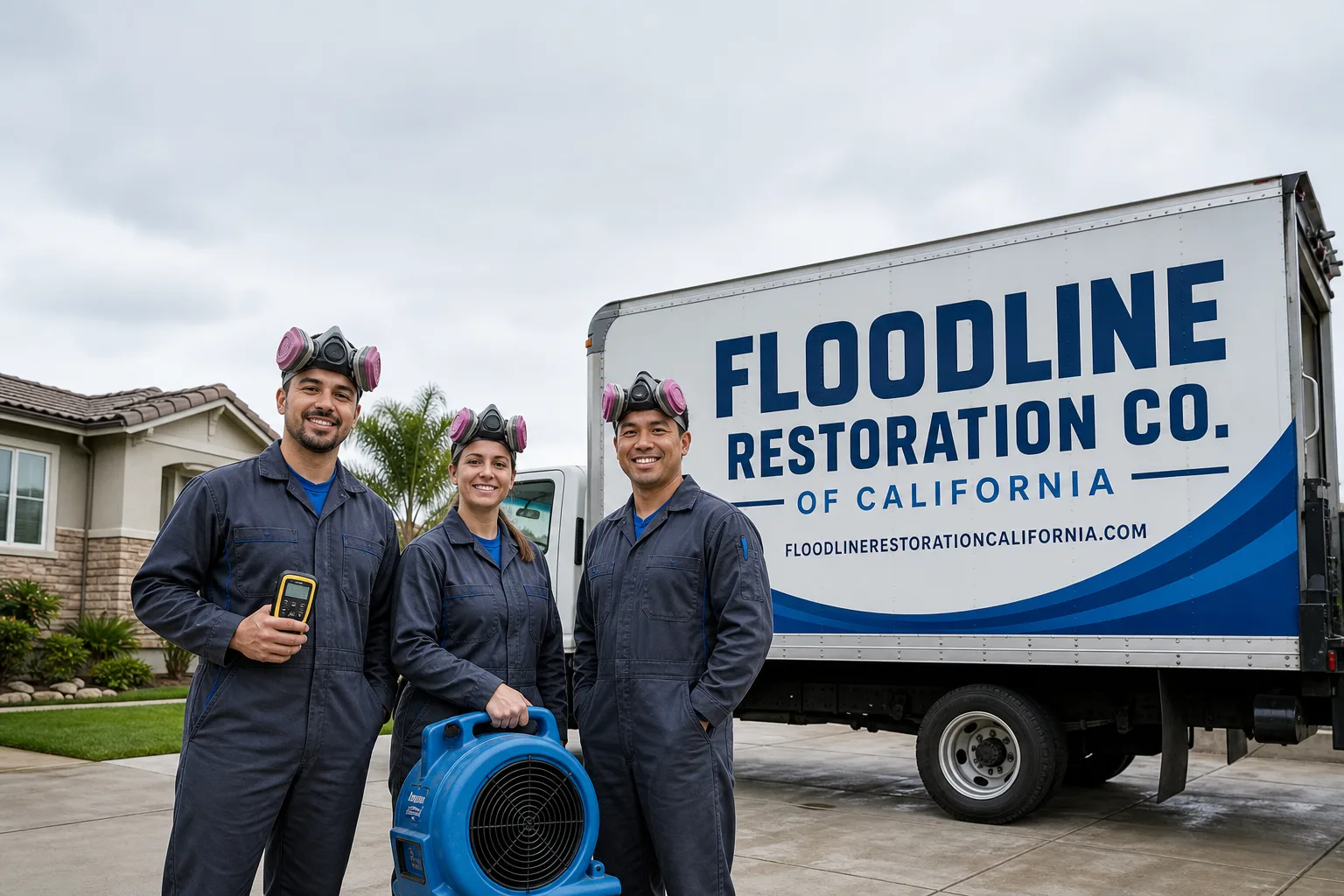
Fast, Reliable Sewage Cleanup Across Koreatown
Sewage cleanup in Koreatown typically costs $1,800 to $6,500 depending on how far the black water has traveled and whether structural access is required, with most jobs completed in one or two visits. We answer the phone with a live dispatcher at any hour, and our certified crew reaches addresses in the 90005 ZIP quickly because we work the corridor daily, not from across the basin. If you’re standing in a flooded unit off Wilshire Boulevard or Western Avenue right now, call (888) 737-2439. We’ll walk you through the first steps, then get extraction running the same visit.
Koreatown’s sewage losses don’t behave like they do in a single-family neighborhood. The housing stock here runs dense: 1920s courtyard buildings, six-unit stucco blocks from the 1960s, and soft-story wood-frame apartments flagged under the city’s Mandatory Seismic Retrofit Ordinance. A toilet backup in one unit can saturate the floor assembly and migrate into the unit below before anyone notices. That’s the job we prepare for when the dispatch board lights up with a 90005 address.
Why Floodline Restoration Co. of California Is Koreatown’s Preferred Sewage Cleanup Company
We’ve been doing full-cycle restoration in Los Angeles since 2010, and the Koreatown work has taught us things you only learn by walking the buildings. Our Sewage Cleanup crews know that a ground-floor unit in a soft-story building can’t simply have extraction equipment rolled in without checking what the crawl space looks like first. Seismic displacement from decades past often means a doorway or floor joist has shifted just enough that negative air machines need shoring before we position them.
Curt Bowman built this company around a dispatch board, not a sales desk. That means when a landlord managing a building remotely from Seoul calls at 2 a.m. with a backup on Harvard Boulevard, a person answers. A background-checked, uniformed technician shows up. The same certified crew that reads the moisture map on day one handles daily readings, hands the log to the owner and the carrier, and stands behind the result in writing for 90 days.
Koreatown property owners and managers tell us the same thing: they want someone who already understands the building type before they walk in. We don’t need to be taught what a shared plumbing chase is or why a 1960s stucco block with a flat roof holds moisture differently than a 1940s courtyard with casement windows. We’ve mitigated sewage in both, repeatedly, and we bill insurance directly so the owner never plays messenger.
Our Sewage Cleanup Services in Koreatown
Sewage Backup Cleanup
A sewage backup in Koreatown apartment blocks usually starts in a cast-iron waste line that was installed when Eisenhower was president. Those pipes crack, roots get in, and the black water that backs up through a ground-floor drain carries pathogens that demand containment, not just extraction. We set up proper containment so sewage doesn’t migrate into adjacent units through shared wall cavities. In a 1920s courtyard building off Normandie Avenue, that containment is the difference between one affected unit and three.
Toilet Overflow Cleanup
When a toilet overflows on the third floor of a 1970s stucco walk-up, gravity does exactly what you fear: water moves through the floor assembly and drips into the unit below. We treat each overflow as a vertical-contamination event, not a bathroom cleanup. That means checking the ceiling of the unit beneath, opening the right drywall, and pulling moisture readings from the shared floor system. Koreatown’s stacked plumbing means a “small” toilet overflow is rarely small.
Septic Failure Cleanup
Most Koreatown buildings are on municipal sewer, but the older courtyard properties sometimes had original cesspools or septic tie-ins that were partially converted decades ago. When they fail, the odor and black water intrusion require immediate sanitation. Our techs are certified to IICRC and IFA standards and arrive with the right disinfectants and application equipment to decontaminate hard surfaces, framing, and any crawl space that the waste contacted.
Black Water Extraction
Black water is sewage, plain and simple. It carries bacteria, viruses, and parasites. In Koreatown’s dense housing, extraction has to happen fast because the urban heat island effect accelerates what moisture does to drywall and framing in the 90005 corridor. We use Dri-Eaz extraction equipment and XPOWER air scrubbers to pull the contaminated water, then establish negative air so airborne particles don’t spread through adjoining units.
What happens when you call
- 1
A real person answersNo phone trees - you reach a local pro.
- 2
You get an upfront price rangeHonest numbers before anyone is dispatched.
- 3
A background-checked tech heads outLicensed & insured, dispatched right away.
- 4
You approve before work beginsNothing starts until you say go.
Trusted Brands We Service in Koreatown
Our Koreatown work regularly involves equipment and building systems from a range of manufacturers, and we keep an inventory of common replacement parts and fittings on our service vehicles so we’re not driving back across town mid-job. That matters on a sewage loss in a tight Koreatown complex where a delay means more drywall opened and more units affected. We’re certified to IICRC and IFA standards, and our drying equipment includes Dri-Eaz and XPOWER units sized for the low-clearance, poorly ventilated spaces common in pre-war Koreatown buildings. The same company that extracts the sewage also handles the rebuild, so you don’t inherit a new crew halfway through.
Common Sewage Cleanup Problems We See in Koreatown Homes
- Delayed containment in stacked units. Sewage from an upstairs toilet flows through floor assemblies into the unit below before anyone notices. By the time a tenant reports a drip, the shared wall cavities are saturated and decontamination is needed across multiple tenants.
- Missed secondary contamination in shared utility closets and laundry rooms. Black water wicks into adjacent drywall and framing within hours here. Koreatown’s urban heat island effect means warmer wall cavities and faster mold colonization than you’d see in outlying Los Angeles neighborhoods.
- Structural access blocked by soft-story conditions. Sewage extraction equipment and negative air machines can’t be safely positioned in a non-retrofitted crawl space without first addressing seismic displacement. In a soft-story Koreatown building, that assessment has to happen before cleanup begins.
- Flat-roof water migration complicating sewage scopes. Many 1960s-1980s Koreatown apartment blocks have flat or low-pitch roofs. When an atmospheric river event in winter breaches a membrane, that water travels down interior wall cavities and can mix with sewage backups in shared drain lines, creating a cross-contamination problem that’s easy to misread as a single-source loss.
Pricing for Sewage Cleanup in Koreatown, CA
What drives cost is the vertical and horizontal spread of the water, not the square footage of the room where it started. A two-story courtyard building off Wilshire and a six-unit stucco block near Olympic both tend to send sewage through shared chases, which means the path, not the puddle, controls the scope. We write the scope before work starts, and we bill your insurance carrier directly. Call (888) 737-2439 for a free estimate.
We Also Serve Cities Near Koreatown
Our crews handle Sewage Cleanup in Koreatown daily, and the same certified technicians cover the surrounding neighborhoods: Los Angeles, Echo Park, Silver Lake, and Hollywood. If you’re a few blocks outside the 90005 boundary, the response time doesn’t change. We’re already working the corridor.
Serving Koreatown, CA - Our Local Coverage Area
We’re based in the Koreatown area and know this community well. Use the map below to see our service coverage - if you’re nearby, we can almost certainly help.
FAQs - Sewage Cleanup in Koreatown
How does sewage cleanup differ in a Koreatown soft-story apartment building?
In a soft-story building, the ground floor is held up by wood framing that may have shifted during past seismic events, which means a sewage loss in a ground-floor unit can’t be treated until a structural assessment clears the crawl space and doorways for equipment access. We check for displaced framing, cracked foundation sections, and anything that would make extraction or negative-air setup unsafe. Cleanup in these buildings is a structural question before it’s a sanitation question.
If a toilet overflows in one unit of our 1920s courtyard building, how far can the sewage spread?
Sewage from an upstairs toilet commonly travels through the floor assembly into the unit directly below, and in older Koreatown courtyard buildings with shared wall cavities, it can wick into adjacent units within hours. The spread depends on where the waste line cracked and how much water moved before the overflow stopped. That’s why our first step on every multi-unit Koreatown loss is a floor-by-floor walkthrough to check what got wet and where.
Why is the crawl space a concern after a sewage loss in Koreatown?
Because many Koreatown buildings, especially the non-retrofitted soft-story wood-frames, have crawl spaces that are structurally compromised from the 1994 Northridge earthquake and other seismic events. Black water that reaches a crawl space pools against structural members and saturates subfloor framing, and the damage can’t be properly assessed or dried until the space is shored and accessible. Crawl space sewage removal in Koreatown often requires shoring before sanitation work begins.
How do you manage parking and access when doing sewage cleanup in a dense Koreatown complex?
We coordinate with building managers on arrival and parking before the crew rolls, especially for buildings on dense blocks off Western, Vermont, or Olympic where street parking is tight and alley access is the only route for equipment. Our crews stage equipment in compact configurations and use smaller footprint dryers and air scrubbers where doorways and hallways are narrow. A sewage loss in a packed Koreatown complex doesn’t have the staging area of a suburban house, and we plan for that before we arrive.
What is the time frame to prevent mold after a sewage backup in a Koreatown building with flat roofs and minimal cross-ventilation?
Mold can begin colonizing within 24 to 48 hours after a sewage backup, and in Koreatown’s dense urban heat island with poorly ventilated interior units, that window tightens. Sewage-saturated drywall and framing in a flat-roof building with no cross-breeze goes fungal faster than in the coastal neighborhoods. Extraction and drying should start the same day you see or smell the backup. Call (888) 737-2439 and a live dispatcher will get a crew scheduled.
Call Floodline Restoration Co. of California for Sewage Cleanup in Koreatown
If you have black water on the floor, sewage smell in the walls, or a backup that’s spreading into the unit below, call us at (888) 737-2439. A live person answers, day or night. We’ll send a certified, background-checked, uniformed crew to your Koreatown building, write the scope before any work starts, and bill your insurance carrier directly. Every job is backed by the 90-Day Done Right Promise, in writing. The line the water left is where we start.
Written by Curt Bowman, Owner at Floodline Restoration Co. of California, serving the Koreatown community with full-cycle sewage cleanup and restoration since 2010.