
Fast, Reliable Reconstruction & Cleanup Across Koreatown
Reconstruction after water, fire, or storm damage in Koreatown usually begins with a structural question: what’s behind the drywall, and how far did the moisture travel? That question matters more here than almost anywhere else in Los Angeles because Koreatown’s housing stock is old, dense, and built in ways that let water move fast between stacked units and shared walls. We send certified crews into the 90005 ZIP every week who already know what they’re walking into: pre-war courtyard apartments near Normandie, 1960s stucco blocks off Olympic, high-rise condo units along Wilshire. If you’re standing in a unit with soggy drywall, warped flooring, or a ceiling that’s already staining, call (888) 737-2439. We answer live, every hour of every day.
Why Floodline Restoration Co. of California Is Koreatown’s Preferred Reconstruction & Cleanup Company
We’ve rebuilt enough units in Koreatown to understand what actually goes wrong here, and it rarely matches the textbook. A pinhole leak in a second-floor bathroom on South Harvard Boulevard becomes a three-unit drywall job by the time we finish the moisture map. A soft-story ground floor on a 1940s courtyard building off Wilshire Place turns a routine repair into a structural conversation. The reason Koreatown property owners and managers keep calling us back is simple: we don’t treat a 90005 address like any other job.
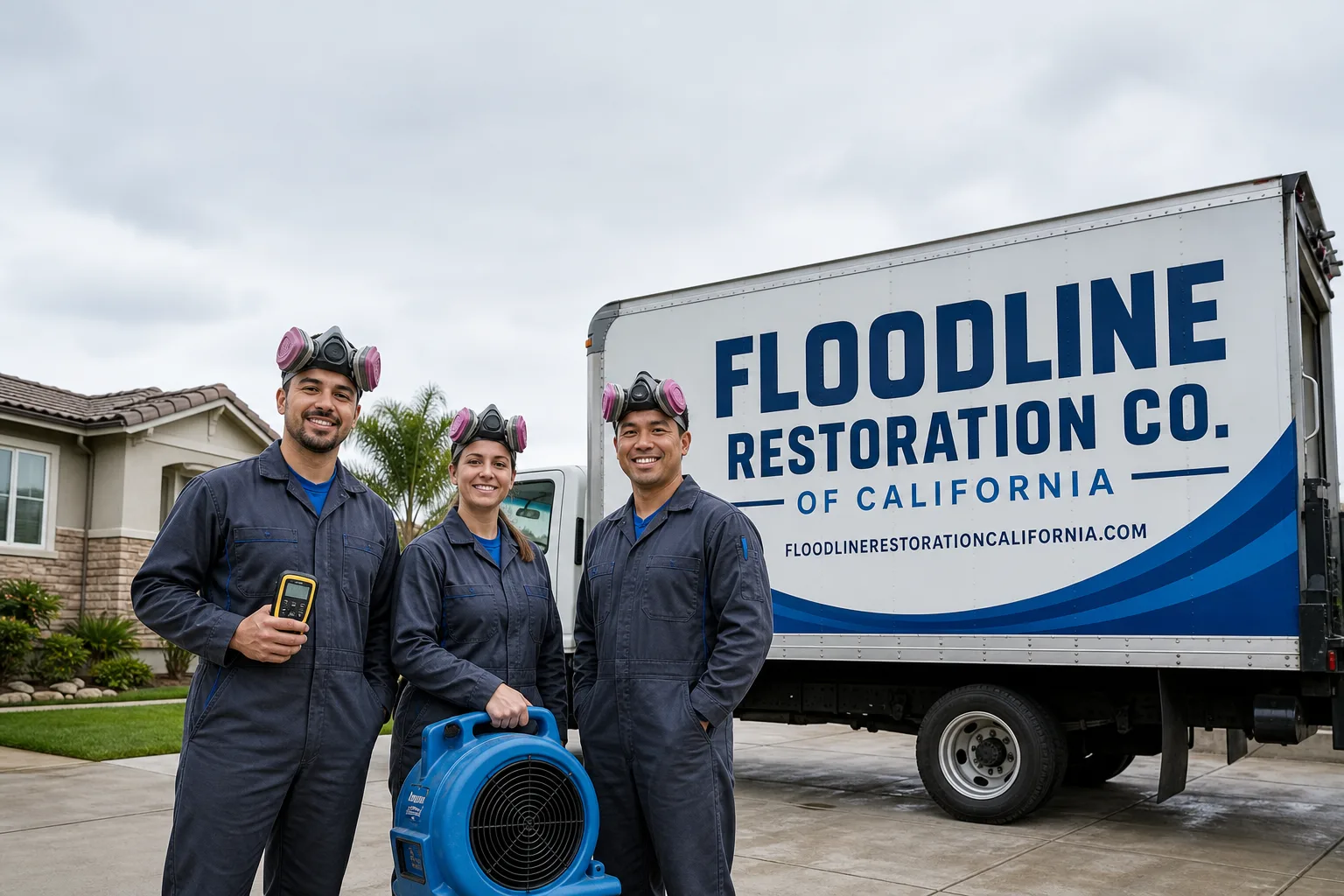
Curt Bowman founded Floodline Restoration Co. in 2010 around a dispatch board, not a sales desk. The crews we send into Koreatown are background-checked, uniformed, and trained to IICRC, RIA, and IFA standards. They carry Dri-Eaz, Phoenix, XPOWER, B-Air, and Injectidry equipment and they read moisture maps daily until the dry standard is met. That matters in buildings where drywall hides what a neighbor’s pipe did three floors up.
We also work with the reality of Koreatown’s property management culture. Many building owners manage remotely and communicate primarily in Korean. Our team knows that a voice call with a clear scope in writing beats a long email thread every time. We document what we find at each address, photograph everything, and send a written scope before work begins. No surprises on the bill. No inherited crew mid-job.
Our Reconstruction & Cleanup Services in Koreatown
Full-Service Reconstruction
We rebuild what the water, fire, or structural movement took apart. That includes framing repair, drywall hanging and finishing, paint, trim, cabinetry reset, and flooring. In Koreatown, full-service reconstruction often means working inside occupied multi-unit buildings where dust control, noise discipline, and tight scheduling matter as much as the rebuild itself. We coordinate with building managers, respect tenant access rules, and keep hallways and shared entries clear while we work.
Drywall & Flooring Repair
Older Koreatown buildings hide water damage well. The 1920s and 1930s courtyard apartments have lath-and-plaster under some drywall, which wicks moisture and holds it longer than modern gypsum. The 1960s through 1980s stucco blocks typically have drywall over wood framing with no fire-blocking between floors, so a leak above a ceiling can pull moisture up into the wall cavity. We cut out what’s wet, dry what’s borderline, and rebuild to match existing textures and paint lines. Flooring repair in Koreatown usually means matching older hardwood, replacing swollen laminate and MDF baseboards, or resetting tile in kitchens and baths.
Contents Restoration & Pack-Out
Tight Koreatown units don’t leave much room to move furniture around during reconstruction. We handle pack-out with an inventory list and photographs, store contents in our facility, and return them when the unit is ready. In a 90005 apartment, that often means packing the entire living room to rebuild a ceiling above it, or clearing a bedroom so we can open a shared wall. Every item gets tagged, logged, and tracked. Owners and tenants see the list before anything leaves the property.
Insurance Claim Documentation
Stacked-unit damage in Koreatown means insurance claims that span multiple policies: the unit owner’s, the neighbor’s, the building’s master policy. We photograph every phase, document moisture readings daily, and produce the written reports adjusters actually need to approve scope. You’ll never play messenger between us and the carrier. We bill the carrier directly when applicable and stand behind the result in writing with our 90-Day Done Right Promise.
Trusted Brands We Service in Koreatown
Our crews carry professional-grade equipment from Dri-Eaz, Phoenix, XPOWER, B-Air, and Injectidry, and we service work tied to IICRC, RIA, and IFA standards on every Koreatown job. When we need specialty drying panels for a tight shared utility closet or low-grain refrigerant dehumidifiers for a Korean spa, a noraebang, or a restaurant kitchen, we don’t have to wait on a supplier across town. Koreatown is one of the densest mixed-use neighborhoods in Los Angeles, and we keep the tools and materials on our trucks that those buildings actually require.
Common Reconstruction & Cleanup Problems We See in Koreatown Homes
- Stacked-unit water migration: A supply line fails on a third floor off Western Avenue and water follows the plumbing chase down to the ground floor before anyone sees a ceiling stain. By the time a tenant calls, the shared wall cavities between units have often been wet for days.
- Soft-story structural displacement: Many Koreatown buildings have non-retrofitted ground floors with open parking or commercial space below. When water saturates those wood-framed ground floors, the framing swells and shifts, turning a water job into a structural one under the city’s Mandatory Seismic Retrofit Ordinance guidelines.
- Rapid mold in low-ventilation units: The urban heat island effect in the 90005 corridor, combined with apartment units that have minimal cross-ventilation, accelerates mold colonization after water intrusion. We’ve seen visible growth within 48 hours in units near Vermont and 8th.
- Delayed pack-out causing avoidable loss: In tight Koreatown apartments, furniture often sits against walls and prevents us from opening them up quickly. The longer wet carpet pad and swollen MDF baseboards sit, the farther the damage line creeps. Pack-out early saves contents and cuts reconstruction scope.
Pricing for Reconstruction & Cleanup in Koreatown, CA
A typical drywall and flooring repair in Koreatown, after a water-loss event in a 90005 apartment unit, runs roughly $1,800-$4,200 depending on affected square footage and how many wall cavities are involved. Full-service reconstruction on a single unit with moderate water damage in one of the 1960s-1980s stucco blocks near Olympic and Normandie typically starts around $6,500 and can reach $18,000 when structural framing, kitchen cabinetry, and flooring are included. Contents pack-out and restoration for a one- to two-bedroom unit generally runs $900-$2,800, which covers inventory, moving, storage for up to 30 days, cleaning, and return delivery.
The two factors that move price most in Koreatown are the number of units affected by a single failure, and whether the building has a non-retrofitted soft-story ground floor. Both are routine here. We give a written scope with line-item pricing before any work starts, and we offer the Senior & Veteran 5% Discount on all services, plus $50 Off Any Repair Over $250. Call (888) 737-2439 for a free estimate. No surprises on the bill.
We Also Serve Cities Near Koreatown
Our Koreatown crews also cover reconstruction and cleanup work across Los Angeles, Echo Park, Silver Lake, and Hollywood. The same certified technicians, the same written scope, the same 90-Day Done Right Promise. If your building sits near the edge of the neighborhood or you manage properties in multiple nearby areas, one call covers it all.
Serving Koreatown, CA - Our Local Coverage Area
We’re based in the Koreatown area and know this community well. Use the map below to see our service coverage - if you’re nearby, we can almost certainly help.
FAQs - Reconstruction & Cleanup in Koreatown
We treat shared-wall saturation as a multi-unit scope from the first visit, not the third. Our technicians open the wet wall from both sides when access allows, map the moisture with daily readings, and cut out only the damaged drywall and framing. In Koreatown courtyard apartments, the wall cavity between units often lacks fire-blocking, so water travels up and down the shared chase. We dry the full cavity with Injectidry panels before closing, then patch and finish both units to match existing texture. Call (888) 737-2439 and we’ll walk the full floor, not just the one unit that called first.
Yes, and we do it with daily moisture logs, photo documentation at every phase, and written scope reports that reference the vertical and horizontal water path through stacked plumbing chases. Adjusters working Koreatown claims know that a third-floor bathroom leak often saturates units below, but the claim still has to be proven with measurements. We produce exactly that proof and coordinate directly with the carrier so you don’t have to translate construction scope into insurance language. The 90-Day Done Right Promise covers the work in writing.
The right way starts with a structural assessment, because water-damaged framing in a non-retrofitted soft-story ground floor has already compromised a building that the city’s Mandatory Seismic Retrofit Ordinance has flagged as vulnerable. In Koreatown, that means we often bring in a licensed structural engineer before we rebuild, then replace or sister damaged floor joists and posts, rebuild the affected bearing walls, and document everything for the property’s retrofit file. This is not a cosmetic repair. A soft-story water job left alone can put the entire upper structure at risk during the next seismic event.
We call you with a live person, explain the scope in plain terms, and send written summaries with photos to whatever address or messaging app you prefer. Our team works with Korean-speaking property managers in Koreatown regularly and understands that a phone call beats a 40-email thread for owners managing from Seoul or another city. You get the same written scope before work starts, the same daily documentation during the job, and the same 90-Day Done Right Promise after it’s finished. No surprises, no language barrier, no silence.
We dispatch the same day you call (888) 737-2439, and because Koreatown’s dense urban heat island effect accelerates mold growth compared to outlying LA neighborhoods, we don’t schedule a Koreatown roof-flood reconstruction for next week. Extraction starts on the first visit, drying equipment runs that day, and reconstruction begins as soon as the moisture log hits the dry standard. In the 90005 ZIP, a flat-roof failure over a top-floor unit has typically already sent water down through the floor assembly into the unit below by the time we arrive. Our crews plan for that stacked-unit scope from the first walkthrough.
Written by Curt Bowman, Owner at Floodline Restoration Co. of California, serving Koreatown with reconstruction and cleanup since 2010.