
Fast, Reliable Water Damage Restoration Across Lake Los Angeles
Water damage in Lake Los Angeles doesn’t behave like it does in Palmdale or Lancaster. The former lakebed caliche hardpan under your home stops water from draining, so even a small leak can turn into wall-base and under-slab saturation within hours. Floodline Restoration Co. of California answers the phone with a live dispatcher 24/7 and gets certified crews to Lake Los Angeles from our Los Angeles dispatch office, with extraction running the same visit. If water is pooling against your slab or soaking into drywall right now, call (888) 737-2439. We’ll tell you what’s happening, what it’ll cost, and when we’ll be there.
Why Floodline Restoration Co. of California Is Lake Los Angeles’s Preferred Water Damage Restoration Company
Lake Los Angeles homeowners don’t have time to wait for a restoration crew that’s 40 miles away and doesn’t know the terrain. We’ve worked enough jobs between 170th Street East, the 93591 corridor, and the scattered ranch lots off Avenue O that our technicians already know what they’re walking into: caliche soil, owner-built framing, septic systems instead of sewer lines, and freeze-prone pipe runs. That local knowledge changes how we dry a structure. A technician who thinks water drains downhill the way it does in the foothills will miss moisture trapped against the slab perimeter. We don’t miss it.
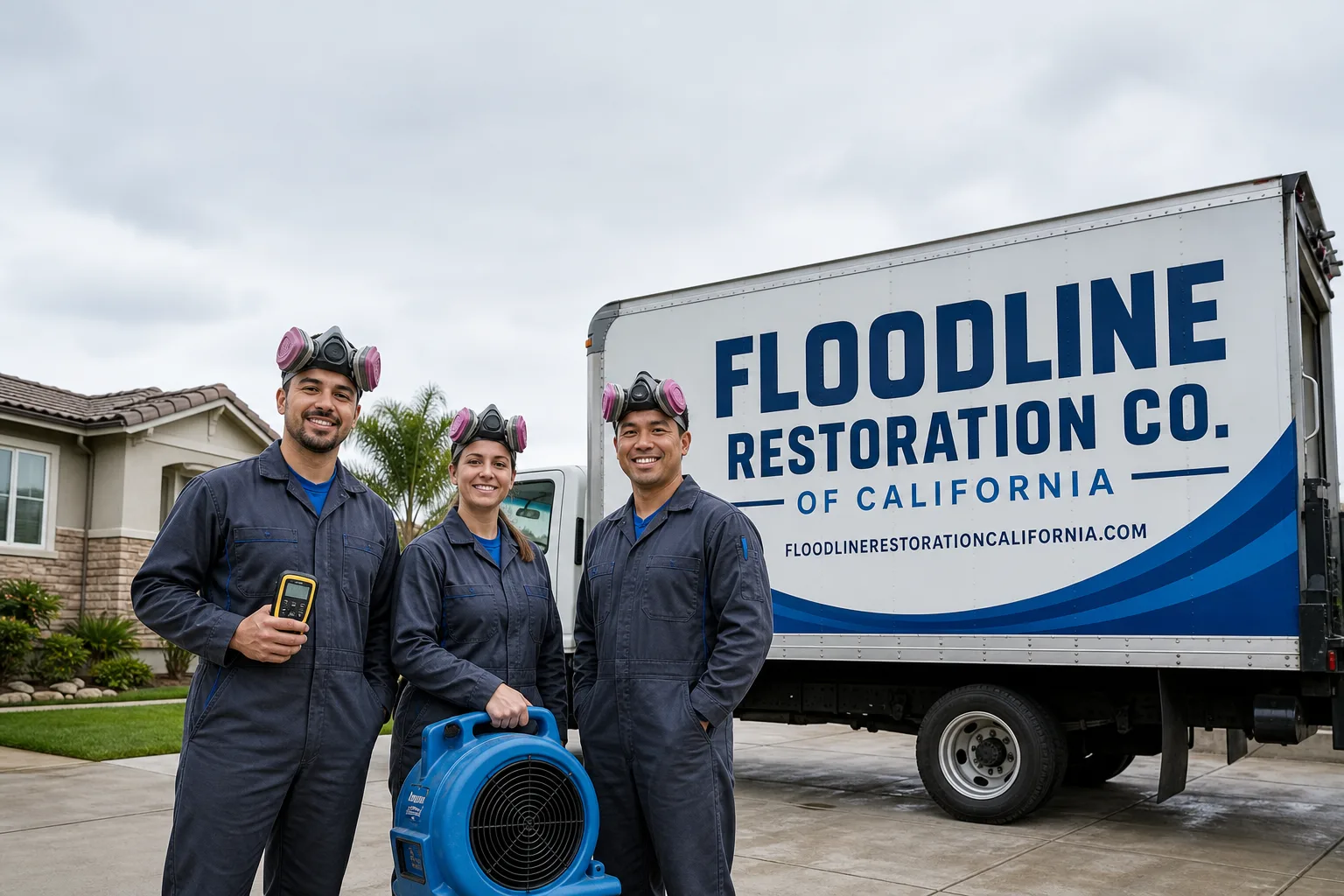
Our crews are IICRC, RIA, and IFA certified, background-checked, and uniformed. We bring Dri-Eaz and Injectidry equipment sized for high-desert conditions, not a contractor-grade fan from a rental yard. Most jobs in Lake Los Angeles are completed in a single visit because the same crew that reads the moisture map on day one handles the daily readings and hands the log to you and your carrier. And every job carries the 90-Day Done Right Promise. It’s a written guarantee, not a handshake. If it’s not done right, we make it right. No paperwork battles, no arguing.
Our Water Damage Restoration Services in Lake Los Angeles
Water Damage Restoration in Lake Los Angeles requires a different playbook than the rest of the Antelope Valley. Here’s how we handle the jobs we see most.
Emergency Water Extraction
When water is standing on a slab floor in Lake Los Angeles, extraction has to start fast. The caliche hardpan under your home means that water doesn’t drain away. It sits. It wicks into drywall, under baseboards, and into the subfloor. Our crews run truck-mounted extraction the same visit, pulling standing water before it migrates into wall cavities. The line the water left is where we start.
Structural Drying & Dehumidification
Drying a Lake Los Angeles home is not the same as drying a house on a graded lot in Palmdale. The 40 to 50 degree day-night swing here creates condensation behind vapor barriers, and non-standard framing from the 1950s through 1970s paper-lot builds throws off standard moisture readings. We map moisture daily with the same crew that started the job, using Dri-Eaz dehumidifiers and Injectidry mat drying where wall plates and sill plates have wicked water. The moisture log goes to you and your insurer every time.
Flood Cleanup
Sheet-flow flooding from winter storms and atmospheric rivers is the defining water threat in Lake Los Angeles. Rain that falls on hard, non-absorptive caliche runs across the flat grade and pools against slab edges and garage thresholds. We extract, remove wet materials, disinfect, and set up drying the same day. We also document everything with photos for your carrier and bill them directly, so you’re not the messenger.
Burst Pipe Restoration
Freeze-burst pipes are a recurring problem in Lake Los Angeles homes with original plumbing in uninsulated exterior walls. When a galvanized line lets go overnight, the water has hours to migrate before anyone notices. We locate the source, stop the flow, extract, and open problem areas only as far as needed to dry what’s hidden. Since many Lake Los Angeles homes are on wells and septic, we also watch for water that’s pushed into under-slab spaces where it can’t escape.
What happens when you call
- 1
A real person answersNo phone trees - you reach a local pro.
- 2
You get an upfront price rangeHonest numbers before anyone is dispatched.
- 3
A background-checked tech heads outLicensed & insured, dispatched right away.
- 4
You approve before work beginsNothing starts until you say go.
Trusted Brands We Service in Lake Los Angeles
We work on homes with every pipe and fixture brand common in the Antelope Valley, and we keep parts and drying equipment sized for the owner-built and custom ranch homes that make up most of Lake Los Angeles. Whether your supply lines are original galvanized, copper from a 1970s remodel, or PEX from a recent repair, our techs know how each behaves in a freeze and how to dry the framing around them. Same goes for septic-connected drain lines, which almost never appear on standard municipal-sewer restoration checklists.
Common Water Damage Restoration Problems We See in Lake Los Angeles Homes
- Water pooling against the slab perimeter. Caliche hardpan doesn’t absorb water. A moderate storm or a slow slab leak sheets water across the flat lot and holds it against the foundation, where it wicks inward. This is the single most common cause of hidden wall-base saturation we see in Lake Los Angeles.
- Freeze-burst pipes in exterior walls. Many owner-built homes here have supply lines run through uninsulated exterior framing. Winter lows drop below freezing often enough that a cold snap will find every weak run. The burst happens inside the wall, so the damage is usually extensive before anybody sees water.
- Septic system backups. A blocked drain line on a private septic system behaves differently than a municipal sewer backup. The containment and cleanup protocols are different too. If a crew shows up assuming city sewer infrastructure, they’ll miss how far the contamination has spread.
- False ‘dry’ readings on non-standard framing. The temperature swing between Lake Los Angeles days and nights can push condensation behind vapor barriers. On old paper-lot homes with inconsistent framing, a moisture meter reads low when the wall is actually holding water. We account for that in every drying plan.
Pricing for Water Damage Restoration in Lake Los Angeles, CA
| Service | Typical Lake Los Angeles range |
|—|—|
| Emergency water extraction (single room) | $400-$900 |
| Structural drying with dehumidification (per room) | $350-$750 |
| Burst pipe repair and wall cavity drying | $800-$1,800 |
| Flood cleanup with sheet-flow water (garage/slab) | $1,200-$3,200 |
| Septic-backup containment, removal, and sanitizing | $1,500-$4,500 |
The biggest factors are how far water has migrated under the slab and whether we need to open walls to dry framing. On Lake Los Angeles’s hardpan, water travels farther than it would on graded soil, so early extraction genuinely reduces cost. Estimates are free. Call (888) 737-2439 and we’ll give you a written scope before work starts, not after.
We Also Serve Cities Near Lake Los Angeles
We handle water damage work across the Antelope Valley. If you’re in Sun Village, Palmdale, Piñon Hills, or Phelan, the same certified crews and the same 90-Day Done Right Promise apply. Water Damage Restoration in Lake Los Angeles is our focus, but the high-desert conditions don’t stop at the city line, and neither do we.
Serving Lake Los Angeles, CA - Our Local Coverage Area
We’re based in the Lake Los Angeles area and know this community well. Use the map below to see our service coverage - if you’re nearby, we can almost certainly help.
FAQs - Water Damage Restoration in Lake Los Angeles
Why does water pool against my foundation in Lake Los Angeles even after a small rain?
Lake Los Angeles sits on a former dry lake bed with caliche hardpan underneath, which is virtually impermeable. Rainwater can’t soak in, so it sheets across the flat grade and ponds against the slab edge and garage threshold. That water wicks into wall bases and under-slab spaces within hours. If you see pooling after a light storm, call (888) 737-2439 for a free assessment before the water migrates further.
Can a burst pipe in an exterior wall really require structural drying here?
Yes. In Lake Los Angeles, the freeze-burst pipes we see run through uninsulated exterior walls, and the water they release has nowhere to drain because of the caliche below. It saturates framing, drywall, and under-slab spaces. Extraction alone won’t fix it. Structural drying with Dri-Eaz dehumidifiers and Injectidry mats is the standard here, not the exception. Call us when you first find the leak, and we’ll stop the damage before it spreads.
How do you handle a sewage backup when my home is on a septic system?
We treat it as a biohazard containment job from the start. Many Lake Los Angeles homes are on private septic rather than municipal sewer, so we isolate the affected area, remove contaminated material, sanitize, and dry. We also check whether the backup came from a failed leach field or a blocked line, because that changes what the carrier needs to see. We document it all and bill your insurance directly.
What does ‘sheet-flow flooding’ mean for my Lake Los Angeles home?
Sheet-flow flooding is what happens when rain hits impermeable caliche hardpan and runs across the surface instead of soaking into soil. On the flat former lakebed grade, that water moves sideways and collects against your slab. It’s the reason even moderate storms cause foundation-level water intrusion here. Our crews know to inspect the slab perimeter and garage threshold first, because that’s where sheet-flow water enters.
Do I need to worry about moisture under the slab if the floor looks dry?
Yes. On Lake Los Angeles lots, water that can’t drain through caliche sits against the slab and migrates under it through cracks and seams. The top of your floor can look dry while the subfloor and wall plates are saturated. We use moisture mapping and daily readings to find what’s hidden. If you’ve had a leak or a pooling event, call us at (888) 737-2439 for an inspection before mold takes hold.
Written by Curt Bowman, Owner at Floodline Restoration Co. of California. Founded in 2010, built around a dispatch board, not a sales desk.