
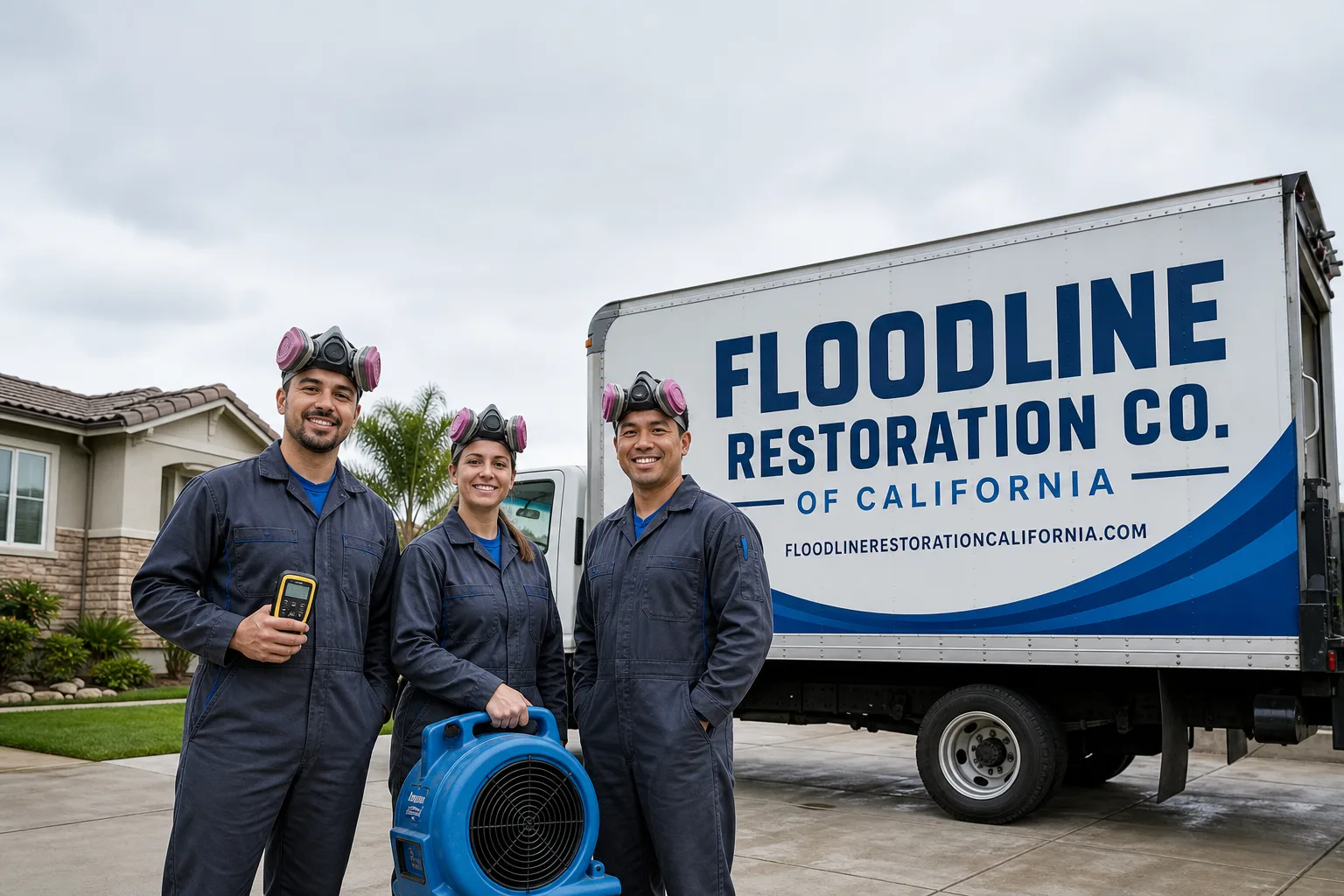
Water Damage Restoration in Communications Hill: Fast, Local Response When the Hilltop Takes the Hit
Water damage in Communications Hill hits differently than it does a mile away in the valley. The steep engineered slopes, shared-wall townhome construction, and wind-exposed hilltop position at roughly 450 feet above the Santa Clara Valley create a damage pattern that’s predictable to crews who know this neighborhood and baffling to restoration companies that don’t. Our technicians respond to Communications Hill within 60 to 90 minutes on most emergency calls, and we carry the drying equipment, HOA coordination experience, and insurance documentation know-how this community’s attached housing stock demands. If water is moving through your walls right now, call (888) 737-2439. A live person answers at any hour, and we’ll dispatch before the water finishes finding its way to the unit below you.
That’s the thing about Communications Hill: water doesn’t respect property lines here. A roof leak on one townhome becomes a ceiling stain in the next unit over within hours. A failed window seal at the exposed western edge pushes moisture behind stucco cladding and into shared wall cavities before the homeowner even notices a damp spot. We’ve spent years learning exactly how water travels through these particular buildings, and we bring that knowledge to every single job.
How Much Does Water Damage Restoration Cost in Communications Hill?
Water Damage Restoration in Communications Hill typically runs between $1,800 and $5,400 for a standard single-room extraction and structural drying job. Whole-unit flood damage affecting multiple rooms or multiple levels of a townhome commonly falls between $4,500 and $12,000. Here’s what that looks like line by line:
- Emergency water extraction: $450-$1,100 depending on affected square footage and standing water depth
- Structural drying and dehumidification (per affected room): $600-$1,900, including daily moisture readings until the dry standard is met
- Burst pipe restoration: $1,500-$6,500, depending on whether the pipe is behind a shared wall or accessible within the unit
- Ceiling and roof-leak water damage repair: $900-$3,800, including drywall replacement and texture matching
- HOA common-area coordination and documentation: included with our service, not a line-item add-on
The strongest cost driver in Communications Hill is whether the water migrated across a shared wall into an adjoining unit. When that happens, two homeowners and potentially two insurance carriers are involved, and the scope of work expands beyond the original source. That’s why we document everything with photo evidence from day one and give you a written scope of work before any equipment gets plugged in. Want an exact number for your situation? Call (888) 737-2439 and we’ll walk the job with you. Estimates are free.
Key takeaways:
- Most Communications Hill water damage jobs cost between $1,800 and $5,400
- Shared-wall water migration is the single biggest cost and complexity driver in this neighborhood
- We bill your insurance carrier directly and provide photo-documented moisture logs
- The $50 off any repair over $250, $89 seasonal tune-up, and Senior & Veteran 5% discount all apply to restoration work here
Why Floodline Restoration Co. of California Is Built for Communications Hill’s Specific Kind of Water Damage
Communications Hill is the last place you want a restoration company learning on the job. The neighborhood was built almost entirely between 2005 and 2015 as a master-planned hilltop community, and nearly every home is a stucco-clad attached townhome or stacked condominium. Units share framing, share weather barriers, and share the consequences when water gets in. Over 42 years of serving communities like this one, our crews have learned that restoration here lives and dies by two things: knowing how wind-driven rain penetrates stucco at elevation, and knowing how to navigate HOA master policies without letting the paperwork stall the drying.
Founded in 2010 by Curt Bowman and built around a dispatch board rather than a sales desk, Floodline Restoration Co. of California answers every call with a live person, 24 hours a day, seven days a week. Our technicians arrive in uniform, background-checked, and certified to IICRC, RIA, and IFA standards. We run Dri-Eaz, Phoenix, XPOWER, B-Air, and Injectidry equipment that’s moisture-mapped from the first reading, and we hand you the daily moisture log when the job is done. Every job is backed by our 90-Day Done Right Promise, known internally as the Keystone Standard. If it’s not done right, we make it right. That’s in writing.
We also know that Communications Hill homeowners don’t want a crew that treats their townhome like a detached house in Almaden or a condo tower downtown. The hillside grading here funnels storm runoff toward the lowest retaining walls and garage entries of downslope rows. After a significant rain, the same cluster of units at the bottom of a terrace floods almost every time. We anticipate those calls before they come, and we stage equipment accordingly.
Our Water Damage Restoration Services in Communications Hill
Emergency Water Extraction
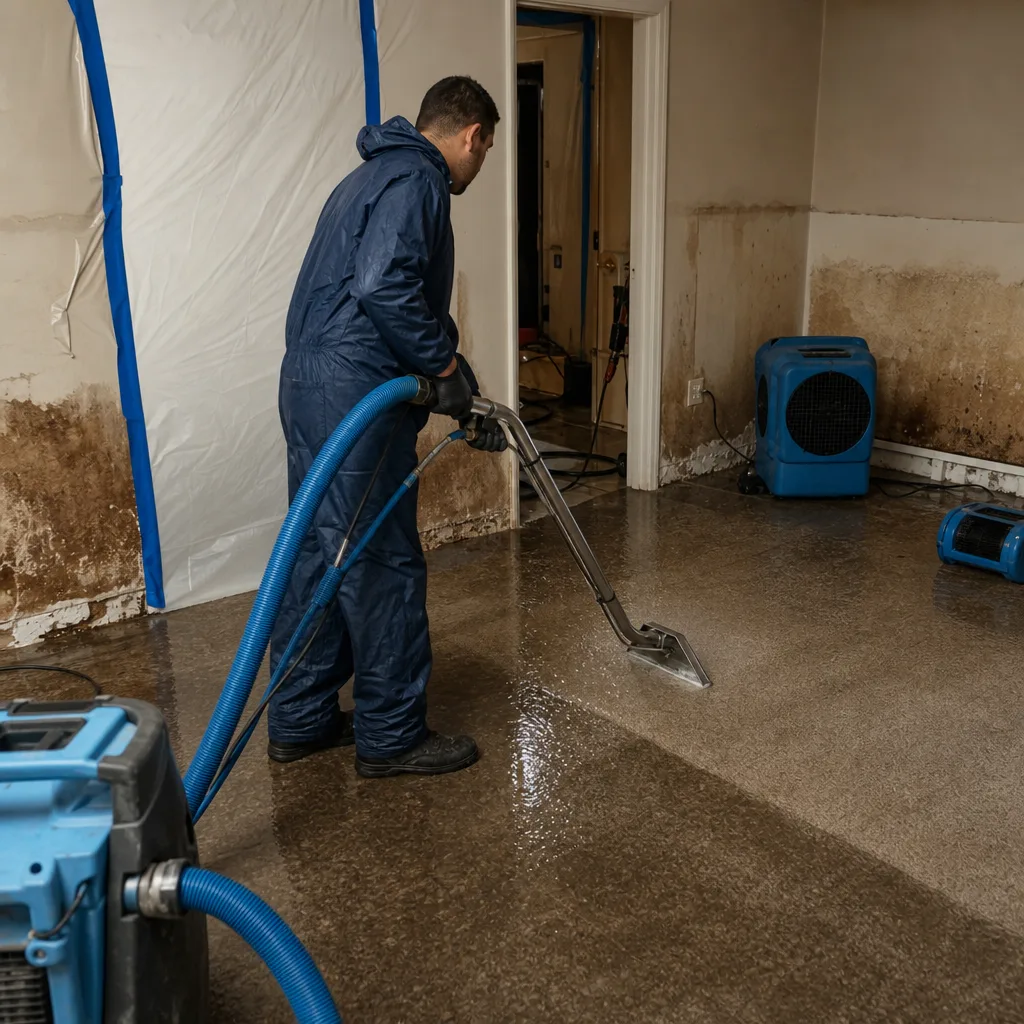
When water is standing in a Communications Hill garage or pooling against a shared wall, the clock starts immediately. We arrive with truck-mounted extraction power and pull water before it migrates under baseboards, through floor assemblies, or across a party wall into the unit next door. In stucco-clad attached construction, every hour matters, because the water that saturates a shared wall cavity by midnight is the water that becomes a mold claim by the end of the week. Same-visit extraction means pumps run on the first visit, not the second.
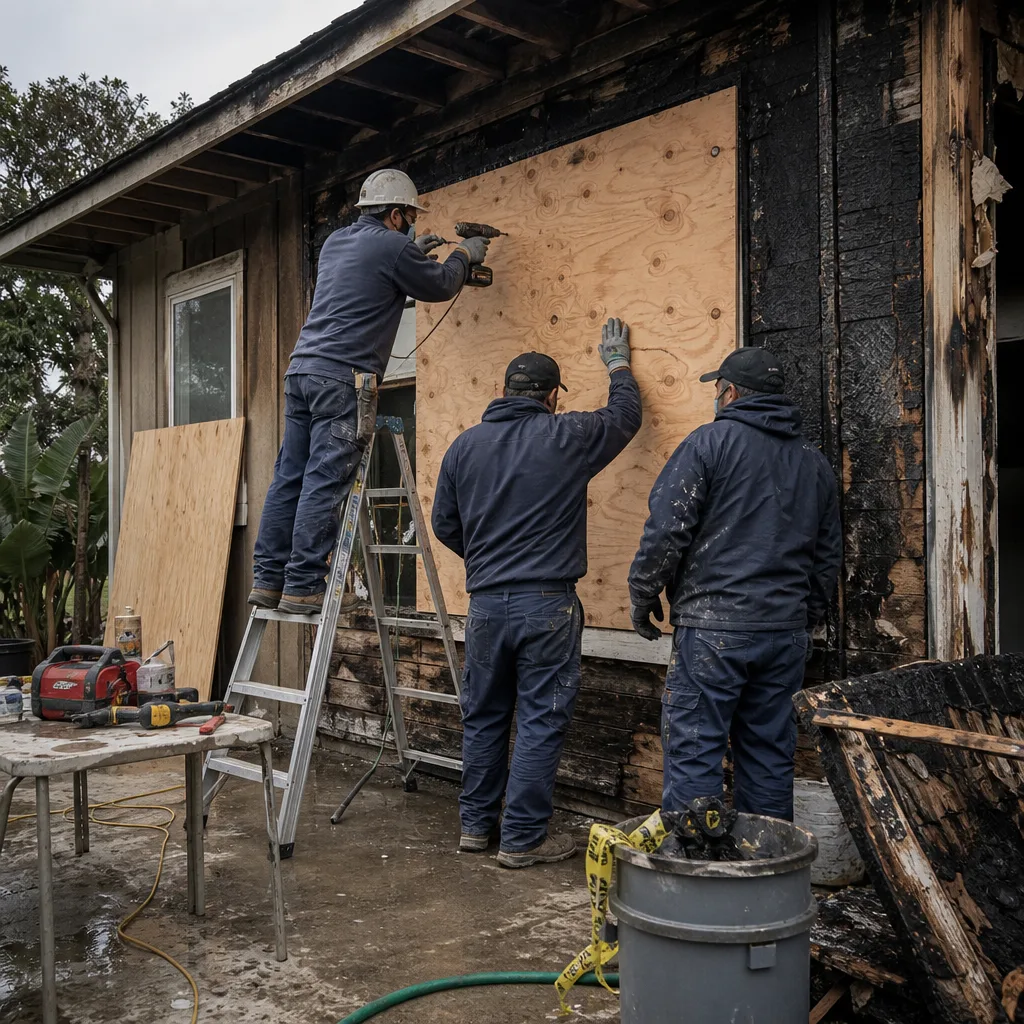
Structural Drying & Dehumidification
Water trapped behind stucco and inside shared wall cavities doesn’t dry on its own in Communications Hill’s winter conditions. We use Dri-Eaz dehumidifiers and XPOWER air movers placed to create negative pressure inside the wall assembly, pulling moisture out where ambient air can’t reach. Daily moisture readings are logged and shared with you and your adjuster. We don’t declare the job done until the dry standard is met, and we prove it with numbers, not promises.
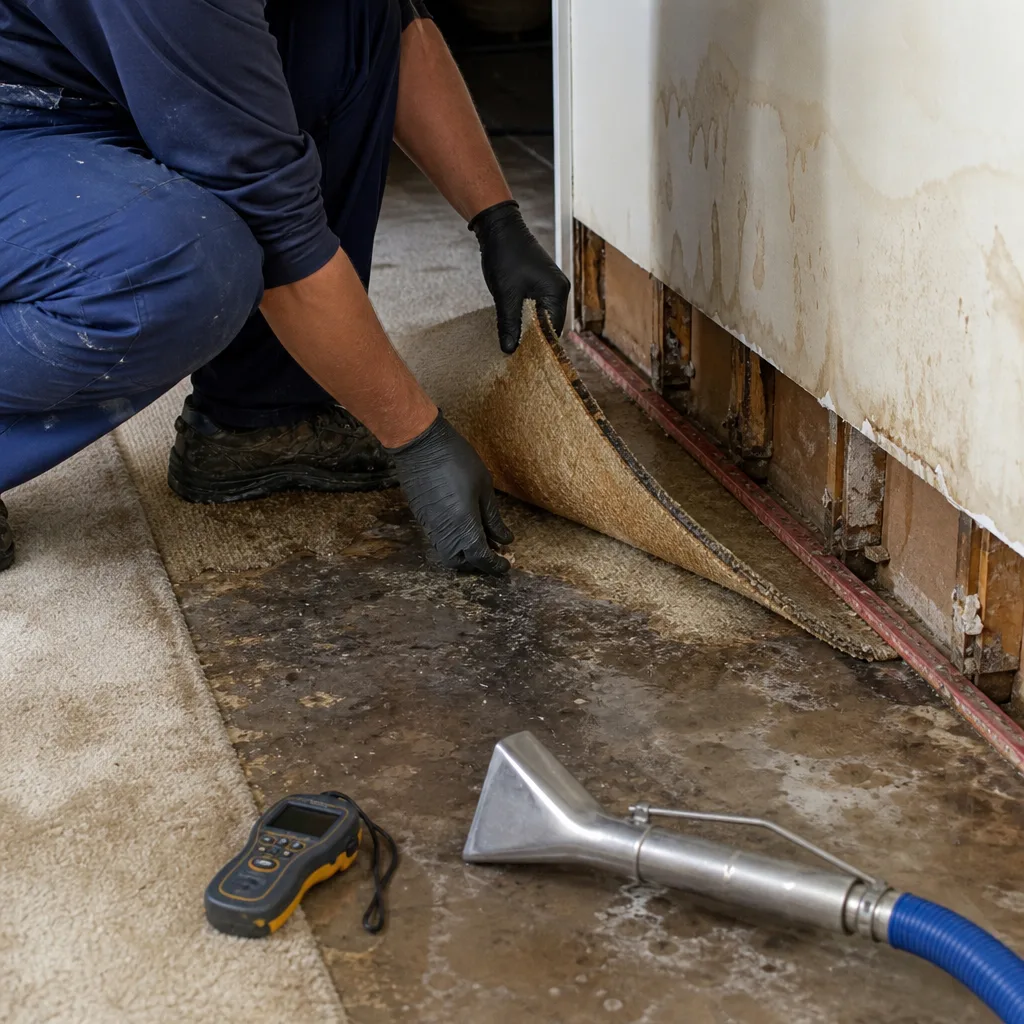
Flood Cleanup
Communications Hill’s steeply engineered slopes are beautiful, but they channel runoff in predictable and sometimes aggressive ways during Pacific storms. The downslope townhome rows, especially those at the bottom of each terrace, catch water that starts as surface flow uphill. Our flood cleanup process includes extraction, debris removal, antimicrobial treatment of affected surfaces, structural drying, and a written scope of any rebuild work. We handle the HOA notification and documentation so you’re not stuck explaining common-area drainage to your own insurer.
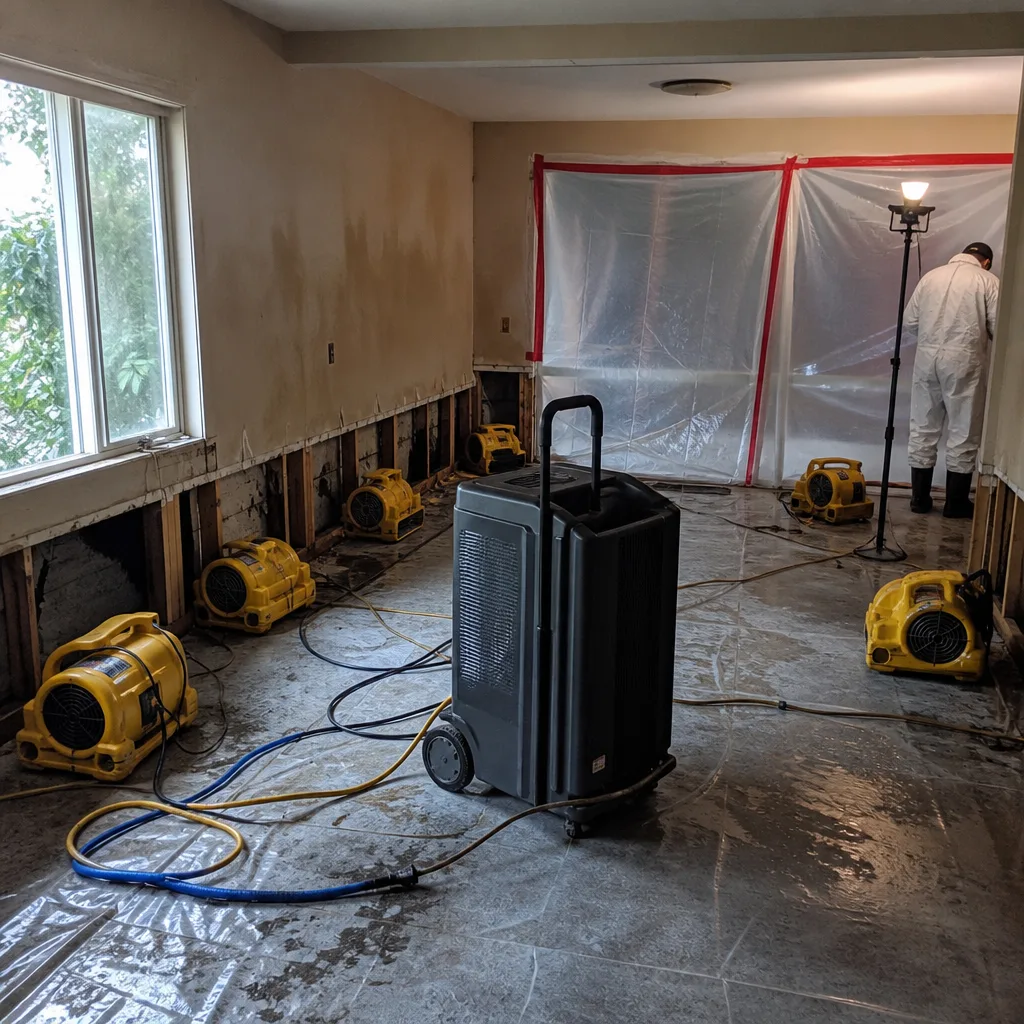
Burst Pipe Restoration
A burst pipe in a Communications Hill townhome is rarely contained to one unit. The supply lines and drain stacks in these attached homes run through shared chases, and a rupture behind a party wall can mean water in the wall cavity of two or three adjoining units within hours. We’ve restored homes in Communications Hill where a failed fitting in one garage soaked three garages in the same building row. Our approach: stop the source, map the moisture, extract, dry, and rebuild, all with the same certified crew and one continuous scope of work.
Ceiling & Roof Leak Water Damage
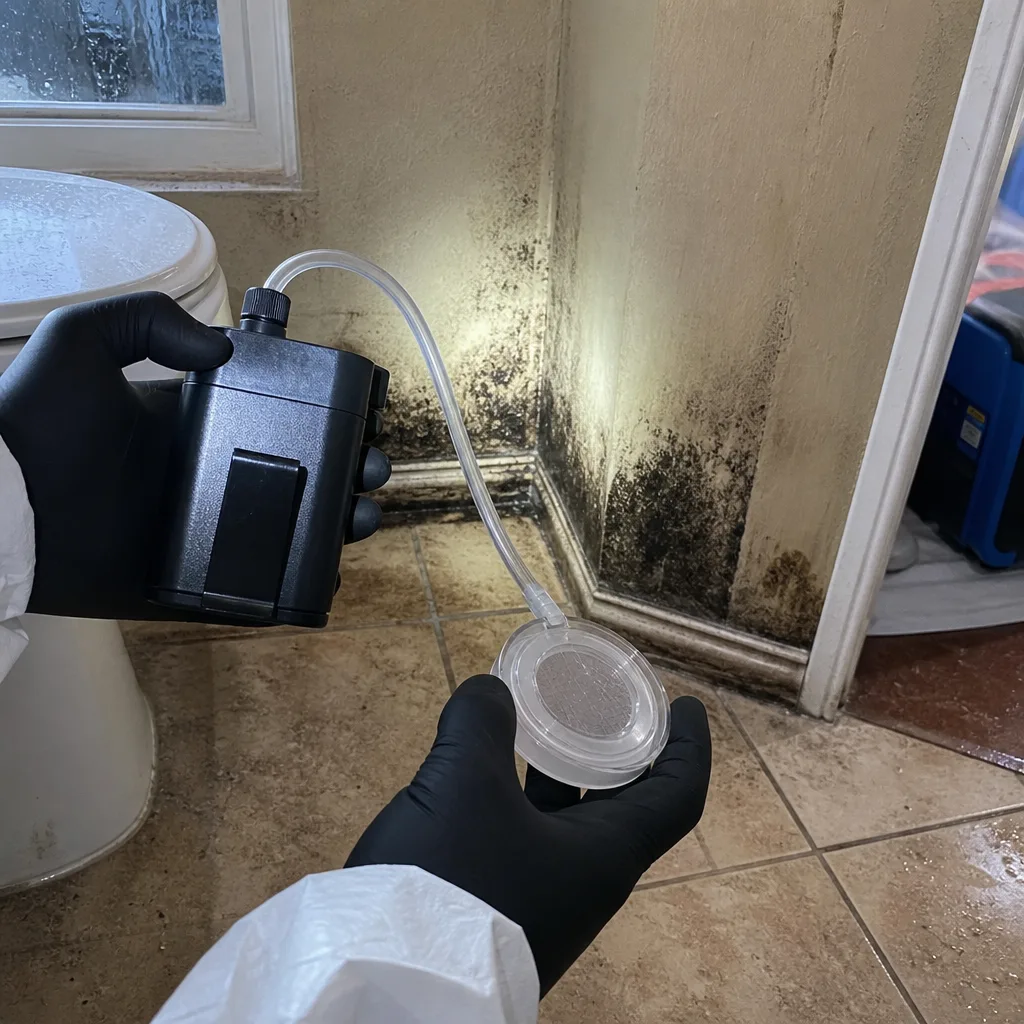
At 400 to 500 feet above the valley floor, Communications Hill is far more exposed to wind-driven Pacific rain than San Jose’s flat neighborhoods. The failure pattern we see most often is window-frame and stucco-penetration intrusion, not a roof leak at all. Flat-land restoration contractors often misdiagnose wind-driven rain intrusion as a roof problem, replace shingles, and walk away while the wall cavity keeps absorbing water. We check the actual penetration point, open only what needs opening, and dry the assembly. Then we rebuild it when the moisture log says it’s ready.
What happens when you call
- 1
A real person answersNo phone trees - you reach a local pro.
- 2
You get an upfront price rangeHonest numbers before anyone is dispatched.
- 3
A background-checked tech heads outLicensed & insured, dispatched right away.
- 4
You approve before work beginsNothing starts until you say go.
Why the Same Few Downslope Townhomes Flood After Every Big Rain
This is the question that defines water damage restoration in Communications Hill, and it’s one most restoration companies can’t answer because they don’t work this neighborhood enough. The answer is the hill itself. The community’s engineered slopes are graded to move storm-water quickly away from homes, but that water has to go somewhere. It travels downhill along surface courses and drainage contours until it reaches the lowest point on each terrace: the retaining wall and garage entry of the downslope row. The units at the bottom of each terrace absorb the collective runoff from every unit above them. That’s not a failure of any one homeowner’s drainage; it’s the hydrodynamics of steep, terraced hillside construction. The units above stay dry not because they’re better protected, but because their water ran downhill into someone else’s garage.
After a winter Pacific storm, our crew responded to a row of attached townhomes on Communications Hill where wind-driven rain had penetrated stucco-clad shared walls and window frames, with water migrating across unit lines into three adjacent garages. Using Dri-Eaz structural drying equipment and XPOWER air movers, we coordinated with the HOA’s master policy adjuster and each owner’s individual insurer to extract standing water, dry wall cavities, and treat the common-area retaining wall drain path. The building row was restored before mold could set in, and the documentation package we built made the insurance picture clear for every owner involved.
That job is typical here. Restoration crews who don’t know Communications Hill treat each flooded unit as an isolated incident. But when the same building row floods after every significant storm, the real fix includes looking at the common-area drainage path, the retaining wall weep holes, and the HOA’s maintenance responsibility. We include that in our scope documentation so the right party pays for the right part of the job.
Common Water Damage Restoration Problems We See in Communications Hill Homes
- HOA master-policy disputes delay emergency extraction. When water crosses a shared wall, unit owners and the HOA often disagree about which policy covers the damage. Meanwhile, standing water sits in wall cavities. We start extraction and drying on the first visit and sort the coverage with both adjusters while the equipment runs, because drying can’t wait for a coverage determination.
- Builder-grade weather barriers allow water to travel across unit lines. The original construction on Communications Hill used shared-wall assemblies that were adequate when built, but a decade and a half of wind-driven rain has stressed them. Once water penetrates the stucco at a window header or wall penetration, it travels horizontally through the shared assembly, and the neighbor with the dry unit becomes the neighbor with the mold problem. We map the moisture across the full wall, not just at the visible stain.
- Wind-driven rain penetrates stucco-clad window frames and garage headers. The exposed hilltop position of Communications Hill means south-facing and west-facing elevations take wind-driven rain that’s far more aggressive than what the flat neighborhoods in ZIP code 95136 experience. A small crack in stucco or failed caulking at a window frame becomes a persistent interior leak during winter storms. Flat-land techs often misdiagnose this as a roof leak and fix the wrong thing.
- Neighboring owners blame each other while mold spreads. In attached townhomes, water damage that starts in one unit and migrates into another creates an adversarial dynamic quickly. The owners argue about who’s responsible while the moisture level in the shared wall stays high enough for mold growth. Our photo-documented moisture mapping and direct adjuster coordination removes the guesswork and usually the argument.
Trusted Equipment and Standards We Use in Communications Hill
Our crews use Dri-Eaz dehumidifiers and structural drying systems, Phoenix air movers, XPOWER axial fans, Injectidry injection drying systems, and B-Air negative-air equipment, selected for the specific assembly we’re drying. The technicians who run this equipment are certified to IICRC, RIA, and IFA standards, and they follow a drying plan that’s written down, not improvised. For Communications Hill homeowners, that means the equipment in your garage or living room is professional-grade and sized correctly for the job, not a rental fan blowing unconditioned air at a wet wall. We stock drying equipment in vehicle-ready condition for rapid deployment to Communications Hill, and we don’t cut corners on daily moisture readings, even when the job runs through a weekend.
Coverage and Response Time for Communications Hill
We serve all of ZIP code 95136, including every terrace, row, and complex on Communications Hill. Our dispatch is coordinated from the San Francisco Bay Area office, and our crews run local routes to Communications Hill that put us at most addresses within 60 to 90 minutes of the call. That response speed matters here because of the shared-wall construction. Water in one unit becomes water in two or three units by the time the next day rolls around. A live dispatcher answers every call at (888) 737-2439, and no one on our side puts you on hold to check a schedule. We’re staffed for emergencies at two in the morning and two in the afternoon.
Do We Work Around HOA Rules in Communications Hill?
Most of the time, the HOA is already involved before we arrive, because in attached townhome construction the HOA governs the shared walls, roofs, and common drainage paths. We coordinate with HOA property managers and their master policy adjusters as a standard part of every Communications Hill job. Equipment staging in shared garages, walkways, and common areas requires HOA awareness and sometimes written notice. We handle that. Our crews are trained to work in occupied attached housing without blocking neighbors’ access, and our documentation packages include the HOA-specific photo evidence and moisture logs that master policy claims require. You don’t have to navigate the HOA alone, and you don’t have to explain restoration equipment to your HOA board.
Pricing for Communications Hill Compared to Nearby San Jose Neighborhoods
Water damage restoration in Communications Hill runs slightly higher than the same job on the flat valley floor in San Jose, Campbell, Alum Rock, or East Foothills. The average single-room extraction and drying job in Communications Hill is $1,800 to $5,400, compared to $1,500 to $4,200 for the same work in a detached single-family home in Campbell. The difference is the attached construction and the HOA coordination. Shared-wall drying takes longer, requires negative-pressure equipment, and produces more documentation. We don’t bury those costs in surprises. The written scope of work you sign before we start shows exactly what’s included, and our direct billing to your carrier means you’re not fronting money while waiting for a reimbursement check. We honor the $50 off any repair over $250, the $89 seasonal tune-up, and the Senior & Veteran 5% discount on restoration work in Communications Hill.
We Also Serve Cities Near Communications Hill
From our Bay Area dispatch, we run crews to Communications Hill and the surrounding cities of San Jose, Campbell, Alum Rock, and East Foothills. If you’re in one of those communities and dealing with water damage, the same 90-Day Done Right Promise and 24/7 live phone response apply. Call (888) 737-2439 from anywhere in the area and a person will answer.
Serving Communications Hill, CA - Our Local Coverage Area
We’re based in the Communications Hill area and know this community well. Use the map below to see our service coverage - if you’re nearby, we can almost certainly help.
FAQs About Water Damage Restoration in Communications Hill
The lowest townhome rows on each terrace are the collection points for surface runoff from every unit above them on that hillside. Communications Hill’s engineered grading directs water downhill, and the retaining walls and garage entries at the bottom of each terrace are where that water concentrates. The units above stay dry because their runoff drains downhill. The fix often involves common-area drainage improvements, and we document the pattern in our moisture mapping so the HOA’s master policy can address it. If your unit is one of the predictable flood spots, call (888) 737-2439 before the next Pacific storm and we’ll do a pre-storm inspection of your drainage path.
The HOA master policy generally covers the shared wall structure and common building elements, while your individual condo policy covers your interior finishes and personal property. But the line between them is complicated in attached construction, and waiting for a coverage determination before starting drying is how small leaks become mold claims. We coordinate with both adjusters from the first visit, provide photo-documented evidence of where the water penetrated and how far it migrated, and run drying equipment while the coverage question sorts out. Direct answers on your policy come from your adjuster, but our documentation package makes that conversation faster and fairer.
Most stucco-clad shared wall assemblies in Communications Hill dry within three to seven days when we run negative-pressure drying with Dri-Eaz dehumidifiers and injection drying through the stucco face. The dryness of the wall cavity depends on how long the water sat before we arrived, the outside temperature and humidity, and whether the wall insulation is fiberglass batts, which hold water, or a closed-cell product, which mostly doesn’t. We take daily moisture readings and give you the log. The wall is dry when the numbers say it’s dry, not when the stain fades.
In shared-wall construction, water that penetrates the building envelope at one unit’s window frame, garage header, or roof flashing can travel horizontally through the shared wall assembly and show up as a ceiling stain or wall dampness in the adjoining unit. The water doesn’t care whose policy covers it. We map the moisture across the full assembly, identify the penetration point, and give both owners and both adjusters the same photo-documented evidence. That’s the fastest way to stop the blame game and start the drying.
Yes, we do it on nearly every Communications Hill job. Our crews are trained to stage drying equipment in shared spaces without blocking neighbors’ access, and we coordinate with HOA property managers and their master policy adjusters from the first visit. We handle the written notices, the equipment placement approvals, and the documentation the HOA needs for its own claim. You don’t have to negotiate with your board about where a dehumidifier can sit. If your HOA has specific rules about contractor hours or equipment, call (888) 737-2439 and we’ll sort it out before we arrive.
Need Water Damage Restoration in Communications Hill? Call Now.
Water in a shared wall doesn’t wait for business hours, and neither do we. Our live dispatch answers every call at (888) 737-2439, any time of day, any day of the year. We’ll walk you through the first steps over the phone, dispatch a certified crew to your Communications Hill address, and start extraction and drying on the same visit. You’ll get a written scope of work before anything gets plugged in, direct billing to your insurance carrier, and the 90-Day Done Right Promise in writing. The line the water left is where we start, and we stay until the job is done right.
Written by Curt Bowman, Owner at Floodline Restoration Co. of California, serving Communications Hill and the surrounding Bay Area with full-cycle water damage restoration since 2010.