
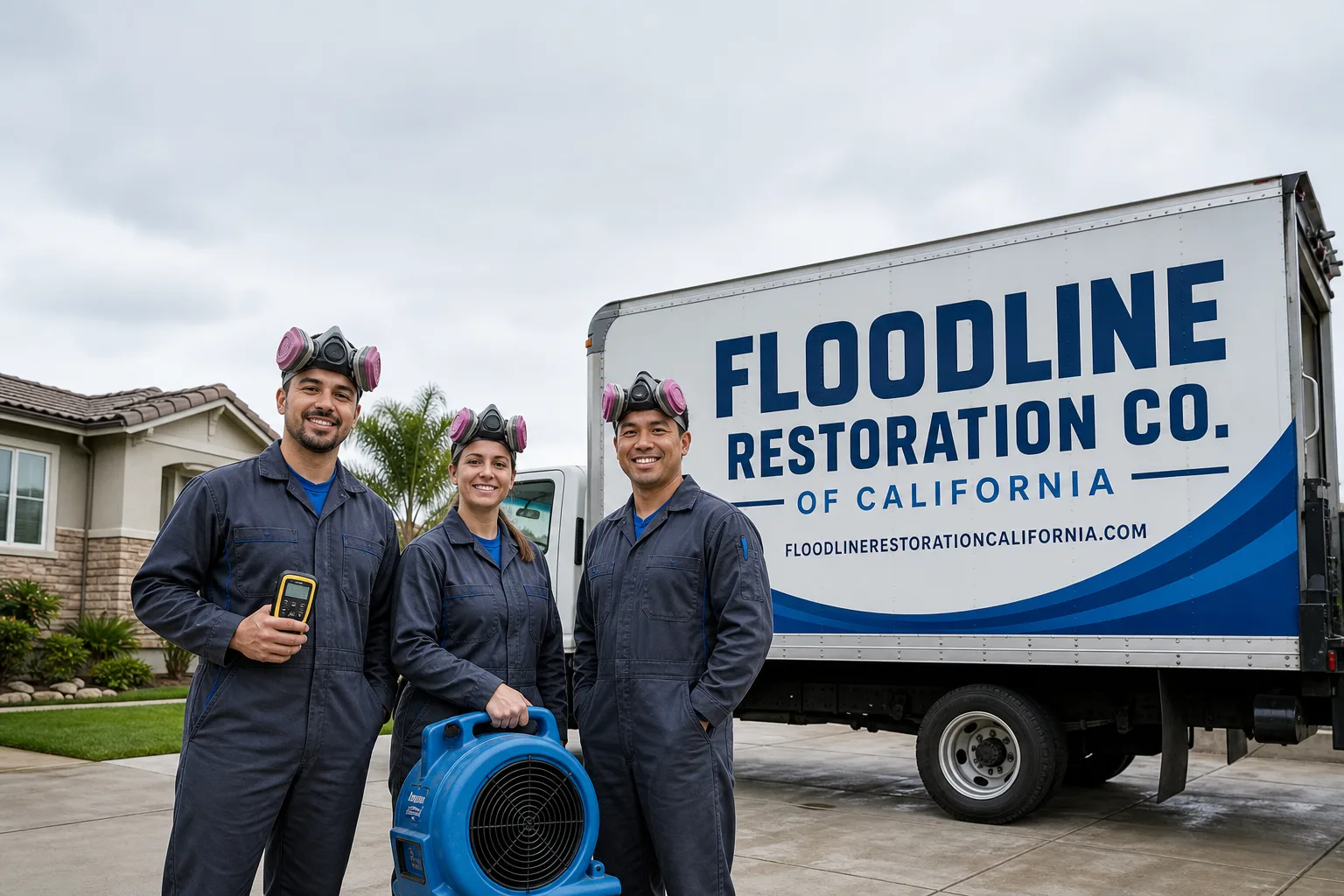
Fast, Reliable Storm & Disaster Restoration Across Temple City
When a storm tears through Temple City, the damage doesn’t wait for business hours. A downed tree limb through a roof, water pushing under a slab edge, or wind ripping shingles off a 1960s ranch all need attention right now. Floodline Restoration Co. of California has crews stationed to reach Temple City fast, usually within the hour during active weather events. Our Storm & Disaster Restoration team handles emergency board-up, roof tarping, flood water extraction, and debris removal, then stays on through the drying and rebuild phases. Call (888) 737-2439 any hour. A live dispatcher answers, not a recording.
Why Storm & Disaster Restoration Matters for Temple City’s Older Homes
Temple City’s housing stock is different from the newer coastal developments. Most homes here were built between 1950 and 1980, stucco over wood frame on slab or shallow raised foundations. That age matters when a storm hits. The 1987 Whittier Narrows earthquake, epicentered just a few miles south near Rosemead, cracked stucco and shifted foundations in many local homes. Those slab hairline fractures never got properly repaired. Now, when atmospheric-river rain dumps several inches in hours and the city’s older storm drains back up, water wicks up through those same cracks and soaks flooring from below. That’s a failure mode we see constantly in Temple City, and it’s one a generic restoration crew from outside the San Gabriel Valley won’t recognize on day one.
Add in the hard, mineral-rich municipal water supply that accelerates corrosion in the original galvanized pipes still running through a large share of these houses, and a single water-loss event after a storm frequently turns into cascading pipe failures behind walls. Our techs know to check for that before they finish scoping for our Water Damage Restoration in Temple City.
Storm & Disaster Restoration Services in Temple City
Emergency Board-Up
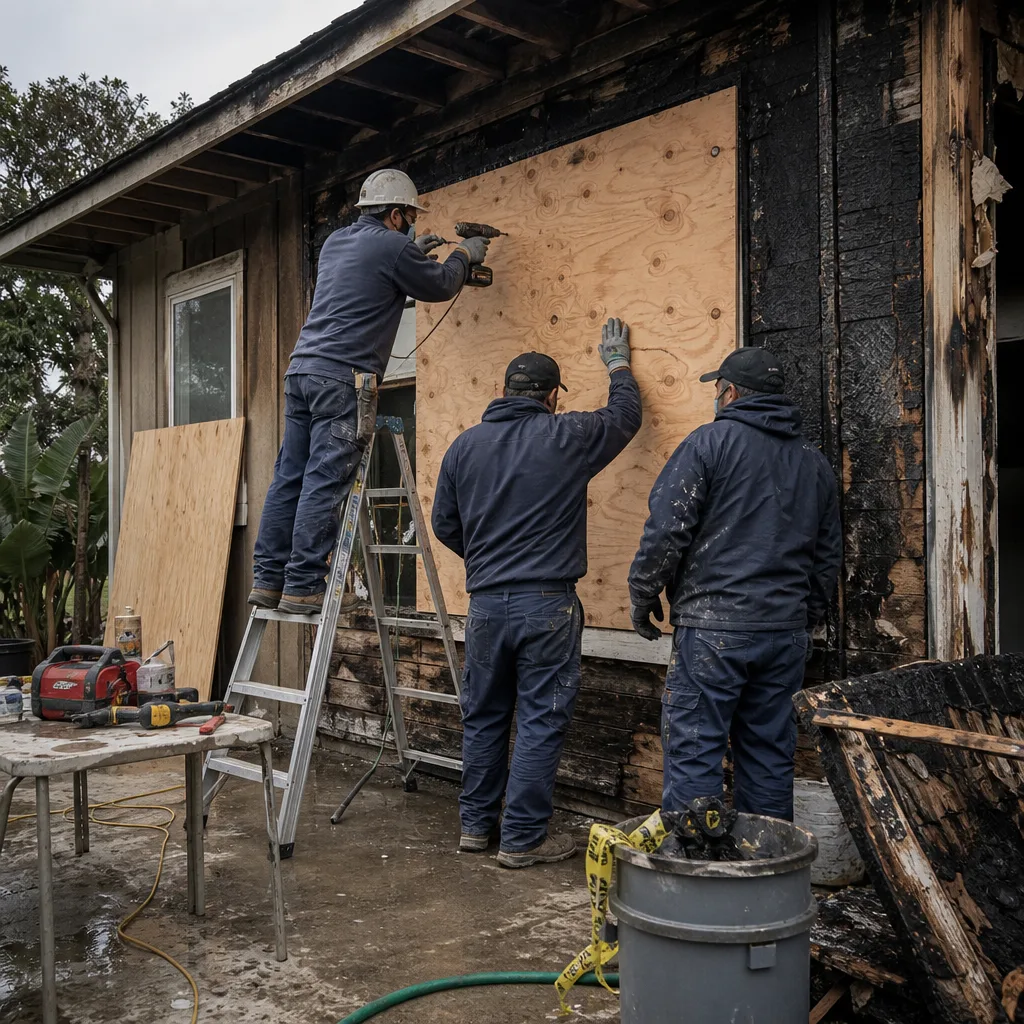
When a tree limb or wind-driven debris opens your home to the elements, the first job is securing the envelope. In Temple City, where many homes still have original windows and single-pane aluminum frames, storm damage often means multiple broken panes and compromised entry points. We board up with plywood cut to fit the actual opening, not whatever’s on the truck. That matters on Temple City’s 1950s ranch houses where window sizes were never standardized. We also document everything with photos for your carrier before we seal anything up.
Roof Tarping
Temple City roofs from the 1950s and 1960s were built with skip sheathing and often still have original compressed shake or early composition shingles. After a wind event, those old surfaces fail in large sections, not just a shingle or two. Our crews tarp with heavy-gauge poly in strips that overlap across the ridge, sealed at all edges. The goal is keeping water out for the days or weeks it takes your adjuster to approve permanent repair work. We’ll also check the roofline for structural sag caused by the 1987 earthquake, because patching a tarp onto a shifted rafter line just means water pools and leaks through another spot.
Storm Damage Cleanup
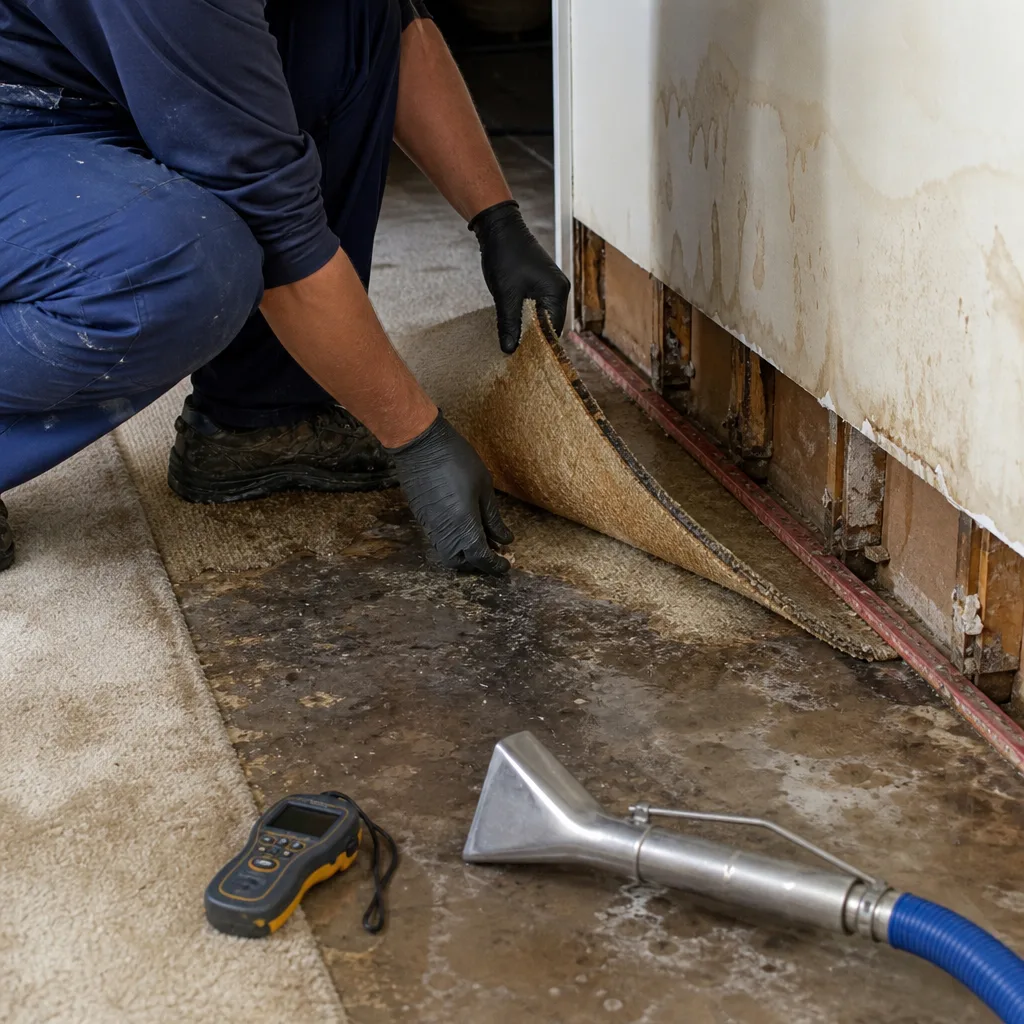
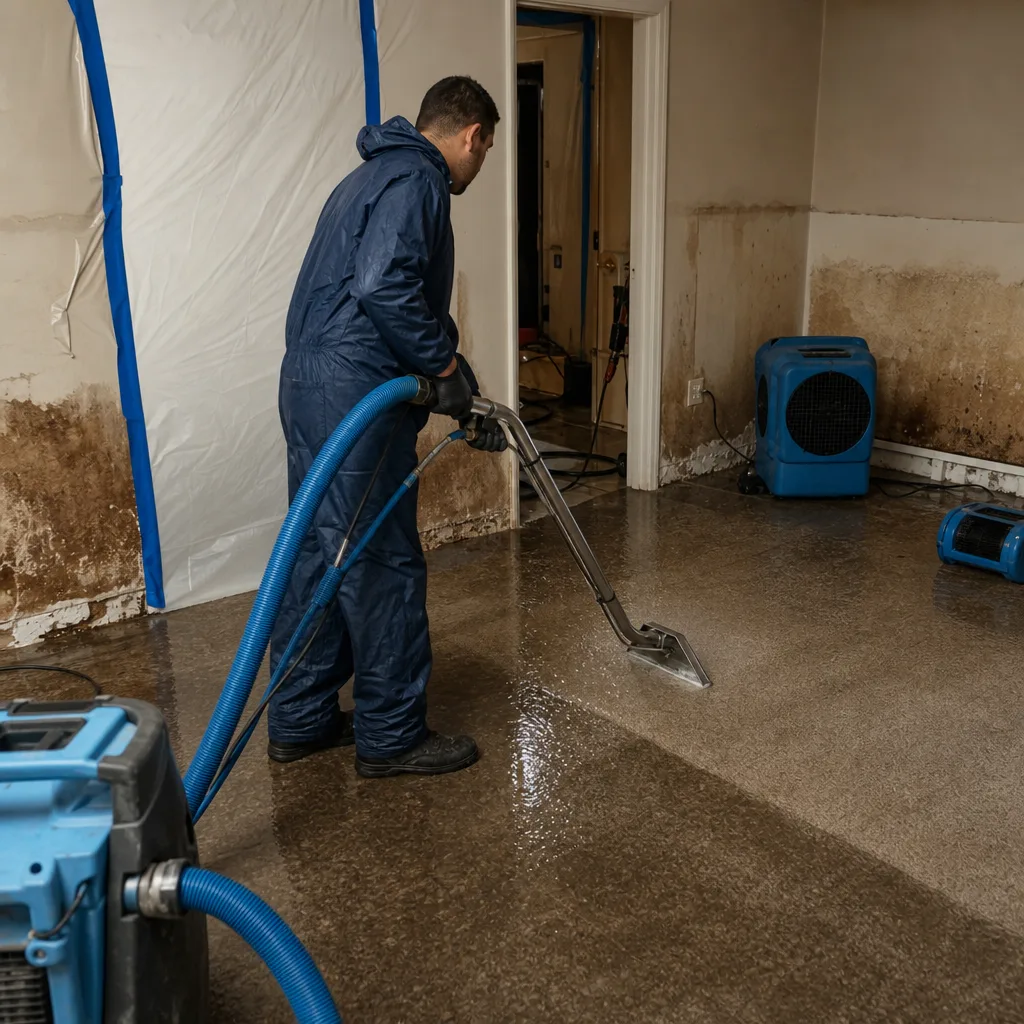
After the rain stops, you’re left with saturated drywall, wet insulation, and often mud and debris carried in by floodwater. Temple City sits in the interior San Gabriel Valley without the marine buffer that keeps coastal LA drier, so winter storm events hit hard and fast. We extract standing water with truck-mounted units, then map moisture across walls and floors with professional-grade Dri-Eaz and XPOWER equipment. Daily readings get logged until the dry standard is met, and we hand that log to you and your carrier. No guesswork.
Flood Damage Restoration
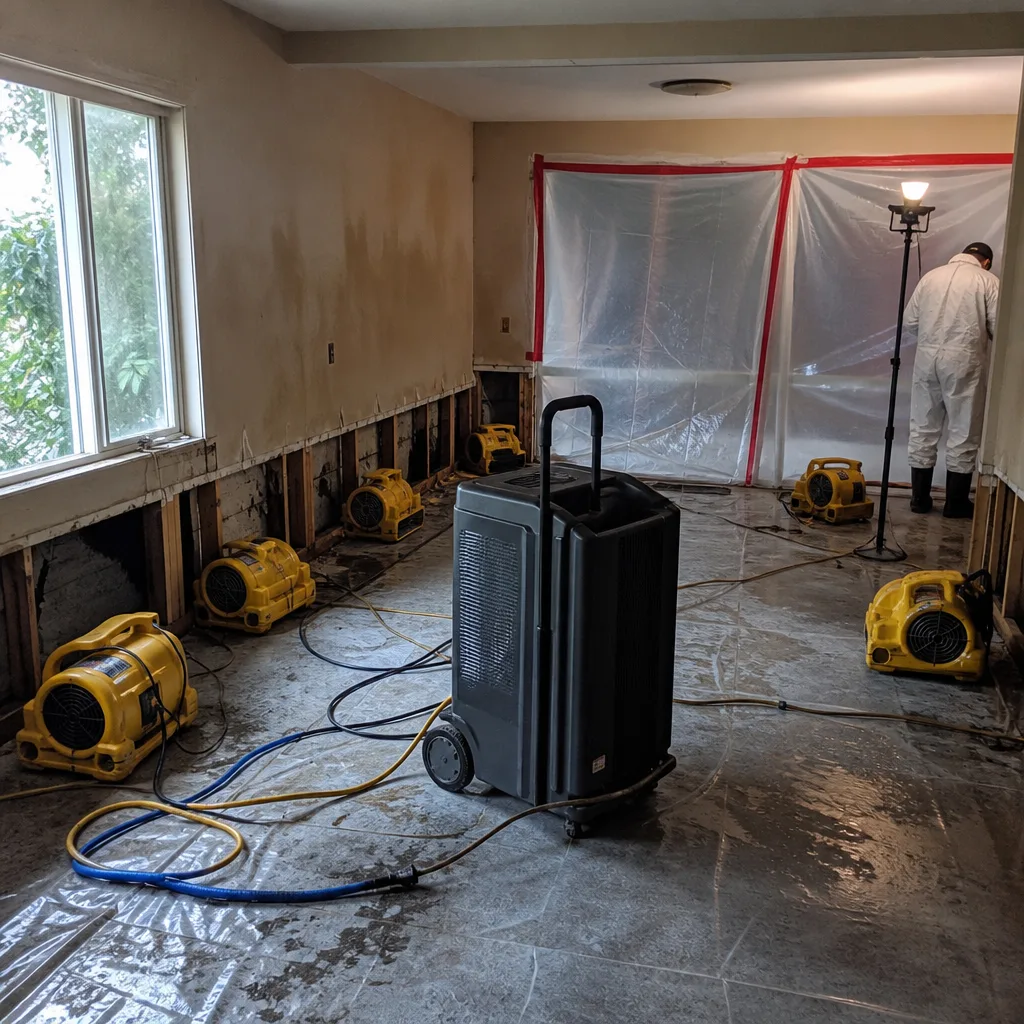
When drains back up or surface water breaches a door line, it finds the lowest point. In Temple City, that’s often the slab edge where the original foundation meets exterior grade. Those hairline cracks from 1987 let groundwater wick upward into carpet, tile, and the bottom plates of walls. We address the water first, then the moisture trapped inside wall cavities where the damage isn’t visible yet. Injectidry systems get into those hidden spaces and pull water out that air movers alone miss.
What happens when you call
- 1
A real person answersNo phone trees - you reach a local pro.
- 2
You get an upfront price rangeHonest numbers before anyone is dispatched.
- 3
A background-checked tech heads outLicensed & insured, dispatched right away.
- 4
You approve before work beginsNothing starts until you say go.
Common Storm & Disaster Restoration Problems We See in Temple City Homes
- Unpermitted garage conversions and enclosed patios that flood. Temple City families have added in-law units, extra bedrooms, and storage rooms over decades, often without pulling permits. When those spaces get wet, our techs have to document the actual framing, plumbing, and electrical behind original stucco. Carriers frequently reject drying line items until that documentation is in front of them. We handle that part.
- Slab-edge water intrusion from 1987 earthquake damage. The Whittier Narrows quake cracked concrete slabs all across town. Most homeowners don’t know it until a heavy rain soaks their floors from below. We map the moisture pattern and can pinpoint where the slab crack sits.
- Galvanized pipe failures triggered by Temple City’s hard water. The municipal supply here carries high mineral content. Original galvanized supply lines from the 1960s are thinned from decades of internal corrosion. A pressure surge or a freeze event after a storm blows out a section, and suddenly water’s running behind a wall nobody touched.
- Roof leaks through original skip sheathing. Older Temple City roofs weren’t built with solid plywood decking. Water breaches through cracked mastic and runs along rafters, emerging far from the actual puncture point. That confuses scoping and leads to missed wet areas. We trace the path, not just the stain.
The Hidden Construction Problem That Changes Everything
Temple City’s damage restoration market is defined by its dense concentration of 1950s-1970s post-WWII tract homes, many held by multi-generational Chinese-American families who have made successive unpermitted additions, garage conversions, and plumbing modifications over decades. That means restoration crews routinely open walls to find non-standard construction that complicates insurance scoping and permit-required repairs. Layered on top of that, the San Gabriel Valley’s notoriously hard water supply accelerates corrosion in the original galvanized pipes still present in a large share of these homes, so what starts as a single water-loss event frequently exposes cascading pipe failures behind walls. It’s not a simple dry-out when you’re dealing with both hidden plumbing failure and unpermitted square footage. You need a crew that’s seen this before.
On a 1950s ranch near Live Oak Park, atmospheric-river rain overwhelmed the old storm drains and pushed water under the slab edge, soaking a garage the owner had converted into an in-law unit without permits. Our techs found the original galvanized supply lines behind the unpermitted drywall had corroded through from Temple City’s hard water, and the 1987 Whittier Narrows shift had cracked the slab enough to let groundwater wick up. We emergency-board-up’d the garage, tarped the compromised roofline, and ran Dri-Eaz desiccants with XPOWER air movers while the adjuster re-scoped for the unpermitted square footage and any needed Reconstruction & Cleanup in Temple City. That job took three extra days to scope correctly. A crew without local Temple City experience would have missed the slab crack entirely and walked away with wet walls still drying behind new drywall.
Pricing for Storm & Disaster Restoration in Temple City, CA
Emergency board-up in Temple City typically runs $450-$900 depending on how many openings need securing. Roof tarping runs $600-$1,400 for a standard single-story ranch, more if you have a two-story or steep pitch. Water extraction and drying after a slab-edge flood usually lands between $1,800 and $4,500, based on the affected square footage and whether hidden wall cavities need Injectidry treatment. Full storm damage cleanup with debris removal and materials disposal adds $800-$2,200 on top of drying. If the job exposes unpermitted construction or plumbing failure, the scope changes and we document everything for your carrier before touching the non-standard work. We give you a written scope before work starts. No surprises at the end. Call (888) 737-2439 for a free estimate.
Do We Need a Permit for Restoration Work in Temple City?
Sometimes. When we open a wall and find non-standard framing, unpermitted plumbing, or structural damage that predates the storm, the city of Temple City requires permits for correcting it. We handle the drawing, the permit application, and the inspection for the rebuild phase. Your insurance carrier may cover code-compliance upgrades if the original loss was covered. That’s a conversation we can have with your adjuster directly.
We Also Serve Cities Near Temple City
Our crews work throughout the San Gabriel Valley, including Storm & Disaster Restoration in Temple City and the surrounding communities of Rosemead, San Gabriel, Arcadia, and East San Gabriel. If you live just outside Temple City and need same-day emergency response, call (888) 737-2439 and give us your cross streets. We’ll tell you exactly when a crew can be there.
Serving Temple City, CA - Our Local Coverage Area
We’re based in the Temple City area and know this community well. Use the map below to see our service coverage - if you’re nearby, we can almost certainly help.
Frequently Asked Questions About Storm & Disaster Restoration in Temple City
That quake cracked slabs and shifted foundations across Temple City. The damage was mostly patched cosmetically and never properly repaired. When a heavy rainstorm soaks the ground, water seeps up through those old cracks and wets flooring from below. That means a “storm flood” in Temple City isn’t always visible surface water. It can be groundwater wicking up through the slab edge, and our moisture maps show exactly where that’s happening so the drying plan gets it right the first time. Call (888) 737-2439 if you have unexplained damp floors after a rain.
Don’t panic, and don’t start ripping out drywall on your own. Document what’s wet with photos, shut off water if a pipe burst, and call us. Our techs handle unpermitted spaces all over Temple City. We map the damage, document the actual construction we find, and work with your adjuster to get the drying and rebuild covered where the policy language allows, including any Biohazard & Crime Scene Cleanup - Temple City requirements if contamination is present. The worst thing you can do is hide the unpermitted area, because carriers find out anyway when the moisture readings don’t match the recorded square footage. Call (888) 737-2439 and we’ll walk you through it.
Yes, in a specific way. The high mineral content in Temple City’s municipal water corrodes galvanized pipes from the inside out. After decades, the pipe walls get thin. A storm that brings a pressure surge or a cold snap can blow out a section that was already about to fail. So what starts as a roof leak or slab flood turns into an additional supply-line failure inside a wall. We check for that whenever we open up a wet wall in Temple City. Call (888) 737-2439 if you suspect a hidden pipe leak after a storm.
If there’s active water coming in, tarp it first. Always. Tarping costs $600-$1,400 and stops the damage while you sort out replacement. A 1960s roof with original skip sheathing won’t take a partial repair well anyway. You’re likely looking at a full reroof, and that’s a scoped, scheduled job that should be priced in writing like a remodel. We tarps now, document the damaged areas for your carrier, and give you a written scope for the permanent repair. Replacement typically runs $14,000-$28,000 for a Temple City single-story, depending on sheathing condition and whether we find old quake damage in the rafter line. We handle that rebuild phase too, so you don’t hand off to another crew mid-job.
Because the original 1950s and 1960s slabs weren’t reinforced the way modern foundations are, and many have hairline cracks from the 1987 Whittier Narrows earthquake. During a heavy atmospheric-river event, the city’s storm drains back up, surface water pools against the foundation, and hydrostatic pressure pushes that water up through the cracks. You’ll see wet carpet or buckled tile starting at the exterior wall and moving inward. Our drying plan includes trenching the affected perimeter and running air movers plus desiccants until the slab reads dry. That’s the only way to avoid mold forming under your flooring later. Call (888) 737-2439 and we’ll send a tech with a moisture meter to map the affected area.
Done Right, Backed in Writing, for Temple City Homeowners
Floodline Restoration Co. of California has been answering the phone with a live person since 2010. Our Temple City customers get background-checked, uniformed technicians trained to IICRC, RIA, and IFA standards. The same crew that reads the moisture map on day one handles the daily readings, hands the log to your carrier, and rebuilds what needs rebuilding. When the job is done, you get the 90-Day Done Right Promise in writing. If it’s not done right, we make it right. No paperwork battles, no arguing.
We stand behind it. That’s the deal. Call (888) 737-2439 for a free estimate, and remember to ask about the $50 Off Any Repair Over $250 and the Senior & Veteran 5% discount. The line the water left is where we start.
Written by Curt Bowman, Owner at Floodline Restoration Co. of California, serving Temple City with storm and disaster restoration. On every job, we leave the moisture log, the warranty, and the name of a company that plans to be here in thirty years.