
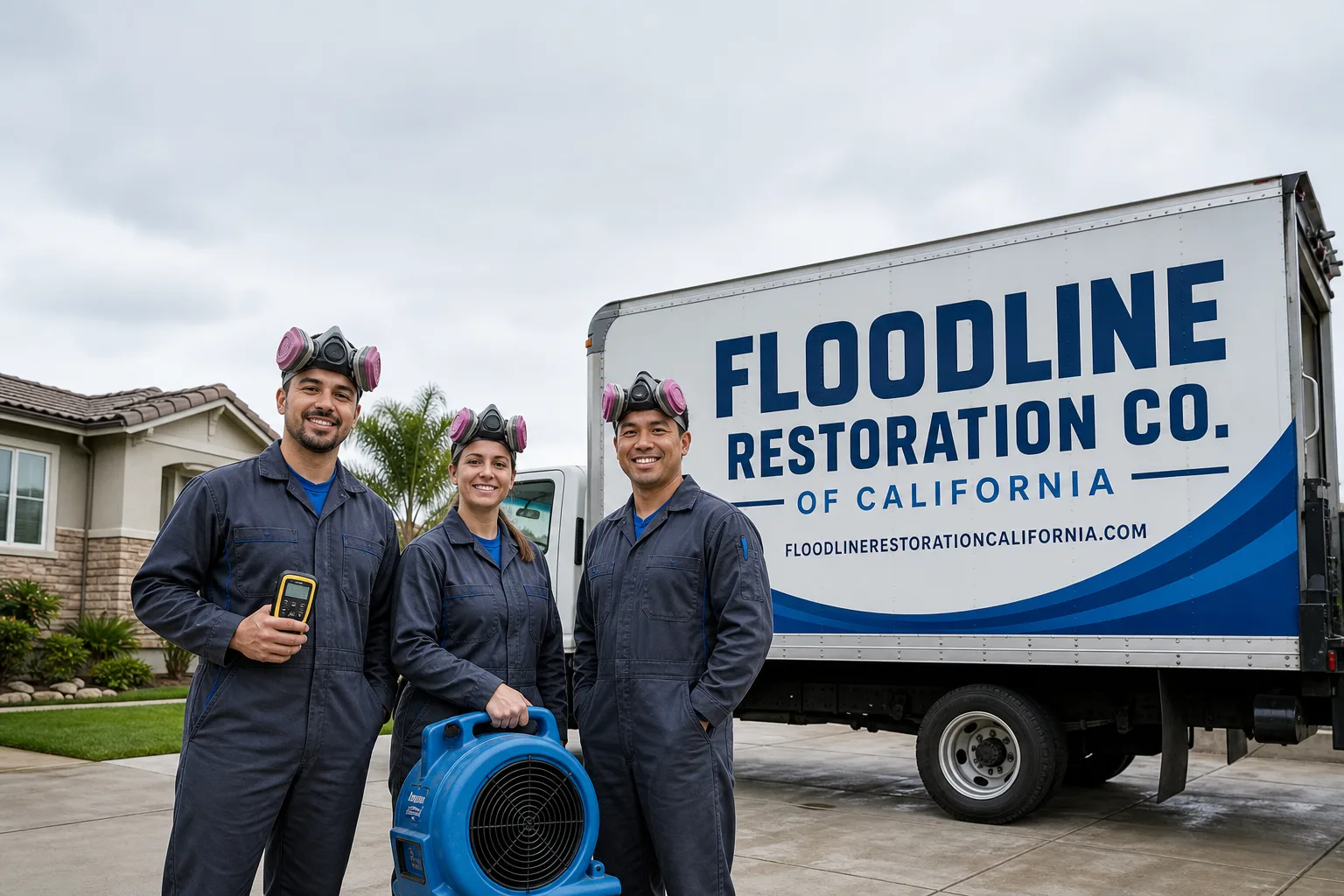
Fast, Reliable Storm & Disaster Restoration Across Petaluma
Storm damage in Petaluma doesn’t wait for business hours, and neither do we. When an atmospheric river pushes the Petaluma River over its banks and into your living room at 3 a.m., you need a crew that knows this city’s water, its houses, and its specific problems. Floodline Restoration Co. answers the phone with a live person 24 hours a day, and our certified technicians reach Petaluma homes fast with the professional-grade equipment the job demands. Call (888) 737-2439 right now and a dispatcher will start coordinating your response. The longer water sits in a Petaluma house, the more the marine air works against you and the deeper the damage goes.
Why Floodline Restoration Co. of California Is Petaluma’s Preferred Storm & Disaster Restoration Company
Petaluma homeowners call us because we’ve been doing this work here long enough to know exactly what a flooded Victorian on the west side needs, and what a stucco tract home in 94954 needs instead. The two are not the same job. Our IICRC, RIA, and IFA certified technicians arrive in clean uniforms, background-checked, carrying Dri-Eaz and XPOWER equipment and a moisture map that gets updated every day until the job is done. There’s no handoff to a different crew after extraction. The same people who pull the water out are the ones who rebuild the wall.
Founded in 2010 by Curt Bowman, we built this company around a dispatch board, not a sales desk. Every call gets answered by a live person at any hour, including 2 a.m. on a Sunday when the river’s rising. And every job in Petaluma is backed by the 90-Day Done Right Promise, our Keystone Standard in writing. If it’s not done right, we make it right. No arguing, no paperwork battles. That’s how we work.
Our Storm & Disaster Restoration Services in Petaluma
Storm & Disaster Restoration covers a lot of ground. In Petaluma, three of those services matter most: flood damage restoration, storm damage cleanup, and emergency board-up. Here’s what each one looks like in this city.
Flood Damage Restoration
Flood damage in Petaluma is different from other Sonoma County towns because the water itself is different. The Petaluma River is tidal, and when it overtops into downtown and the west-side neighborhoods around D Street, the water coming in is Category 3, meaning it carries sewage and tidal backflow. That’s not standard water mitigation. Our crews open Category 3 protocols on every river flood job, regardless of how the water looks. Biohazard containment, full PPE, and disposal of porous materials are not optional here. They’re the only way to prevent the odor, illness, and recurring mold that come back weeks later if someone treats river water as clean.
Storm Damage Cleanup
Storm damage cleanup in Petaluma usually means a mix of things: standing water inside, debris blown against the house, saturated drywall and plaster, and mud tracked through low-lying properties near the river. We handle all of it, working through the 94952, 94953, 94954, and 94975 ZIP codes. Because much of the older stock near downtown was built before modern waterproofing, even a moderate storm can push water into basements and crawlspaces that were never designed to stay dry during a heavy rain event.
Emergency Board-Up
A broken window or a compromised wall after a storm is an open invitation, not just to weather but to anyone walking by. Our emergency board-up service arrives in Petaluma the same visit and secures the opening with plywood cut to fit and fitted to keep the rain out and the house locked down. We serve homeowners from Cotati to Boyes Hot Springs with the same urgency. You don’t wait overnight for a temporary patch. If the damage happens at night, we’re on the phone and on the road.
Roof Tarping
When wind peels shingles off a Petaluma roof, water enters fast, especially during the winter months when the Petaluma Gap pushes rain horizontally off the Pacific. Our roof tarping service covers the exposed area quickly and securely so you can wait for a permanent repair without more water working into the structure. We know the older roof pitches common on Victorian and Craftsman homes here, and we carry the materials to tarp them properly without causing further damage.
What happens when you call
- 1
A real person answersNo phone trees - you reach a local pro.
- 2
You get an upfront price rangeHonest numbers before anyone is dispatched.
- 3
A background-checked tech heads outLicensed & insured, dispatched right away.
- 4
You approve before work beginsNothing starts until you say go.
Trusted Brands We Service in Petaluma
We don’t limit ourselves to a narrow line of equipment, which matters when a Petaluma house was flooded by river water and needs aggressive drying under high ambient humidity. Our inventory includes Dri-Eaz and XPOWER units, which we use because they’re proven in exactly the conditions the Petaluma Gap creates. That matters less to you than the result, but it’s part of why we can show up with enough capacity to actually dry a house, not just run a fan and walk away. For Petaluma customers, we keep backup equipment staged and ready so a replacement dehumidifier doesn’t mean a day of lost drying time.
Common Storm & Disaster Restoration Problems We See in Petaluma Homes
Every city has its own failure patterns. Here are the ones we see most often in Petaluma:
- River flooding treated as clean water. A homeowner sees clear-looking water from the Petaluma River and assumes it’s Category 1 or 2. It isn’t. Tidal backflow mixes with combined stormwater and sewer infrastructure here, so the water is contaminated regardless of appearance. Skipping biohazard containment leaves pathogens soaking into porous plaster and old-growth redwood framing.
- Closing walls too early because of the Petaluma Gap. Standard drying runs 3 to 5 days. In Petaluma, the marine air keeps indoor humidity high enough that moisture stays trapped inside wall cavities for much longer. Closing up a wall when the wood is still above 16% moisture content produces mold inside the cavity within two weeks. We run extended dehumidification as a matter of course here.
- Hidden wicking behind Victorian wainscoting. Original horsehair plaster and cast-iron plumbing create capillary pathways. Water that entered at the D Street turning basin can travel upward inside walls and saturate redwood framing that looks dry from the outside. Pressure-washing the surface doesn’t touch it. You need moisture mapping and selective demolition to find and dry the hidden wet areas.
- East side drainage failures hiding bulk water. Homes in 94954 built after 1980 often look dry while water runs behind stucco cladding. Failed French drains and gutters push stormwater into framing where it rots slowly and feeds mold. By the time a homeowner notices the odor or the warped baseboard, the damage is extensive. We trace the actual path of the water, not just the visible stain.
Pricing for Storm & Disaster Restoration in Petaluma, CA
We Also Serve Cities Near Petaluma
Our crews regularly work in Cotati, Rohnert Park, Sonoma, and Boyes Hot Springs, handling the same storm and river-related damage that affects Petaluma homes. If you live just over the city line, the same response applies: live dispatch, certified technicians, and the 90-Day Done Right Promise in writing.
Serving Petaluma, CA - Our Local Coverage Area
We’re based in the Petaluma area and know this community well. Use the map below to see our service coverage - if you’re nearby, we can almost certainly help.
FAQs - Storm & Disaster Restoration in Petaluma
Why does every Petaluma River flood require Category 3 biohazard protocol even if the water looks clear?
Every Petaluma River flood is treated as Category 3 because the river is tidal and its water mixes with the aging combined stormwater and sewer infrastructure in the historic downtown grid. Even clear-looking floodwater carries sewage backflow, bacteria, and parasites. Any porous material it touched, including drywall, plaster, carpet, and wood, must be either removed or disinfected under full biohazard protocol. Treating it as clean poses a health risk and creates recurring odor. If your property near the turning basin or D Street corridor was flooded, call (888) 737-2439 and we’ll start Category 3 documentation immediately.
How does the Petaluma Gap change structural drying after a storm flood?
The Petaluma Gap keeps ambient humidity high year-round by funneling cold marine air through the city from Bodega Bay. That means the standard 3-to-5-day drying window almost never works in Petaluma. Moisture inside walls and floors reabsorbs humidity from the air instead of releasing it, so drying takes longer and requires continuous dehumidification. We run Dri-Eaz LGR units and XPOWER air movers for as many days as the moisture map shows are needed, often seven to ten days or more on river jobs, before we close anything up. Call (888) 737-2439 for an on-site moisture assessment.
What hidden damage should west-side Victorian owners expect after a D Street or turning basin flood?
West-side Victorian and Craftsman homes in 94952 were built with horsehair plaster, old-growth redwood framing, and original cast-iron plumbing, all of which absorb and hold water in ways modern drywall doesn’t. Expect hidden capillary wicking upward behind wainscoting, plaster that feels dry on the surface but remains saturated underneath, and cast-iron plumbing that looks intact but has been structurally weakened by the flood. If the house got river water inside, the damage is always deeper than the visible stain. We document everything for you and your carrier. Call (888) 737-2439 for a full moisture map of your home.
Can you restore original cast-iron plumbing after a Petaluma storm surge, or does it need replacement?
Sometimes the cast-iron can be restored and other times it cannot, and the answer depends on what the floodwater did to it. Category 3 backflow corrodes cast iron from the inside, and in a Victorian house that’s 100 years old, the metal may already be near the end of its life. We can clean and test salvageable sections, but we won’t rebuild a wall over pipe that’s going to fail again. A written scope spells out what can be kept and what should be replaced before any demolition starts. Call (888) 737-2439 and we’ll walk the line with you.
Why do post-1980s east side (94954) homes flood differently than downtown Victorians?
East side homes in 94954 flood differently because they were built differently. Post-1980s stucco tract homes have French drains and gutters that route water away when they work, but when they fail, water runs behind the cladding and pools inside wall cavities without pooling visibly on the floor. The flooding is hidden, the damage is bulk-water intrusion, and mold grows inside framing before anyone sees a wet spot. Downtown Victorians flood from outside coming in, and the water is visible and immediate. East side homes flood from failures you can’t see, and the damage is slower and more insidious. Both need full assessment. Call (888) 737-2439 and we’ll trace the water’s actual path, wherever it led.
Call Floodline Restoration Co. for Storm & Disaster Restoration in Petaluma
When the river rises or the wind takes your roof, we’re the local crew that picks up the phone at any hour and gets extraction running the same visit. We know Petaluma’s west-side Victorians, its east-side tract homes, the turning basin, and the D Street corridor. We know the river is never clean. We know the Gap slows every drying job. And we stand behind every job with the 90-Day Done Right Promise in writing. Call (888) 737-2439 now for a free estimate and a live person on the other end.
Written by Curt Bowman, Owner at Floodline Restoration Co., providing Storm & Disaster Restoration in Petaluma.