
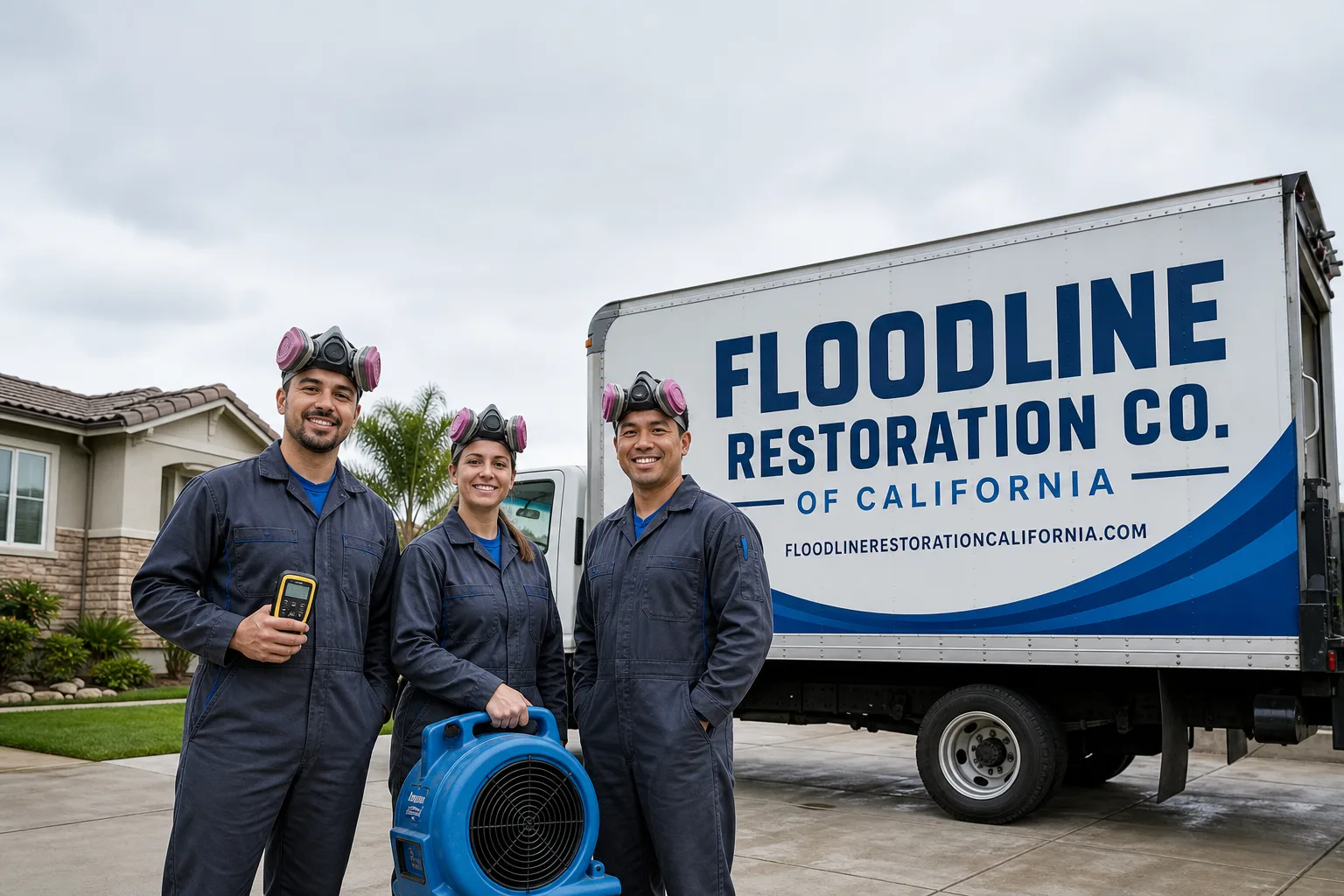
Fast, Reliable Storm & Disaster Restoration Across Glendale
Storm damage in Glendale rarely announces itself politely. A Santa Ana wind event can peel roofing off a Verdugo Woodlands home at 3 a.m., and by the time the rain follows, you’re dealing with water where it shouldn’t be. Most storm restoration jobs in Glendale run between $2,800 and $14,000 depending on scope, and the single most important call you make is the first one. Floodline Restoration Co. of California answers with a live dispatcher 24 hours a day, every day, and we can usually have a certified crew at your door within 60 to 90 minutes anywhere in Glendale. Call (888) 737-2439 and you’ll speak to a person, not a recording.
We’ve worked Glendale long enough to know that the Verdugo Mountains don’t just sit there looking scenic. They shape how wind, fire, and water move through this city. Our Storm & Disaster Restoration team knows which Chevy Chase Canyon streets flood first, which Adams Hill bungalows still carry original galvanized pipe, and which Montecito Park properties need a follow-up visit after the burn scar lets go. That local knowledge is the difference between a patch job and a restoration that holds.
Why Floodline Restoration Co. of California Is Glendale’s Preferred Storm & Disaster Restoration Company
Glendale homeowners tend to stay put. We meet people who have lived in the same Spanish Colonial Revival bungalow in Tropico for forty years, raised kids there, and have no intention of leaving. Those homeowners want a company that knows their house type, their street, and the particular way water behaves on a hillside lot above Foothill Boulevard. We’ve built our reputation in Glendale on that kind of familiarity.
Our technicians show up in uniform, background-checked, and certified to IICRC, RIA, and IFA standards. They carry Dri-Eaz extraction pumps, Phoenix axial fans, and the moisture-mapping equipment needed to prove the job is dry before we call it finished. When a Glendale customer calls about storm damage, we treat the clock seriously: a live dispatcher picks up at two in the morning, and the same crew that handles your emergency does the daily moisture readings, hands you the log, and rebuilds what needs rebuilding. No mid-job handoff to a subcontractor you’ve never met.
The strongest thing we can point to is the 90-Day Done Right Promise, what we call the Keystone Standard. It’s given in writing. If it’s not done right, we make it right. No paperwork battles, no arguing. Curt Bowman founded this company in 2010 around a dispatch board, not a sales desk, and that’s still how we run jobs in Glendale.
Our Storm & Disaster Restoration Services in Glendale
Emergency Board-Up
After a wind event tears a window out or a debris flow takes out a patio door, your Glendale home is open to weather, pests, and anyone walking by. We board up damaged openings the same day, using plywood cut to fit the opening and anchored without destroying the surrounding frame. In older Glendale homes with original wood sash windows, we’re careful to secure boards to the casing, not through the glass stops, so the repair later doesn’t become a full window replacement.
Roof Tarping
Santa Ana winds in Glendale don’t just scatter patio furniture. They lift shingles, tear off flashing, and drive embers into eaves. A properly installed tarp keeps rain out of the attic until a roofer can do the permanent repair. We use heavy-duty poly tarps secured with furring strips and cap nails, and we walk the roofline first to flag any soft decking that could give way underfoot. In hillside ZIP codes like 91207 and 91208, we also check for ember damage from the fire season that may have weakened sections months before the storm hit.
Storm Damage Cleanup
Storm cleanup in Glendale often means more than sweeping up leaves and branches. When a debris flow pushes mud past a garage door in Chevy Chase Canyon, that mud carries ash, bacteria, and whatever it picked up on the way downslope. We remove contaminated debris, extract standing water, pressure-wash surfaces, and set drying equipment with a moisture log updated daily until the dry standard is met. Our crews use Dri-Eaz and Phoenix equipment, the same professional-grade gear you’ll find on commercial restoration jobs.
Flood Damage Restoration
Rain-driven flooding in Glendale hits flatland neighborhoods and canyon properties differently. In central Glendale’s older apartment buildings, a single failed roof drain can send water through multiple units in one night. In the hills above Brand Park, mud-laden runoff comes through doors and windows fast. Either way, the first 48 hours matter most. We extract, dry, and document everything for your insurance carrier, with photo records and moisture readings the adjuster can actually use.
What happens when you call
- 1
A real person answersNo phone trees - you reach a local pro.
- 2
You get an upfront price rangeHonest numbers before anyone is dispatched.
- 3
A background-checked tech heads outLicensed & insured, dispatched right away.
- 4
You approve before work beginsNothing starts until you say go.
Trusted Brands We Service in Glendale
Floodline crews work with whatever your Glendale home has, but we see a lot of the common national equipment and materials on job sites across 91207, 91208, 91209, and 91210. We stock standard fasteners, sealants, and tarps sized for the typical Glendale roofline, and we can match most modern water heater and HVAC components without waiting on a special order. Our certification through the IICRC means we follow the industry standards your insurance company recognizes, and our RIA and IFA training keeps our technicians current on restoration methods that hold up under Southern California conditions.
Common Storm & Disaster Restoration Problems We See in Glendale Homes
- Galvanized supply lines failing in older bungalows. Glendale’s pre-WWII homes in Adams Hill and Tropico often still have original galvanized piping. The city’s moderately hard municipal water corrodes these lines from the inside, so a pinhole leak may have been running inside a wall for months before a storm makes it obvious. We flag these during storm restoration because they’re frequently misdiagnosed as storm-only damage.
- Debris flows overwhelming hillside drainage swales. After fire seasons strip vegetation from the Verdugo Mountains, even modest winter rain sends mud and ash downhill. Drainage swales that worked for decades suddenly can’t keep up, and mud forces past garage door seals into first-floor spaces. Crews that don’t know to flag burn-scar properties miss the follow-up visit entirely.
- Smoke penetration into HVAC ducting. Santa Ana winds drive embers into attic vents before suppression crews arrive, leaving char and smoke residue deep in ductwork. We regularly find this during unrelated water restoration work in Glendale homes that never had a visible fire.
- Foundation cracking along the Verdugo Fault. Storm water follows the path of least resistance, and in hillside neighborhoods that often means hairline cracks in foundations and chimneys. Adjusters from out of the area frequently miss these on initial inspections, which is why our photo documentation notes every crack we find before and after extraction.
Pricing for Storm & Disaster Restoration in Glendale, CA
We Also Serve Cities Near Glendale
Our crews work throughout the San Fernando Valley’s east side and into Los Angeles proper. Homeowners in Burbank, La Cañada Flintridge, Echo Park, and Silver Lake call us for the same reason Glendale does: a live person answers, and the crew shows up with the right equipment. If you’re in a neighboring community and dealing with storm damage, we cover Storm & Disaster Restoration in Glendale and the surrounding area with the same written promise on every job.
Serving Glendale, CA - Our Local Coverage Area
We’re based in the Glendale area and know this community well. Use the map below to see our service coverage - if you’re nearby, we can almost certainly help.
FAQs - Storm & Disaster Restoration in Glendale
After a wildfire in the Verdugo Mountains, why does our Glendale hillside home need a second restoration visit months later?
Because fire seasons in the Verdugo Mountains strip the hillside vegetation that holds soil in place, and when winter rains arrive, that loose soil becomes a debris flow. Your October call may be for smoke and soot remediation. Your January call is for mud under the garage door. A crew that doesn’t flag your property as a burn-scar risk will finish the first job and never schedule the follow-up, which is exactly the mistake we train our Glendale technicians to avoid. Call (888) 737-2439 and ask us to check your property’s burn-scar exposure before the next rain.
How do you handle heavy smoke penetration in HVAC systems after a Santa Ana-driven fire event in Chevy Chase Canyon?
We treat smoke penetration as a contamination problem, not a cosmetic one. That means scoping the ductwork with a camera, documenting what’s inside, and either cleaning the system to the IICRC standard or recommending replacement if the residue is too heavy to remove safely. In Chevy Chase Canyon, where Santa Ana winds drive embers into attic vents, we routinely find smoke residue deep enough that a simple filter change won’t touch it. Our report goes to your adjuster with photos, so the claim is handled on evidence, not argument.
Do older Glendale apartment buildings (1950s-1980s) really turn a single roof leak into a multi-unit claim?
Yes, and it happens faster than most owners expect. Glendale’s central and southern ZIP codes contain some of LA County’s densest concentrations of 1950s to 1980s multi-family stock. A roof drain failure on the top floor sends water down through ceiling cavities, wall chases, and electrical runs into the units below. What starts as one tenant’s wet ceiling becomes a building-wide drying and restoration scope with multiple insurance policies involved. We’ve handled enough of these in Glendale to know how to document each unit separately and coordinate with the building owner’s adjuster without leaving any unit’s claim under-supported.
Why do my adjuster’s photos miss the foundation cracks after a storm in the Verdugo Woodlands?
Because most adjusters photograph what’s visibly wet, not what the Verdugo Fault has been doing for decades. Hairline foundation cracks in hillside homes often open slightly after heavy rain, and they’re easy to miss under furniture, behind landscaping, or in a dim garage. Our technicians document every crack, chip, and separation with measurements and close-up photos dated to your storm event. That record goes to your carrier with our moisture log, so the adjuster isn’t relying on a wide-angle shot of a wet floor to understand the full scope. If you’re in the Verdugo Woodlands and suspect foundation movement, call (888) 737-2439 before you sign anything from your insurance company.
Can you board up our windows after a debris flow in Adams Hill without tearing out the original Spanish Colonial trim?
Yes. We anchor boards to the casing, not through the glass stops or into the original trim. In a neighborhood like Adams Hill, where the Spanish Colonial Revival trim is part of the house’s character and value, we treat that woodwork as something to preserve, not puncture. The board-up is temporary, but the damage a careless install does to original trim is permanent. We cut and fit each board on site, secure it against wind and entry, and leave the trim untouched for the permanent repair. Estimates for board-up and any debris removal are free. Call (888) 737-2439.