
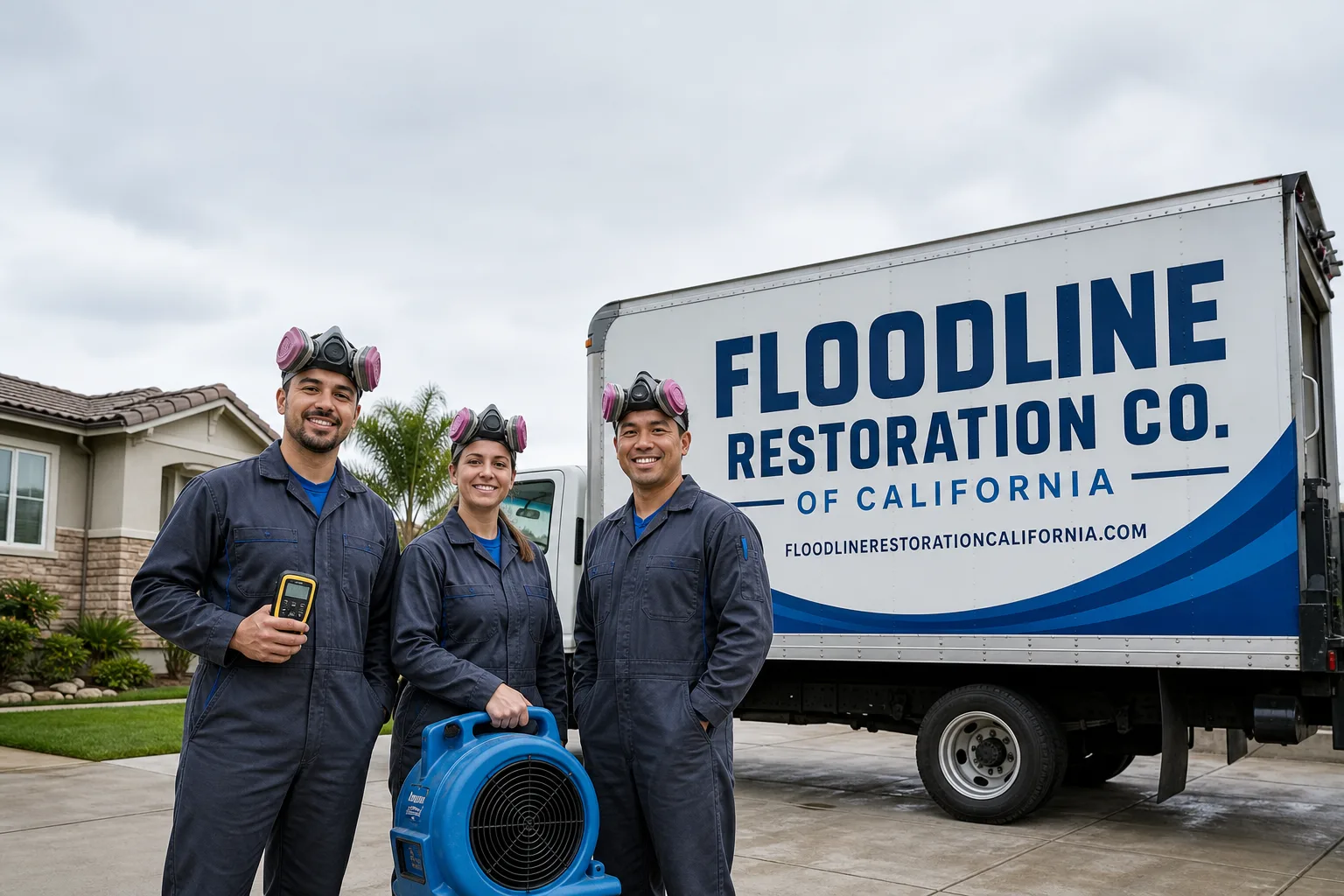
Fast, Reliable Mold Remediation Across Visitacion Valley
Mold remediation in Visitacion Valley typically costs $1,800-$4,500 for a contained removal job, with crawl space work running $2,500-$6,000 depending on square footage and whether structural drying is needed. We reach most Visitacion Valley homes within 60-90 minutes of your call, because our Bay Area dispatch is live around the clock and our crews know 94134 well. If you’ve noticed a musty smell that won’t go away, staining on stucco walls, or allergy symptoms that ease when you leave the house, call (888) 737-2439. We’ll send a certified technician to test, find the moisture source, and write the scope before any work starts.
Why Floodline Restoration Co. of California Is Visitacion Valley’s Preferred Mold Remediation Company
Visitacion Valley homeowners call us because we treat the cause and not just the stain. Our crews have pulled back flooring and opened walls in hundreds of 1940s-1960s stucco homes along Bayshore Boulevard, Sunnydale Avenue, and around the McLaren Park slope, and we know what this neighborhood’s houses do when water gets behind them. Curt Bowman founded Floodline Restoration Co. in 2010 around a dispatch board and a live person answering the phone, and that hasn’t changed. When you call at 2 a.m. with water pushing into a crawl space off Visitacion Avenue, a human picks up and a background-checked, uniformed crew starts moving toward you.
We don’t hand the job off. Our Mold Remediation technicians handle the moisture mapping, the containment, the removal, the drying, and the rebuild if framing or drywall has to come out. Every job carries the 90-Day Done Right Promise in writing: if it’s not done right, we make it right, no arguing. That’s the Keystone Standard, and it applies whether we’re treating a small bathroom ceiling near Schwerin Street or a full crawl space under a two-unit building near the Cow Palace. Visitacion Valley customers also get the Senior & Veteran 5% Discount, always, and $50 Off Any Repair Over $250. A square deal: no surprises on the bill.
Our techs are trained to IICRC, RIA, and IFA standards, and they show up with Dri-Eaz and Phoenix equipment that actually removes moisture rather than hiding it. Same crew, day one to done. We’ll be there when we say.
Our Mold Remediation Services in Visitacion Valley
Mold Inspection & Testing
Before any removal starts, we find out what you’re dealing with and where the water is coming from. In Visitacion Valley, that almost always means checking the crawl space first, because bowl topography pushes groundwater toward slab foundations from November through April. We run moisture meters across walls and floors, collect air and surface samples where needed, and give you a written report that maps the moisture and identifies the mold genus. You’ll know whether it’s a minor surface issue or a structural problem before a single containment zip wall goes up.
Mold Removal
Mold removal in Visitacion Valley homes often means working inside wall cavities of 1950s stucco construction, where old mineral wool insulation has been wicking moisture for months or years. We contain the affected area under negative air pressure, cut out contaminated drywall and insulation, treat the framing with an EPA-registered antimicrobial, and dry the structure to the IICRC dry standard before any rebuild. Contaminated material goes out through sealed bags and disposed of per San Francisco building code. You get daily moisture readings, and so does your insurer if a claim is open.
Black Mold Remediation
Stachybotrys, the mold people call black mold, needs constant moisture to survive. In Visitacion Valley, it usually means a slow hidden leak from a galvanized supply line behind a wall, or persistent crawl space humidity from hillside runoff. We treat it with full containment and HEPA air scrubbing, not a spray bottle. The framing gets treated after the moisture source is corrected, because treating black mold while the pipe still leaks is just a countdown to the next bloom. If your home is one of the legacy units near the Sunnydale-Velasco Hope SF redevelopment, we also check shared drainage lines, because what happens on the next lot moves groundwater under your slab.
Air Quality Restoration
Once the mold is gone and the framing is dry, you should be able to breathe the house and not think about it. Our air quality restoration process uses HEPA-filtered negative air machines and air scrubbers to pull mold spores and fine particulates out of the living space. In Visitacion Valley’s tightly built 1950s stucco boxes, that matters: there’s little natural air exchange, so spores hang around. We test airborne spore counts before and after, and we don’t clear a containment zone until the counts read normal for your home’s baseline. This is one of the final steps before we hand you the moisture log and the Done Right paperwork.
Crawl Space Treatment
If your Visitacion Valley home sits low on the valley floor, your crawl space is probably the source of the musty smell upstairs. We see it constantly along Rutland Street and the blocks between Visitacion Avenue and Bayshore. Hillside runoff from McLaren Park concentrates groundwater against slab foundations, saturating soil and wicking moisture up through footings. We contain and dehumidify with Dri-Eaz LGR units, remove mold-contaminated insulation, and install a 20-mil vapor barrier across the dirt floor. We’ll also recommend and install crawl space ventilation corrections if the existing vents sit below grade or are blocked. A dry crawl space is the difference between treating mold once and treating it every rainy season.
Moisture & Humidity Control
The goal isn’t just killing mold; it’s making the house unable to grow it again. In Visitacion Valley, that means addressing three things at once: the hillside moisture pushing in from below, the galvanized pipes failing from within, and the parapet roof flashing letting rain into wall cavities from above. We install dehumidification where crawl spaces hold humidity, seal leak points in stucco exteriors, and document every correction in your moisture log. When we’re done, you’ll have a dry standard reading and a record that shows your insurer or a future buyer exactly what was done.
What happens when you call
- 1
A real person answersNo phone trees - you reach a local pro.
- 2
You get an upfront price rangeHonest numbers before anyone is dispatched.
- 3
A background-checked tech heads outLicensed & insured, dispatched right away.
- 4
You approve before work beginsNothing starts until you say go.
Trusted Brands We Service in Visitacion Valley
Our Visitacion Valley customers run all makes and ages of homes, and our crews handle every configuration we’ve found in 94134: 1940s stucco bungalows, 1960s two-units, and the mid-century public housing stock near the Sunnydale-Velasco site. We don’t carry a warehouse of one-size equipment and force it onto a job. We stage Dri-Eaz and Phoenix drying systems appropriate to the footprint of your house, and we keep a full range of HEPA air scrubbers and negative air machines ready for the tight closets and undersized crawl spaces that show up in this neighborhood’s older construction. If your house predates the current code, we’ll tell you, in writing, what needs to happen before drywall goes back on.
Common Mold Remediation Problems We See in Visitacion Valley Homes
- Hillside groundwater pushing into slab foundations. Visitacion Valley sits in a bowl, and stormwater draining off McLaren Park’s hillsides concentrates around Bayshore and the lower streets. That water doesn’t run down the street; it pushes laterally into soil and then up through slab cracks and footings, saturating crawl space soil from roughly November through April.
- Corroded galvanized supply lines inside walls. The 1940s-1960s homes that dominate Visitacion Valley were plumbed with galvanized steel, and San Francisco’s moderately hard water has been eating at those pipes for sixty years. A pinhole leak behind a kitchen wall can wet the drywall for months before anyone sees a stain, and by then the studs are growing mold.
- Step-flashing failures at stucco parapet walls. Many Visitacion Valley roofs carry aging composition shingles with old step flashing where the roof meets the characteristic flat stucco parapet. When that flashing dies, winter rain enters the wall cavity directly, and mold appears on interior ceilings weeks later. If you only clean the ceiling, the next storm brings it back.
- Contractors who treat the wall and skip the crawl space. We see it constantly: a previous company removes visible mold around a window or in a closet, but never looks under the house. In Visitacion Valley, the crawl space is almost always part of the problem, and if it’s not dried and sealed, the mold re-humidifies and spreads back into the framing within weeks.
Pricing for Mold Remediation in Visitacion Valley, CA
We Also Serve Cities Near Visitacion Valley
Our crews regularly run mold jobs in the neighborhoods and cities around Visitacion Valley, including Visitacion Valley, Mission District, Noe Valley, Daly City, and San Francisco proper. If you own a home on the boundary between Visitacion Valley and Daly City, or a condo near the Mission District line, we’re already nearby. Same live dispatch, same crew, same Done Right Promise.
Serving Visitacion Valley, CA - Our Local Coverage Area
We’re based in the Visitacion Valley area and know this community well. Use the map below to see our service coverage - if you’re nearby, we can almost certainly help.
FAQs - Mold Remediation in Visitacion Valley
Why does mold keep returning in my Visitacion Valley crawl space even after I’ve cleaned it?
Because the moisture source hasn’t been stopped. In Visitacion Valley, the crawl space doesn’t just get wet from a leak; it gets wet from hillside runoff and groundwater pressure from McLaren Park’s slopes, which builds against slab foundations from November through April. If a contractor sprays the visible mold but doesn’t install a vapor barrier, dry the soil, and correct drainage, the crawl space re-humidifies within weeks and the mold colony restarts. A proper crawl space treatment in 94134 includes dehumidification to the dry standard, vapor barrier installation, and drainage correction, then the antifungal treatment. Call (888) 737-2439 and we’ll inspect the crawl space and show you the moisture readings.
How can I tell if the mold in my 1950s Visitacion Valley stucco home is from a hidden plumbing leak?
Look at where the staining is and whether it grows after rain or regardless of weather. If mold recurs in the same interior wall during dry months, or you hear a faint hiss behind a wall, or your water bill edges up unexplained, the odds are high it’s a galvanized supply line pinhole leak inside the wall cavity. Mold from a roof flashing failure follows storms; mold from a plumbing leak doesn’t care about the season. We can cut a small inspection hole, run a borescope, and moisture-meter the wall cavity to confirm before we open the wall. That’s the difference between a $2,000 fix and a $5,000 one, and we’ll show you the evidence.
Do I need a permit for mold remediation in Visitacion Valley?
In most cases, no. Mold remediation itself, including containment, removal, antimicrobial treatment, and drying, does not require a city permit in Visitacion Valley. However, if we’re cutting out and replacing structural framing, moving plumbing, or altering the building envelope, San Francisco’s Department of Building Inspection may require a permit. We pull permits when needed and coordinate with the City. If you own a unit near the Sunnydale-Velasco Hope SF redevelopment, some shared-wall work may trigger additional review, and we’ll handle that too. You’ll know before work starts exactly what’s permitted and what isn’t.
What is the best way to prevent mold in a Visitacion Valley home with a crawl space during the rainy season?
Control the water before it gets under the house. Install a 20-mil vapor barrier over the crawl space soil, make sure gutters and downspouts discharge at least six feet from the foundation, and grade soil away from the slab. In Visitacion Valley’s bowl topography, water runs toward you from the McLaren Park slopes, so perimeter drainage matters more here than in higher-ground neighborhoods. We also recommend a crawl space dehumidifier set to maintain 50% or lower relative humidity, and annual checks on galvanized supply lines that may be nearing end of life. We can set this up and log the readings for you. Call (888) 737-2439 and we’ll do a walkthrough with a moisture meter before the rains start.
Can mold testing identify if my home’s mold is from the nearby construction at Sunnydale-Velasco Hope SF?
Mold testing can identify the mold genus and spore concentration, and combined with a moisture map and a walkthrough, it can often point to whether the water source is coming from your own property or a shared drainage failure from the adjacent redevelopment. If your crawl space is wet and your neighbor’s is dry, and the water seems to track from the direction of active construction, that’s a pattern our techs can document. We provide photo-documented findings and a written report suitable for handing to your insurer or the construction project manager. We don’t argue with anyone; we document and hand you the evidence. Phone (888) 737-2439 and we’ll schedule the inspection.
Get Mold Out of Your Visitacion Valley Home
You’ve likely lived in Visitacion Valley long enough to know how the rainy season works here. The water comes down the slopes, the ground swells, and the crawl space smells. Don’t wait until the drywall gets soft or the grandkids start wheezing in the back bedroom. Call Floodline Restoration Co. at (888) 737-2439. A live person answers, day or night, and we’ll get a certified technician to your door with a moisture meter, a scope, and a written quote. You get a real plan and a real price before any work starts. And when it’s done, it’s done right, backed in writing by the 90-Day Done Right Promise.
Written by Curt Bowman, Owner at Floodline Restoration Co. of California, serving Visitacion Valley and the wider Bay Area with mold remediation, water damage restoration, and full reconstruction.