
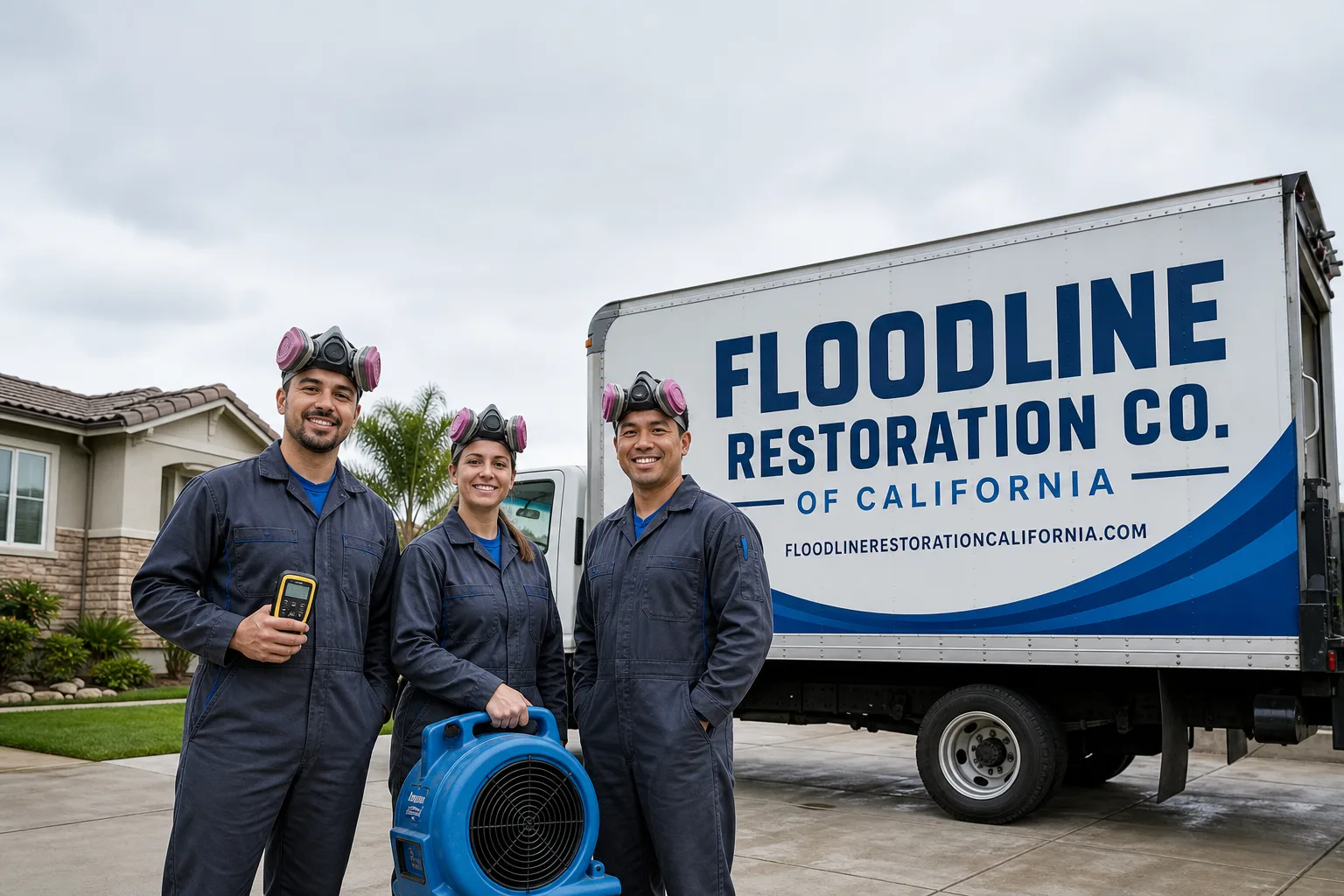
Fast, Reliable Mold Remediation Across Lawndale
Mold remediation in Lawndale costs between $1,800 and $6,500 for most residential jobs, depending on how far the growth has spread through wall cavities and whether neighboring units are involved. In the 1960s-era apartment buildings that dominate this city, a slow leak inside one unit’s wall routinely wicks into two or three adjacent units before anyone sees visible mold. Our crews work across Lawndale every day, from the duplexes along Hawthorne Boulevard to the triplexes near Prairie Avenue. Call (888) 737-2439 and a live dispatcher picks up, any hour, any day.
Why Floodline Restoration Co. of California Is Lawndale’s Preferred Mold Remediation Company
Lawndale homeowners tend to stay put. We meet people who have lived in the same stucco house for thirty years, raised kids there, and plan to stay another thirty. They do not want a sales pitch. They want someone who understands that a 1962 triplex on a 5,000-square-foot lot behaves very differently than a single-family home in El Segundo. Our Mold Remediation teams know what lives inside these walls because we have opened them, mapped them, and dried them for more than a decade.
Every technician who steps onto a Lawndale property is background-checked, uniformed, and trained to IICRC, RIA, and IFA standards. We run Dri-Eaz and Phoenix equipment that fits through the narrow alley-load doors and tight stair landings this housing stock throws at us. And when we finish, the homeowner gets the 90-Day Done Right Promise in writing. No arguing. If it is not done right, we make it right.
Our Mold Remediation Services in Lawndale
Mold Inspection & Testing
Mold in Lawndale rarely announces itself with a big black patch on the living room wall. It hides in the stud bays of party walls, behind baseboards, under stair stringers. Our inspection starts with a moisture map of the entire structure, not just the unit where someone smelled must. We pull air samples, swab suspect surfaces, and compare indoor spore counts against the outside baseline on that specific Lawndale block. Then we hand you a written scope: what we found, where it is, what we will do about it.
Mold Removal
Once testing confirms colonization, removal begins with containment. In Lawndale’s compact apartments, that means plastic barriers run tight against hallways and doorframes so spores do not drift into a neighbor’s kitchen. We remove affected drywall and insulation, HEPA-vacuum every exposed stud bay, and bag debris before it ever leaves the containment zone. The goal is simple: remove the mold, not just hide it.
Black Mold Remediation
Stachybotrys and other toxigenic molds grow where moisture has persisted for weeks, not days. In Lawndale’s marine-layer climate, that includes the back side of drywall, inside vinyl wallpaper, and under cabinets that sit against uninsulated exterior stucco. We treat every black mold job as a full containment project with negative air pressure, HEPA filtration at the source, and clearance air testing before we pull the barriers down. The safety of the people living in the home comes before speed. Always.
Air Quality Restoration
After the physical mold is gone, the air has to prove it. We run HEPA air scrubbers during the entire remediation and follow with post-remediation verification sampling. In Lawndale apartments where shared HVAC chases and unsealed wall penetrations allow cross-unit air movement, we check the air in adjacent units too. The tenant next door breathes the same building, so their air matters as much as yours.
Moisture & Humidity Control
Lawndale sits inside the persistent marine fog belt, roughly three miles from the Pacific. Even during Southern California’s dry season, ambient humidity here runs higher than Gardena or Torrance. That means passive drying does not work. We set aggressive dehumidification targets, log daily moisture readings with a moisture map on day one, and keep running equipment until every cavity drops below the dry standard. The homeowner and their carrier get the full log.
Crawl Space Treatment
Many Lawndale single-family homes built between 1950 and 1975 sit over shallow crawl spaces with original earth floors and zero vapor barrier. Damp soil means damp joists. Damp joists mean mold. We lay Class 1 vapor barriers, seal foundation vents where appropriate, and treat affected framing with antimicrobial coatings after drying the space down. If the crawl space stays wet, the house above it never really dries out.
What happens when you call
- 1
A real person answersNo phone trees - you reach a local pro.
- 2
You get an upfront price rangeHonest numbers before anyone is dispatched.
- 3
A background-checked tech heads outLicensed & insured, dispatched right away.
- 4
You approve before work beginsNothing starts until you say go.
Common Mold Remediation Problems We See in Lawndale Homes
- Party-wall migration. In Lawndale’s 1960s-era apartment buildings, stucco party walls were often built without modern fire or moisture separation. A supply-line failure inside one unit’s wall can wick laterally into two or three neighboring units undetected. Technicians here routinely find the affected area on a moisture map extends far beyond the unit where the loss was reported.
- Passive drying failures. The marine layer that rolls off the Pacific keeps Lawndale’s ambient humidity chronically elevated, even during dry season. Remediation crews that rely on passive drying leave hidden cavities above mold-growth thresholds. Regrowth shows up within weeks.
- Oversized equipment in tight spaces. 1960s apartments in Lawndale have narrow doors, alley-load access, and stair landings built for compact furniture, not restoration equipment. Crews that do not plan for this leave damp pockets behind kitchen cabinets and under stairs because they could not physically place a dehumidifier there.
- Galvanized pipe failures. Lawndale’s dense postwar housing stock retains much of its original galvanized plumbing. These pipes corrode from the inside out, fail slowly, and leak inside walls for weeks before anyone notices. By the time a stain appears, mold has usually colonized the cavity.
Pricing for Mold Remediation in Lawndale, CA
We Also Serve Cities Near Lawndale
Our crews cover the full South Bay from Lawndale outward, including Marina del Rey, Hawthorne, Del Aire, and Alondra Park. The same live dispatch, the same equipment, the same written guarantee.
Serving Lawndale, CA - Our Local Coverage Area
We’re based in the Lawndale area and know this community well. Use the map below to see our service coverage - if you’re nearby, we can almost certainly help.
FAQs - Mold Remediation in Lawndale
Lawndale sits roughly three miles from the Pacific inside the persistent marine fog belt, so ambient relative humidity stays elevated year-round. In practice, that means mold can become established inside a wall cavity within 48 to 72 hours of a water event, and passive drying almost never works. Restoration here requires aggressive mechanical dehumidification, even for losses that might dry passively in Gardena or Torrance. If you suspect mold, call (888) 737-2439 for an inspection and moisture map before the problem spreads.
Stucco party walls in Lawndale’s 1960s apartments were built without modern fire or moisture separation, which means water and mold do not stop at the property line between units. A leak inside one unit’s wall wicks laterally through shared stud bays into closets, baseboards, and cavities in adjacent units. Our moisture maps routinely extend two or three units beyond the one where the loss was reported. Treating only the original unit leaves hidden mold behind the neighbor’s wall.
Yes. Original galvanized supply lines in Lawndale’s 1950s-1970s housing corrode from the inside out, dripping for weeks inside a wall cavity before any stain reaches the finished surface. By the time you see discoloration, the cavity has usually been wet long enough for full mold colonization. We remediated a triplex on Manhattan Beach Boulevard near Prairie Avenue where exactly this happened: a second-floor bathroom leak had wicked invisibly through the party wall into neighboring units’ closets before anyone saw a drop of water.
We plan equipment placement around the access constraints before we start. Lawndale’s old alley-load buildings have narrow doors, single entrances, and no staging area. Our crews use compact Injectidry wall-drying systems inside tight stud bays and smaller Phoenix dehumidifiers that fit through narrow doorframes and into hallways. We coordinate unit access and parking with the property owner ahead of time, and we run equipment quietly enough to keep tenants in place during the work.
The remediation stops being a single-unit project and becomes a multi-unit restoration project. We map the full extent first, contain every affected area, and treat all cavities where the moisture log shows elevated readings. We also notify and coordinate with the adjacent unit owners or the property manager, because their air quality is affected too. The carrier is billed directly for the full documented scope, and every affected unit gets our 90-Day Done Right Promise in writing. Call (888) 737-2439 to get a crew on site today.
Written by Curt Bowman, Owner at Floodline Restoration Co. of California, serving Lawndale and the South Bay with IICRC-certified mold remediation and full-cycle restoration. Our crews coordinate from the brand’s Los Angeles office and serve Lawndale locally, with live dispatch 24 hours a day, every day.