
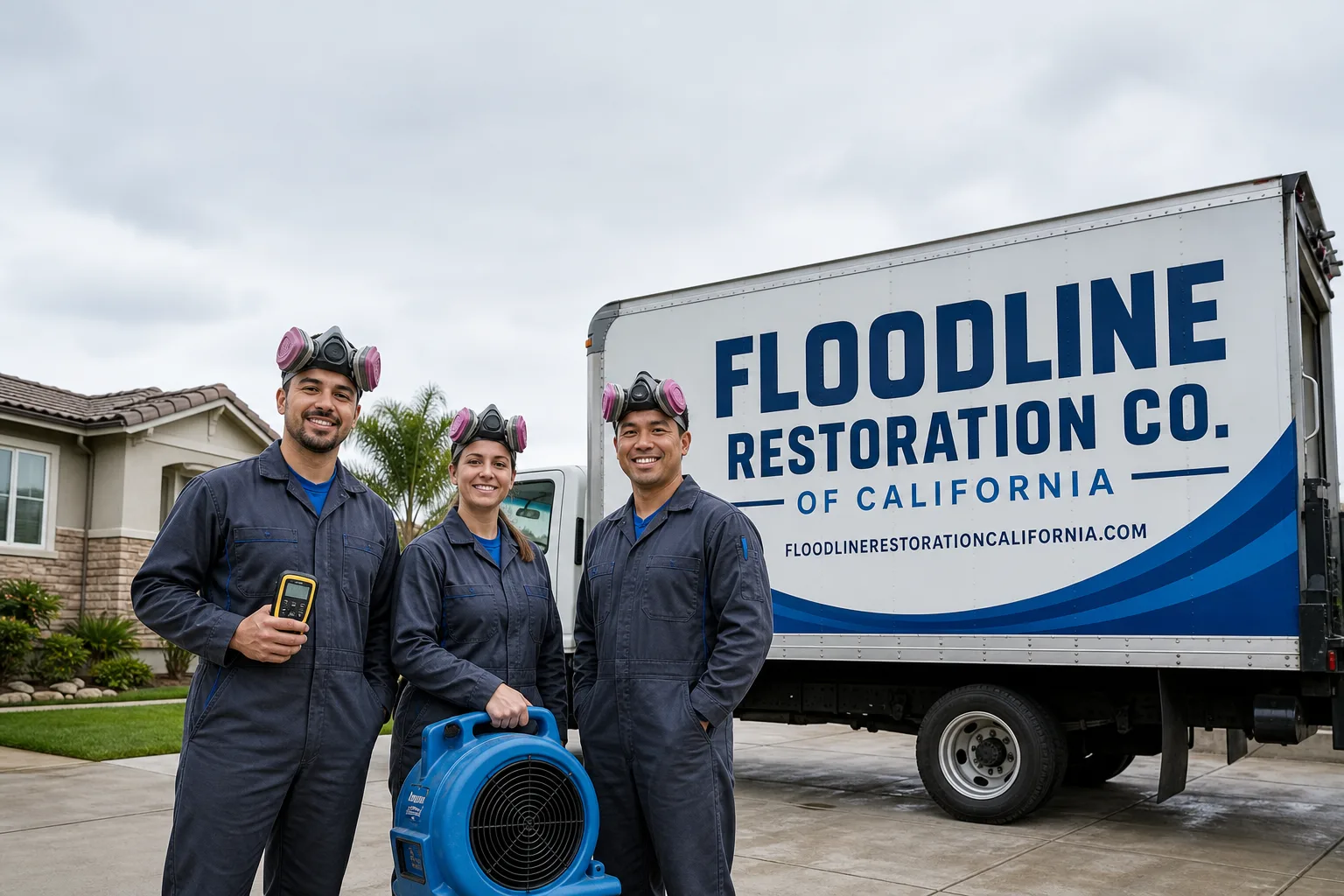
Fast, Reliable Mold Remediation Across Dinuba
Mold remediation in Dinuba costs between $1,800 and $6,500 for a typical single-room project, with whole-home jobs running $8,000 to $25,000 depending on how far spores have traveled. Most jobs in the 93618 zip code are completed within 3 to 5 days once containment is set. We’re Floodline Restoration Co. of California, and we’ve been cutting mold out of Central Valley homes long enough to know that in Dinuba the problem is rarely just the mold. It’s the irrigation seep, the subsidence crack behind the baseboard, and the fog-season moisture that never really left the wall cavity in the first place. Call (888) 737-2439 and a live dispatcher will answer, day or night.
Why Floodline Restoration Co. of California Is Dinuba’s Preferred Mold Remediation Company
We run a dispatch board, not a sales desk. That’s been true since Curt Bowman founded the company in 2010, and it means when you call about mold in a Dinuba home, you talk to someone whose only job is getting a certified crew to your door. Our technicians are background-checked, uniformed, and certified to IICRC, RIA, and IFA standards. They don’t upsell. They write a scope of work, walk you through it, and get your signature before anything starts.
Dinuba homeowners deal with a specific set of problems: irrigation canals that raise the water table every spring, slab foundations that have shifted for decades from groundwater pumping, and 1940s wood-frame walls with no insulation and no vapor barrier. A contractor who doesn’t know those conditions will treat the surface mold and miss what’s feeding it. We know to check the crawl space first in this town. We know to map the subsidence cracks before we touch the drywall. And we’ve done it enough times that our 90-Day Done Right Promise means something here. If it’s not done right, we make it right – in writing, no arguing. That’s the Keystone Standard, and it applies to every mold job we take in Dinuba.
Crews reach most Dinuba addresses within 60 to 90 minutes of your call. That includes neighborhoods from the older grid near East El Monte Way out to the newer developments south of town. The same crew that shows up with the moisture map on day one handles the daily readings until the dry standard is met, hands you and your insurance carrier the log, and leaves you with a written scope and a signed guarantee.
Our Mold Remediation Services in Dinuba
Mold Inspection & Testing
A proper inspection in Dinuba starts with the subsidence question. Before we sample for mold, we document pre-existing foundation cracks and slab settling so we can separate chronic structural movement from water-event damage. That matters because Tulare County sits on some of the most severely land-subsidence-affected ground in the United States. Your foundation has likely moved. The mold you see may be riding on moisture that entered through a crack that opened ten years ago, not last month. Air and surface samples tell us which species we’re dealing with, and we send them to an independent lab. A typical mold inspection in Dinuba runs $350 to $600.
Mold Removal
We remove mold; we don’t just spray it. That means physical removal of contaminated drywall, insulation, and trim under containment, HEPA vacuuming of every surface in the affected room, and disposal in sealed bags that leave your property. In Dinuba, where so many homes are built on piers or thin slabs over clay soil, we check the crawl space beneath every job before we close the walls. A single-room mold removal in Dinuba typically runs $1,500 to $4,000. If the mold has migrated into wall cavities or the subfloor, expect $4,500 to $8,500. Every job gets photo documentation your insurance carrier can actually use.
Black Mold Remediation
The phrase “black mold” gets thrown around a lot. What matters is whether the mold is toxigenic, and that requires testing. We treat every Dinuba black mold job with full containment, negative air pressure, and an EPA-registered antimicrobial applied after the physical removal is done. Black mold remediation in Dinuba runs $2,500 to $9,000 depending on whether it’s isolated to one wall or has spread through the HVAC system. We don’t rush this work. In a 1950s home with original ducting, hidden mold in the plenum is common, and missing it means a callback in November when the fog settles in.
Air Quality Restoration
After the mold is gone, the air in your home still carries spores that settled on surfaces we didn’t remove. That’s why every Dinuba job ends with HEPA air scrubbing and a post-remediation verification test. For homes near the agricultural canals east of town, we often recommend a dehumidifier sized to the crawl space, because the soil beneath your house stays wet long after the field irrigation stops in October. Air quality restoration as a standalone service in Dinuba runs $600 to $1,400.
What happens when you call
- 1
A real person answersNo phone trees - you reach a local pro.
- 2
You get an upfront price rangeHonest numbers before anyone is dispatched.
- 3
A background-checked tech heads outLicensed & insured, dispatched right away.
- 4
You approve before work beginsNothing starts until you say go.
Trusted Brands We Service in Dinuba
We stock parts and filters for the systems Dinuba homeowners actually have in their homes, and we service equipment from across the restoration industry. Our crews run Dri-Eaz and Phoenix dehumidifiers and air movers, and our moisture mapping and drying protocols are written to the standards our RIA and IFA certifications require. What that means for you is faster turnaround on parts, fewer scheduling delays, and a crew that shows up with the right equipment for a 1940s wall cavity the first time. We don’t guess, and we don’t send a rookie with a rental machine to solve a problem a veteran tech would have caught at the walkthrough.
Common Mold Remediation Problems We See in Dinuba Homes
- Irrigation season mold cycles. Field irrigation water deliveries ramp up sharply in spring, and the water table under Dinuba rises with them. Homes with pier-and-beam foundations wick that moisture up through the soil, into the floor joists, and into wall cavities. We see the same houses take on water on roughly the same agricultural calendar every year.
- Subsidence cracks behind the mold. Most Dinuba homes sit on ground that has been sinking for decades from groundwater pumping. The cracks in your slab or foundation aren’t a cosmetic issue; they’re the highway moisture travels into your walls. Remediating visible mold without addressing the crack means the mold returns. We document and seal these cracks as part of the job.
- Uninsulated 1940s and 1950s wall cavities. Many Dinuba homes were built to house agricultural workers with minimal insulation. A wall with no insulation dries slowly, and any residual moisture left after a September remediation turns into hidden mold by November when Tule fog keeps humidity near saturation for weeks. Jobs done before the fog season require aggressive desiccant drying, not standard air movers.
- Tight, alley-load access. A lot of Dinuba homes are accessed from alleys with clearances too narrow for standard equipment trailers. We run compact desiccant units and portable containment that fit through 30-inch doors. If your neighbor’s contractor told you the house is “too hard to access,” call us. We do it every week.
Pricing for Mold Remediation in Dinuba, CA
We Also Serve Cities Near Dinuba
Floodline Restoration Co. of California runs crews to Reedley, Cutler, Orosi, and Orange Cove on the same dispatch rotation as Dinuba. If you’re a homeowner in one of those towns dealing with mold, water, or fire damage, our Mold Remediation team covers the full service area. For specifics on mold in this agricultural belt, read more about Mold Remediation in Dinuba and how we handle subsidence and irrigation-related moisture.
Serving Dinuba, CA - Our Local Coverage Area
We’re based in the Dinuba area and know this community well. Use the map below to see our service coverage - if you’re nearby, we can almost certainly help.
FAQs - Mold Remediation in Dinuba
Why do Dinuba homes get mold in fall even when there’s no plumbing leak?
Most fall mold in Dinuba comes from residual moisture trapped in uninsulated walls during September and October, when warm days dry the exterior but Tule fog keeps humidity high, followed by the irrigation cycle shutting off and shifting soil moisture patterns. If a home wasn’t fully dried before November, those hidden wall pockets bloom. The fix is aggressive desiccant drying before the fog season locks moisture in – and that’s exactly what our Phoenix and Dri-Eaz equipment is built for. Call (888) 737-2439 if you see condensation on windows in October.
How does land subsidence affect mold remediation in Dinuba?
Land subsidence in Dinuba means your foundation has likely moved, opening cracks that let groundwater and irrigation seep into wall cavities and crawl spaces. We document every pre-existing crack before remediation so we can separate chronic structural movement from water-event damage. If we don’t address those cracks, the mold you paid to remove comes back when the ground shifts again next harvest season.
Do we need special equipment for mold removal in alley-load or tight-lot homes?
Yes, and we already run it. Many Dinuba homes are accessed from alleys with clearances too narrow for standard trailers. We use compact desiccant units and portable containment setups designed to fit through 30-inch doors and tight gate clearances. You don’t need to clear a path for a full-size truck; we’ll stage equipment in the alley and run hoses where they need to go.
Why does mold keep returning in my crawl space after a previous remediation?
Because the moisture source was never cut. In Dinuba, the most common source is irrigation water wicking up through clay soil into pier-and-beam crawl spaces. A previous contractor may have treated the visible mold but never installed a vapor barrier or addressed the drainage issue that keeps the soil wet from March through October. We install crawl space vapor barriers and antimicrobial treatments as the last step, not an add-on.
What’s the fastest way to get mold testing during the harvest season?
Call (888) 737-2439 and tell the dispatcher you need testing in Dinuba. We keep crews on rotation through harvest season specifically because field irrigation ramps up in spring and shuts off in October, and that calendar drives a spike in mold-related calls. Same-week testing is available, and if you’re in a moisture emergency, a certified tech can be at your door within 90 minutes.
Mold in a Dinuba home never gets better by waiting. Call (888) 737-2439 for a free estimate. A live person answers, day or night.
Written by Curt Bowman, Owner at Floodline Restoration Co. of California, serving Dinuba and the Central Valley since 2010.