
Water Damage Restoration What It Really Costs: What San Diego Homeowners Pay in 2026
Most San Diego water damage restoration jobs run between $3,500 and $11,000 in 2026, with the final number driven by water source, square footage, and how many hours passed before extraction started. A clean Category 1 supply-line leak caught in the first day might cost under $2,500. A Category 3 sewage backup that sat over a weekend under a slab-built 1960s ranch house can push past $20,000 once demolition and rebuild enter the picture. The national average figure you see online, roughly $3,000 to $7,000, is nearly useless for a San Diego homeowner dealing with a wet subfloor under saltillo tile and no crawl space to inspect.
If you’d rather not sort through line items on a damage estimate at two in the morning, call (888) 737-2439 and we’ll walk you through it. That’s what we do at Floodline Restoration Co. of California home.
Key Takeaways
- Most San Diego water damage restoration jobs run $3,500 to $11,000, with sewage and long-standing leaks pushing higher.
- Every 24 hours before extraction roughly doubles the cost of drying and demolition, with a hard 48-hour window before mold becomes a real factor.
- San Diego slab foundations and Spanish tile construction add drying time and cost that national averages never capture.
- California carriers in 2026 typically cover sudden and accidental damage, but they push back on slow leaks, lack of maintenance records, and mold that developed over time.
- Direct insurance billing by one restoration company keeps scope gaps from appearing between the mitigation crew and the rebuild crew.
What Each Phase of Water Damage Restoration Actually Costs in San Diego
Here’s where most homeowners get lost: an estimate isn’t one number. It’s a stack of line items that follow the order of the work. And the order matters, because each phase depends on the one before it. A San Diego restoration estimate in 2026 typically breaks down like this:
- Extraction and water removal: $500 to $1,800 for a standard room, more if water has pooled under flooring or soaked into wall cavities. This is the 24/7 emergency call item.
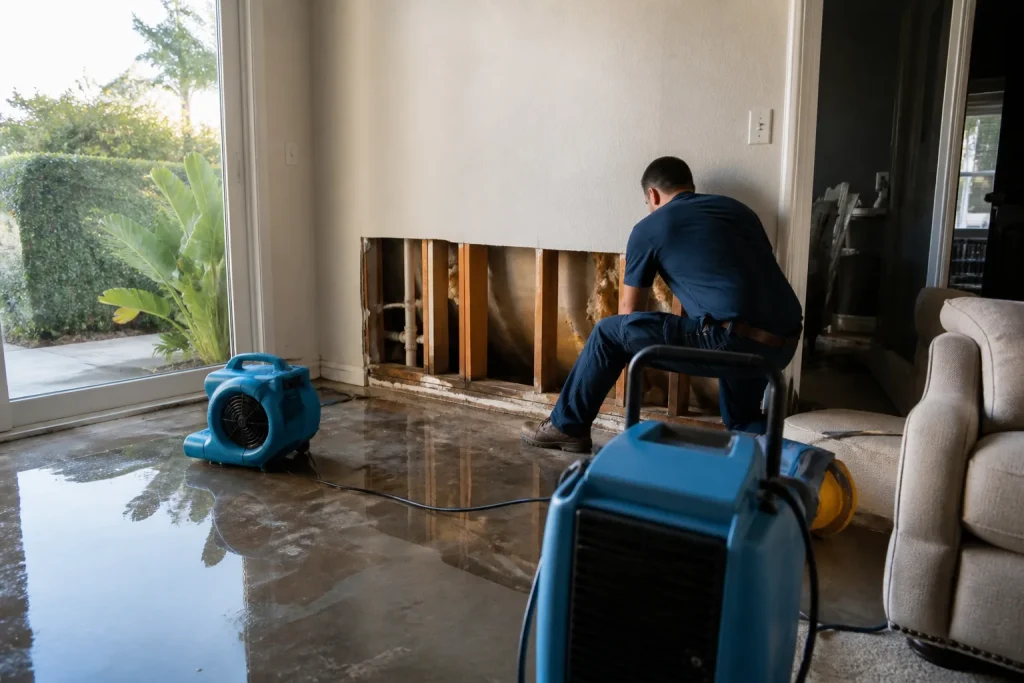
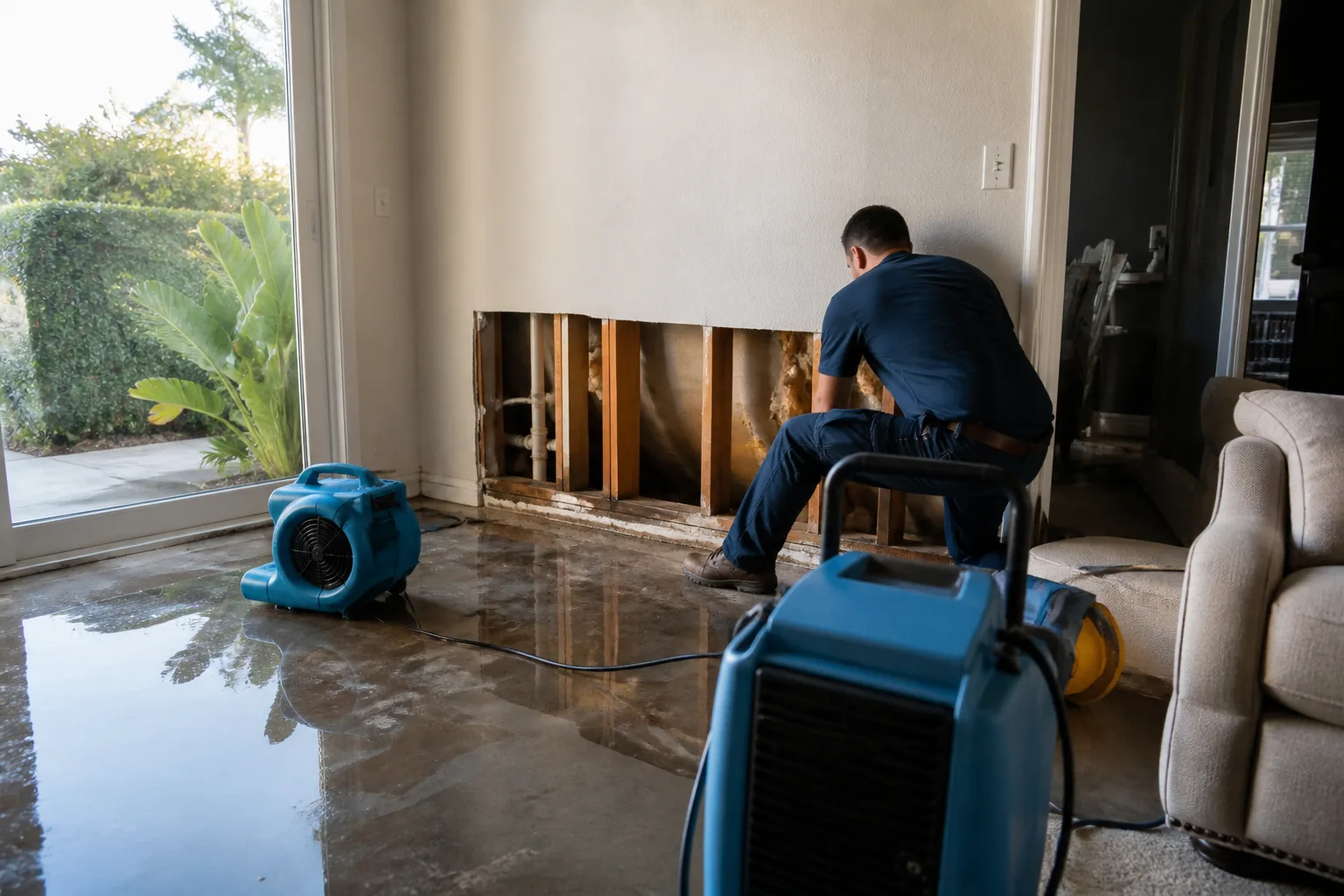
- Drying equipment rental and monitoring: $30 to $75 per day per air mover or dehumidifier, with most San Diego jobs running 3 to 7 days. A 1,200-square-foot scene typically needs 8 to 14 pieces of equipment. Daily moisture readings log progress until the dry standard is met.
- Antimicrobial and sanitizing treatment: $300 to $900 depending on square footage and water category. Category 2 and 3 water always require this; Category 1 often doesn’t.
- Demolition and debris removal: $1,000 to $4,000 for drywall cut 2 feet up from the flood line, baseboards pulled, and flooring removed. Saltillo tile demolition in San Diego runs high because it comes up in pieces and the thinset underneath has to be ground off the slab.
- Rebuild and finish work: $3,000 to $15,000 depending on what was removed. Drywall, texture matching, paint, baseboards, and flooring replacement all fall here. This is the phase competitors hand off to another company, and it’s where scope gaps appear.
We pulled a kitchen in Clairemont last month where the homeowner had a bid from a mitigation-only crew for $4,800. What the bid did not include was the 220 square feet of wet drywall cut and replaced, the saltillo tile that had to come up to dry the slab, or the HOA requirement for a licensed contractor sign-off on the shared wall. The honest number was $11,400. A good estimate reads like a map of the whole job, not the first leg of it.
How Elapsed Time Multiplies the Cost
The single biggest cost variable in San Diego water damage restoration isn’t the size of the leak. It’s the gap between the moment water hit the floor and the moment extraction equipment started running. Here’s how that plays out in real numbers:
- Under 24 hours: Category 1 water, no saturation of drywall or flooring, most jobs dry in place. Cost stays in the extraction-and-dry range: $1,800 to $4,500.
- 24 to 48 hours: Drywall wicks water up from the baseplate. Baseboards delaminate, laminate flooring swells, and water reaches the slab. Demolition now enters the estimate. Typical range: $4,500 to $8,000.
- 48 hours to 1 week: Mold growth becomes a documented risk, not a hypothetical. Antimicrobial treatment shifts from optional to required. Carriers begin asking why mitigation was delayed. Costs jump by 40 to 70 percent because demolition now extends to wall cavities and possibly flooring.
- Over a week: The job stops being water mitigation and starts being mold remediation plus rebuild. You’re no longer looking at a restoration estimate; the scope now includes Mold Remediation in San Diego costs, which San Diego carriers scrutinize line by line, often pushing back on anything that resembles a pre-existing condition.
We’ve seen the same leak in two different San Diego houses cost $3,200 in one and $14,000 in the other. The difference was nine days and one hope that the carpet would dry on its own.
San Diego-Specific Cost Factors the National Averages Ignore
San Diego construction does not look like the houses in national restoration pricing databases. Here’s what actually changes the math in this market.
Slab-on-grade foundations. A house without a crawl space means water that reaches the floor has nowhere to go except up into drywall or sideways under flooring. You can’t get underneath to dry it. Saltillo tile and thinset hold water against the slab, which means tile comes up, the slab gets dried with professional Dri-Eaz and Phoenix equipment, and the whole floor gets redone. Priced at the national average, that job never pencils out. In San Diego, a wet subfloor under Saltillo tile in a Normal Heights or North Park bungalow is a $7,000 to $12,000 event by itself.
Stucco and 1960s construction. Old stucco walls and shared-party-wall condos in Mission Valley or downtown high-rises often have limited access to wall cavities. Drying them requires Injectidry systems that push air into cavities without opening walls, which is effective but adds $500 to $1,200 in equipment time and daily monitoring. National estimates that assume you can just cut the drywall out and replace it don’t account for lath-and-plaster or double-layer construction.
HOA coordination. Condo water damage rarely stops at your unit. HOAs in San Diego routinely require licensed contractors to carry specific insurance, file paperwork, and coordinate with building engineers. That’s time and documentation, and it shows up as a line item or a delay. Homeowners who skip the licensed contractor over a $400 savings often end up redoing the work after the HOA files a complaint.
What California Homeowners Insurance Covers in 2026, and Where Carriers Push Back
This is the section we’d tell our own parents to read first.
California homeowners insurance in 2026 generally covers water damage when it meets the standard of “sudden and accidental.” A supply line that bursts while you’re out, a water heater that fails and floods the garage, a washing machine hose that lets go at 2 a.m. Those are covered events. The repair of the thing that failed is often excluded, but the resulting water damage is covered. Carriers also cover the cost of extraction, drying, and reasonable demolition to access wet materials.
Where carriers push back:
- Slow or repeated leaks. A pinhole leak in a supply line behind the sink that dripped for three weeks is likely to be called a maintenance failure, not a sudden event. The carrier may deny the claim outright or pay only for the last day’s damage.
- Mold that developed over time. If the damage sat for more than a few days before mitigation, carriers will argue the mold is not a covered peril. Standard California policies cap mold remediation coverage, often at $5,000 or $10,000. The wet drywall is covered; the mold behind it may not be.
- Missing maintenance records. Water heater failures are the most common carrier dispute we see in San Diego. If the unit is past its rated service life and there’s no record of annual flushing, the carrier may call it gradual deterioration. A $14,000 restoration gets denied over a $79 maintenance visit that never happened.
We handle direct insurance billing on every job at Floodline. That means our crew documents damage with photos, moisture maps, and daily logs, and submits that directly to the adjuster. You don’t play messenger. We submit. They review. The claim moves forward with someone who speaks carrier language.
The Hidden Cost of Splitting Mitigation and Rebuild
Here’s a problem most San Diego homeowners don’t see until the bill arrives: the mitigation crew and the rebuild crew don’t talk to each other.
Mitigation-only companies dry the structure, hand you a scope of demolition they performed, and leave. Then a general contractor shows up, walks the site, and finds that the mitigation crew cut drywall 18 inches up but the moisture map says the water reached 30 inches. Or the flooring that was pulled stops at the doorway but the hallway shows signs of wicking. Now the rebuild bid has change orders. The insurance carrier sees a second scope that doesn’t match the first. You get caught in the middle, writing checks to cover the gap.
We built Floodline Restoration Co. to close that gap. The same crew that reads the moisture map on day one handles daily Water Damage Restoration in San Diego readings, hands the log to the homeowner and carrier, and rebuilds what needs rebuilding. No handoff. No inherited crew. No scope gap between two companies that never felt accountable to each other. The written scope we give you before work starts is the same scope we build to. If we missed something, the 90-Day Done Right Promise covers it in writing, no arguing.
When to Call a Pro
If the water came from a sewage line, a toilet overflow, or any source you wouldn’t drink from, don’t touch it. Category 2 and 3 water carries bacteria and pathogens, and the safety gear matters as much as the equipment. We’ve seen families try to mop up a sewage backup in Mira Mesa and keep the water heater running to “help dry it out.” The heat and humidity speed up bacterial growth, and the thing that should have been a $6,000 cleanup becomes a full gut to the studs. Some jobs are not DIY jobs.
Same goes for water that sat over 48 hours. If you can smell anything earthy or the drywall feels soft above the baseboard, you’re past drying-in-place territory. A professional moisture map will tell you in an hour what an inspector’s guess won’t tell you in a week. Fire & Smoke Damage Restoration in San Diego doesn’t get any easier either, if water damage isn’t handled before smoke remediation starts.
What It Costs: 2026 San Diego Price Table
| Scenario | Typical Cost Range | Key Variables |
|---|---|---|
| Supply line burst, caught same day | $1,800-$4,500 | One room, no demolition |
| Water heater failure, garage flood | $3,500-$7,000 | Category 1, drywall and baseboards |
| Sewage backup, single room | $5,500-$12,000 | Category 3, full sanitizing, possible tile removal |
| Slab leak under Saltillo tile | $7,000-$14,000 | Tile demolition, slab drying, reflooring |
| Kitchen supply leak, 5 days unattended | $9,000-$18,000 | Mold factor, cabinet replacement, counter work |
| Condo leak with HOA coordination | Add $1,500-$4,000 | Paperwork, shared-wall access, building rules |
The Bottom Line
Water damage restoration cost in San Diego follows the variables, not the national average. Water source, elapsed time, slab construction, tile flooring, and insurance documentation all move the final number more than square footage does. The homeowners who get hurt in 2026 are the ones who wait a week to see if it dries, hire the cheapest mitigation-only bid, and then discover the rebuild gap when the second crew shows up. The homeowners who come out whole are the ones who call the moment water appears, get a written scope, and let one company carry the job from extraction to rebuild.
If you’re in San Diego and need help, Floodline Restoration Co. of California offers free estimates. Call (888) 737-2439 and a live person answers, any hour, any day. We’ll be there when we say.
Frequently Asked Questions
Most San Diego water damage restoration jobs run between $3,500 and $11,000. A small supply-line leak caught the same day might cost under $2,500, while a sewage backup or long-standing slab leak can exceed $15,000 once demolition and rebuild are included. Call (888) 737-2439 for an exact quote based on your square footage and water source, estimates are free.
Yes, when the damage is sudden and accidental, like a burst supply line or a water heater failure. Carriers typically exclude slow leaks, maintenance failures, and mold growth that developed over time. Direct insurance billing with photo documentation and daily moisture logs improves the odds of a covered claim. Call (888) 737-2439 and we’ll document the damage for your adjuster from day one.
At Floodline Restoration Co., a live dispatcher answers 24/7 and a certified crew starts extraction the same visit, often within an hour or two in most San Diego neighborhoods. Every hour before extraction raises the cost and the mold risk. Call (888) 737-2439 the moment water appears, even if it’s 2 a.m.
If the water was clean, touched nothing but flooring, and dried within 24 hours, you might only need extraction and drying. If the water was sewage, sat longer than 48 hours, or reached drywall or the slab, cleaning alone leaves moisture where mold grows. We write a scope before work starts, so you’ll know exactly what’s needed before anyone lifts a tool. Call (888) 737-2439 for a free inspection.
Written by Curt Bowman, Owner at Floodline Restoration Co. of California, serving San Diego since 2010.
Need Damage Restoration Help?
Call Floodline Restoration Co. of California - licensed & insured, available 24/7 in San Diego.
(888) 737-2439