
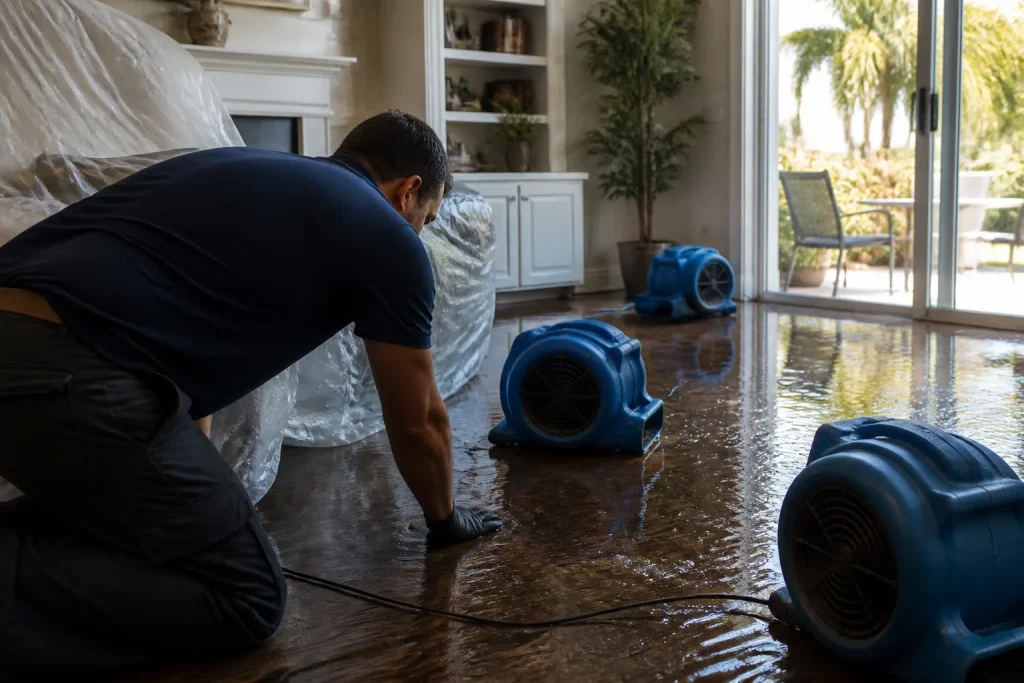
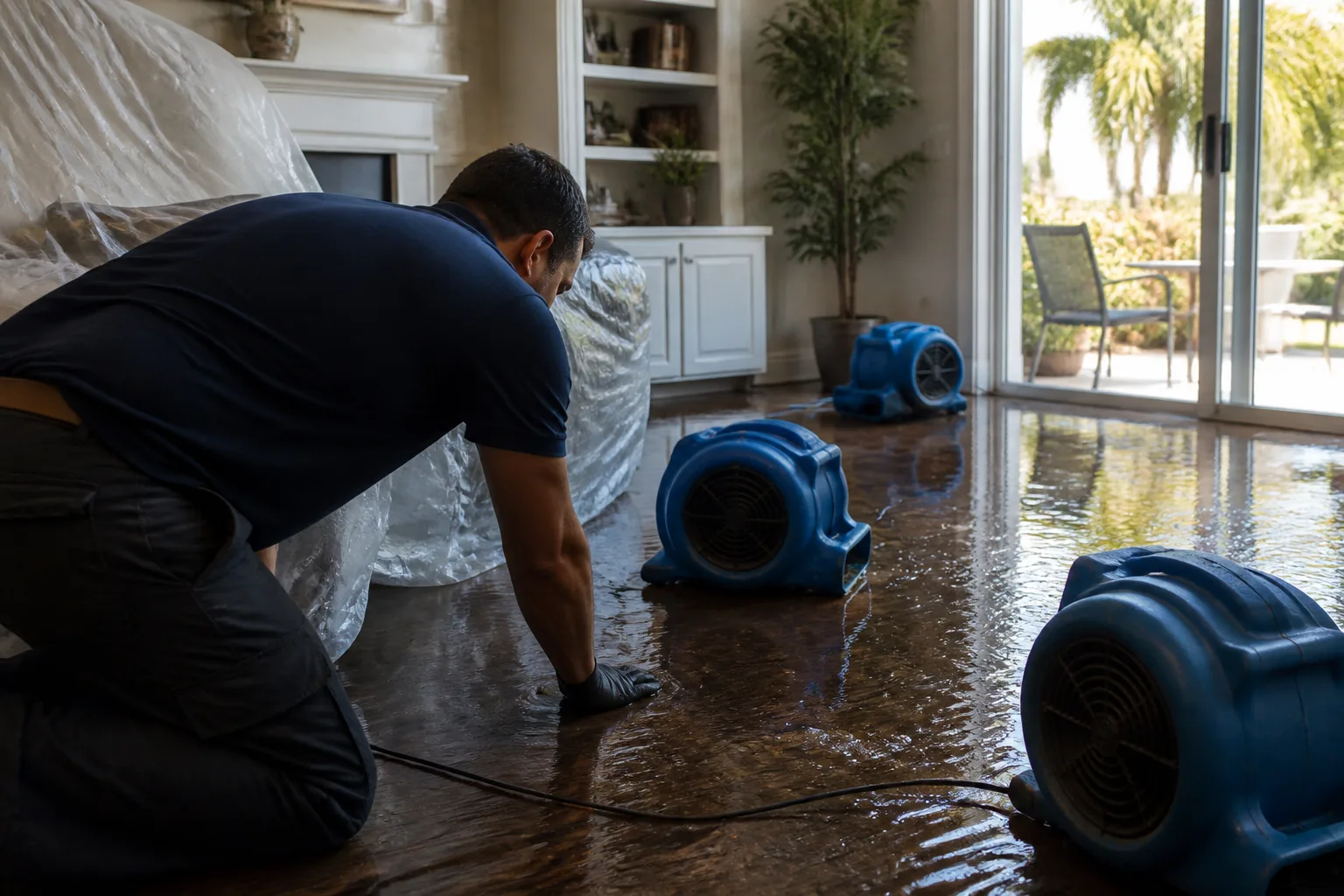
Emergency Water Damage Restoration Near Me: What San Diego Homeowners Should Do First
When water is spreading across your San Diego home, the first 90 minutes determine whether you’re dealing with a cleanup or a rebuild. The right sequence is: shut off the water source, photograph everything exactly as it sits, remove only what’s safe to move, then call a restoration company that can dispatch a live crew. If you’d rather skip the details and get someone rolling now, call Floodline Restoration Co. at (888) 737-2439 and a live dispatcher will answer.
Here’s the part most guides get wrong: grabbing every towel in the house and soaking up standing water feels productive. It also destroys the documentation your insurance carrier needs to approve the full scope of your claim. There’s a right order to the first hour, and it starts with your phone camera, not the linen closet.
What to Do in the First 90 Minutes: A Timed Sequence for San Diego Homeowners
You don’t need to be a restoration technician to take the right first steps. You need a sequence. Here’s the order we teach every homeowner who calls us in a panic from Clairemont, Rancho Bernardo, or anywhere else in San Diego County.
Minutes 0-15: Stop the source, then photograph.
- Shut off the water. If it’s a burst supply line or failed water heater, close the fixture valve first, then the main shutoff if needed. In San Diego, most homes have the main near the street or where the line enters the garage. If you can’t find it, don’t burn twenty minutes looking. Call us while the water still runs and we’ll talk you through it on the phone.
- Photograph before you touch anything. Wide shots of the room first, then medium shots of affected walls and floors, then close-ups of the water source itself. Capture the water line on drywall, the extent of pooling, and any damage to baseboards or flooring. Your carrier will want to see the full picture before mitigation began.
- Photograph standing water depth if visible. A ruler or coin in the frame helps establish scale. This feels ridiculous at 2 a.m. It matters when the adjuster reviews the claim.
Minutes 15-45: Move what’s safe, leave what’s evidence.
- Move furniture out of standing water only if you can do it without dragging it across wet flooring. Dragging a saturated sofa leg across a wet wood floor turns a refinish into a replacement, and your carrier knows the difference.
- Lift drapes and skirts off wet floors. Pin them up or drape them over furniture. Fabric that sits in water wicks moisture and stains.
- Leave saturated carpet, pad, and drywall in place. Your first instinct may be to pull up wet carpet or cut out soggy drywall. Don’t. Removing materials before documentation voids coverage for secondary damage in some policies, and it robs the adjuster of the evidence they need to approve the right scope. We’ve seen homeowners in Mira Mesa tear out drywall before the claim was filed, then fight the carrier for six months over what was pre-existing versus what they removed. Let the restoration company and the carrier see it as it happened.
Minutes 45-90: Kill the power to wet areas and make the call.
- Shut off electricity to affected rooms at the breaker panel. Only if the panel is dry and accessible. If the panel is anywhere near water, do not touch it. Water and live circuits are a fatal combination in San Diego homes where panels sit in garages that also hold water heaters.
- Call a restoration company with live dispatch. This is the call that determines how fast extraction starts. Every hour of standing water in San Diego’s mild climate grows mold activity in drywall and pad. We answer the phone at 2 a.m. with a person, not a recording, and a certified crew reaches the job the same visit.
Why Call Restoration Before Your Insurance Carrier
This question comes up on nearly every emergency call in San Diego. Homeowners assume the insurance company needs to be the first phone call. That’s backwards, and it costs time you don’t have.
Your carrier’s adjuster won’t dispatch a crew to your house. The carrier’s first available adjuster may not return your call for a day or more, especially if a storm event in Mission Valley or a citywide pipe burst has them overloaded. Meanwhile, water soaks deeper into subfloor and wicks up drywall.
A restoration company that does direct insurance billing handles carrier notification for you. We document everything from the first reading, file the claim with the carrier’s preferred method, and manage the adjuster’s questions directly. You never play messenger between us and your insurer. That’s a square deal, and it’s how a damage restoration company in San Diego should operate.
We’ve been doing this in San Diego since 2010, and the homeowners who call us before their carrier consistently have smoother claims. The evidence chain starts intact, the moisture log is complete, and the adjuster reviews a fully documented scope rather than the aftermath of a homeowner’s best efforts.
One note for homeowners with HOAs: if you’re in a unit-to-unit leak situation in a Pacific Beach condo or anywhere else, your HOA’s master policy and your own HO-6 policy may both apply. Document everything. The restoration company you call should be able to help clarify which policy covers which damage before you sign anything.
San Diego-Specific Water Damage Risks No One Tells You About
San Diego has a reputation for mild weather, but the city’s water damage patterns are surprisingly specific. We see the same scenarios repeat in the same neighborhoods year after year.
Late-night water heater failures in newer Mira Mesa tract homes. Mira Mesa has thousands of homes built in the 1970s and 1980s with water heaters in the garage or an interior closet. When the tank goes, it doesn’t drip. It releases forty to fifty gallons into the surrounding space. Most failures happen at night when no one’s watching, and by morning the water has run under walls and into adjacent rooms. If your water heater is over ten years old, know where your main shutoff is before you need it.
Storm drain backup in Mission Valley. Mission Valley sits low and collects runoff from surrounding mesas. During heavy winter rain events, storm drains can back up and send water into lower units and street-level garages. This isn’t covered by standard flood insurance in most cases, but it may be covered by your homeowner’s policy as sewer backup or storm damage depending on the specific policy language. The documentation threshold matters here. Photograph the water coming in, not just the water that’s already inside.
HOA unit-to-unit leaks in Pacific Beach condos. Condo buildings in Pacific Beach cluster plumbing stacks between units. A leak in unit 3’s shower pan drips into unit 2’s ceiling, and by the time the stain shows, hidden mold has been growing for weeks. When you see a ceiling stain, water has already traveled further than the stain suggests. This is where a moisture reading with professional equipment matters. A visual inspection won’t show the full path of the water.
These aren’t edge cases. We pull a water heater out of a garage in Mira Mesa, Rancho Penasquitos, or Scripps Ranch virtually every week. The difference between a $2,000 mitigation and a $30,000 rebuild is usually how fast the homeowner found the shutoff and made the call.
What “24/7 Emergency Service” Actually Means
Every restoration company in San Diego has “24/7 emergency service” painted somewhere on a van. The phrase means nothing until you see how the call is answered at 2 a.m.
There are two operational models. The first is an answering service. You call, a third-party operator takes a message, and the restoration company gets a text or email. Someone calls you back in the morning. The second is a live dispatcher employed by the restoration company, sitting at a dispatch board, authorized to roll a crew that hour.
Floodline Restoration Co. runs on the second model. We built the company around a dispatch board, not a sales desk. A live dispatcher picks up at all hours, every day. The dispatcher knows where the crews are, what equipment is on which truck, and what’s needed for the job you’re describing. Extraction is running the same visit.
When you call Floodline Restoration Co. of California home at (888) 737-2439, you’re talking to someone in our office who can actually do something about your emergency, not a call center logging tickets.
The distinction matters for one reason: every hour water sits in a San Diego home grows the scope of damage. What starts as a three-hour extraction turns into a seven-day dry-out, then into mold remediation, and then into rebuild. A company that answers with a live person can stop the clock. A company that answers with a recording starts the clock later.
The Dehumidifier Mistake That Can Void Your Coverage
This is the one piece of advice we give that surprises every homeowner: do not rent or set up dehumidifiers and fans before a professional moisture reading is taken.
Here’s why. The first moisture reading on wet materials is the baseline for your entire claim. It tells the adjuster how much water entered the structure, where it traveled, and what the drying scope should be. If you run box fans and a rental dehumidifier on the damaged area before that baseline is captured, you’ve changed the conditions the adjuster needs to see. In some cases, particularly with secondary damage like warped framing or subfloor delamination, carriers have denied coverage because the homeowner’s DIY drying equipment masked the original moisture extent.
This isn’t a scare tactic. We’ve watched homeowners in Chula Vista and El Cajon spend four hundred dollars on rental drying equipment, run it for a weekend, and then fail to collect on the secondary damage because the carrier couldn’t determine what the original water exposure was. You wouldn’t wash your car before the accident inspector arrives. You shouldn’t dry your walls, either.
What you can do is remove standing water with a wet vacuum if one is available. Surface water removal doesn’t change the moisture content inside walls and subfloor the way running dehumidifiers does. Then stop, document, and call. The professional drying plan starts with a moisture map, not a fan.
This is exactly why we run daily moisture readings with professional-grade equipment and log every reading until the dry standard is met. That log goes to you and your carrier. It’s how we keep the claim moving and the scope honest.
If you’re already in the middle of a water event in San Diego and you’ve started drying things on your own, stop now and call (888) 737-2439. We’ll work with what’s been done and help you preserve what’s left of the documentation.
When to Call a Pro
Any water event that reaches drywall, insulation, subfloor, or more than a few square feet of floor is past DIY territory. The signs are usually obvious: standing water across a floor, water stains spreading upward on walls, a squishy feel underfoot, or a water heater that’s released its tank.
But even a small leak hidden behind a wall is a professional job. Water sitting in an enclosed cavity creates the warm, dark, humid environment that mold loves. That’s how a pinhole leak in a supply line becomes a Mold Remediation in San Diego project six weeks later.
The calculation is simple: professional extraction and drying usually costs less than the rebuild it prevents. We’ve seen the alternative too many times. A homeowner waits a week, the drywall starts to smell, and now a one-day extraction is a two-week remediation plus a rebuild. Done right the first time is always the cheaper path.
Related services in San Diego: Water Damage Restoration in San Diego, Fire & Smoke Damage Restoration in San Diego, and full mold remediation all run through the same certified crew, so you’re not juggling contractors mid-job.
The Bottom Line
Water damage in San Diego is a race between documentation and degradation. Your job in the first hour is to stop the source, photograph the evidence, move only what’s safe to move, and call a restoration company with a live dispatcher. Leave the drying plan to professionals who can document the baseline your carrier needs.
Don’t run dehumidifiers or fans before that first reading. Don’t tear out drywall before the claim is filed. Don’t wait for the adjuster to call you back while water soaks deeper into your subfloor.
If you’re in San Diego and need help right now, Floodline Restoration Co. of California offers free estimates - call (888) 737-2439. A live dispatcher answers at any hour, and a certified crew can be on the way the same visit. We’ve been doing it this way since 2010, and we back every job with the 90-Day Done Right Promise in writing. That’s the Keystone Standard, and we stand behind it.
Frequently Asked Questions
With live 24/7 dispatch, a certified crew can typically reach most San Diego neighborhoods within an hour of your call, depending on current call volume and traffic conditions. Floodline Restoration Co. answers every call with a live person, not an answering service, so you’ll know your ETA before you hang up. Call (888) 737-2439 for a real-time dispatch update.
Most standard homeowner’s policies cover sudden and accidental water damage, including burst pipes, water heater failures, and appliance leaks. Gradual leaks are often excluded, which is why documentation from the first hour matters so much. Floodline Restoration Co. does direct insurance billing and manages adjuster communication for you, so you’re never playing messenger between us and your carrier. Call (888) 737-2439 and we’ll help clarify your coverage before work begins.
No. Removing saturated carpet or pad before a professional assessment and documentation can void coverage for secondary damage in some policies. Leave wet materials in place, photograph everything, and let the restoration company and adjuster see the full extent of the water event. This protects your claim and your home. Call (888) 737-2439 for guidance on your specific situation.
Emergency water damage restoration in San Diego typically ranges from $1,200 to $4,500 for extraction and drying, depending on the affected square footage, water category, and how long the water has been present. Rebuild work adds to that scope. Floodline Restoration Co. offers free estimates and direct insurance billing, so you’ll have a written scope before work starts. Call (888) 737-2439 for an exact quote.
Written by Curt Bowman, Owner at Floodline Restoration Co. of California, serving San Diego since 2010.
Need Damage Restoration Help?
Call Floodline Restoration Co. of California - licensed & insured, available 24/7 in San Diego.
(888) 737-2439