
How to Choose the Right Damage Restoration Company in San Diego
The right damage restoration company in San Diego is one that handles the entire job, from first extraction to final drywall, with the same crew, a written moisture log, and a warranty that outlives the invoice. Most homeowners screen for certifications and reviews, which matters, but the question that protects you long-term is whether the company that tears out wet drywall is the same one rebuilding it. If you’d rather skip the research and talk to someone now, call (888) 737-2439.
San Diego has over 60 restoration companies listed on Google. The question most homeowners ask is “are they certified and well-reviewed?” The question they should ask is “who is standing in my house on day 14 when the drywall goes back up, and do they know what was behind it?” We’ve watched too many San Diego homeowners sign with a company that extracted water beautifully, then waved goodbye as a subcontractor they’d never met arrived to rebuild, carrying no moisture log and no context for what happened before the walls were opened.
Why Job Continuity Matters More Than Any Single Credential
Most restoration companies in San Diego split their work into two phases. Phase one is extraction and drying, handled by their own IICRC-certified technicians. Phase two is reconstruction, handed to a rotating cast of subcontractors. Each phase technically works, but the seam between them is where documentation gets lost, mold gets missed, and homeowners end up fighting their insurer over damage that appeared after the first contractor left.
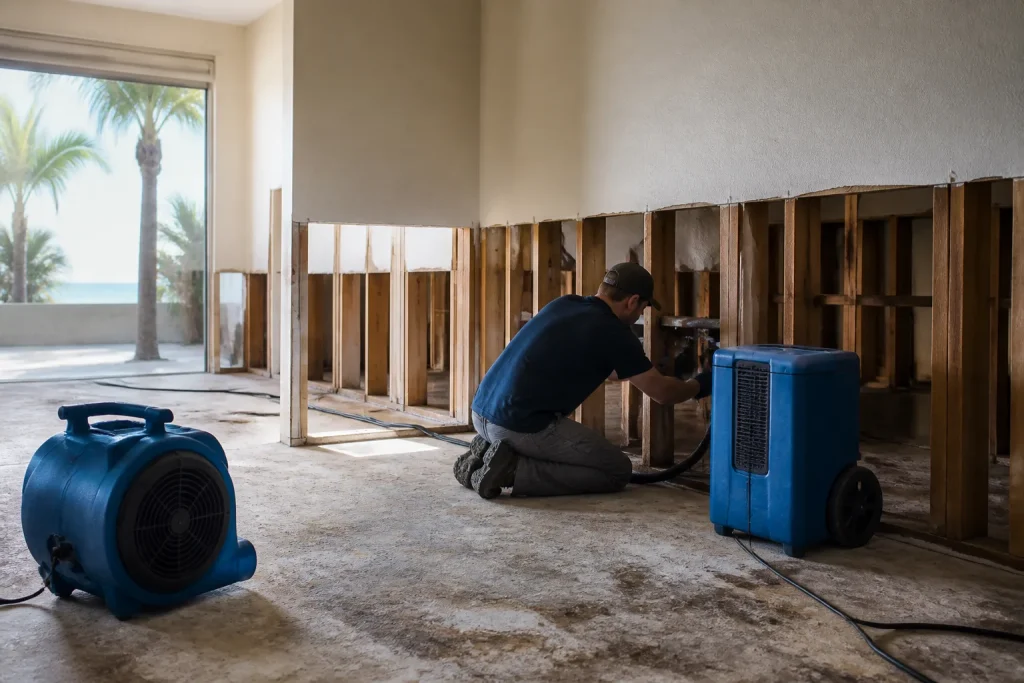
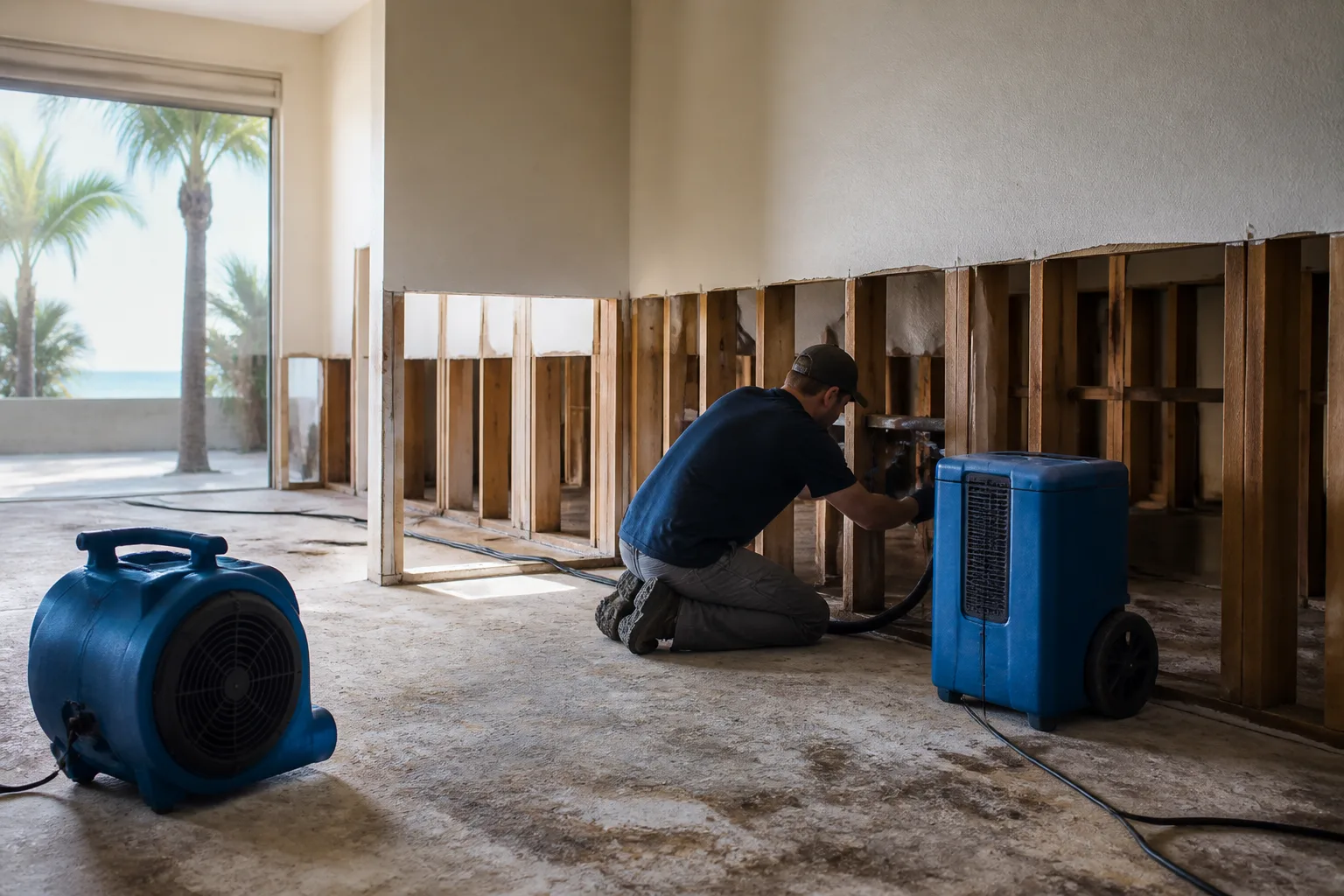
When the same crew that read the moisture map on day one handles daily readings, logs the dry standard, and rebuilds what needs rebuilding, there’s no handoff to fumble. The person hanging drywall knows exactly where the water traveled because they watched the readings climb and fall. At Floodline Restoration Co. of California home, we run every job this way, from first extraction to finished trim. It’s slower to scale, but it’s the only way we know to guarantee the result and actually mean it.
Five Questions to Ask Before You Sign Anything
Don’t sign an authorization form until you’ve asked these five questions. A legitimate San Diego restoration company answers all of them without hesitation.
- Who holds the IICRC certification on the technician roster, and will those technicians be on my job? Certification is only as good as the person standing in your hallway. Ask for names, not just company credentials.
- What does the written warranty cover after the job closes? Verbal promises evaporate. Get it on paper with a defined term. We give every customer our 90-Day Done Right Promise, the Keystone Standard, in writing, with no paperwork battles and no arguing.
- Who handles reconstruction, your crew or a subcontractor? If it’s a subcontractor, ask what documentation transfers to them, specifically the moisture log and daily drying readings.
- How do you bill insurance, and what do I owe upfront? Direct billing means the company works with your carrier directly. Upfront payment with a promise of reimbursement shifts financial risk onto you, and most homeowners don’t notice until a claim stalls.
- What’s your San Diego CSLB license number, and can I verify it? Any restoration company doing structural repair in San Diego needs a valid contractor’s license. We’ll cover verification below.
How to Read a Restoration Estimate for Red Flags
Estimates reveal more about a company than their website ever will. Here’s what to look for when a San Diego restoration company hands you a number.
- Vague line items. “Dry affected areas” without square footage, equipment days, or moisture readings is a placeholder, not a plan. You want an itemized breakdown listing each affected area, the equipment deployed, and the projected drying window.
- Per-square-foot pricing without a drying-day component. Drying isn’t a flat fee. It depends on the materials affected, the humidity in your home, and the type of water. A quote that prices everything per square foot is guessing, not assessing.
- Missing moisture documentation protocol. Ask where the moisture log lives, who reads it daily, and whether you and your carrier get a copy. If the answer is vague, walk away. We run Dri-Eaz, Phoenix, XPOWER, B-Air, and Injectidry equipment, and every job gets a moisture map from day one with daily readings logged until the dry standard is met. The log goes to you and your carrier, not into a filing cabinet.
We pulled one out of a garage over in Clairemont last month where the homeowner had three quotes. Two of them priced the job per square foot with no drying-day line. The third, from us, itemized equipment days and expected dry time. The two flat quotes were within $200 of each other and thousands below what the job actually required. The insurance carrier challenged them, and the homeowner was stuck in the middle. A square deal means no surprises on the bill, and that starts with an estimate that names the work.
What Direct Insurance Billing Actually Means
Companies that require you to pay upfront and promise reimbursement are shifting financial risk without telling you. What actually happens is this: you pay the full invoice, submit a claim, and wait. If the carrier disputes a line item, you’re the one arguing with them while the restoration company has already been paid and is gone.
Direct insurance billing means the restoration company works directly with your carrier, submits the documentation, handles the adjuster conversations, and gets paid by the insurer, not by you. At Floodline, the homeowner never plays messenger between us and the carrier. We bill directly, coordinate with adjusters, and hand you a written scope of work before anything starts. That’s a square deal, and it’s how restoration should work in San Diego.
How to Verify a San Diego Restoration Company’s Licensing in Under Three Minutes
San Diego restoration work that includes structural repair, drywall replacement, or rebuild requires a valid contractor’s license through the California Contractors State License Board, the CSLB. Verifying a company’s standing is straightforward and worth doing before you sign anything.
- Go to the CSLB website and click “Check a License.”
- Enter the company name or license number. The license must be active and current.
- Check the license classification. Restoration companies doing rebuild work should hold a General Building (B) license or a relevant specialty license.
- Look at the license history. Any suspensions or revocations show up here.
- Check workers’ compensation coverage. It’s listed on the same page and tells you whether the company’s crew is covered if someone gets hurt on your property.
Floodline Restoration Co. of California has been serving San Diego since 2010, founded by Curt Bowman around a dispatch board, not a sales desk. Our technicians are background-checked, uniformed, and trained to IICRC, RIA, and IFA standards. We’re proud to enter our 42nd year serving local communities, and we plan to be in town in thirty years, which means we hire local, train apprentices into journeymen, and answer the phone with a person.
Why Most “Certified” Restoration Companies Still Fail Homeowners
Certifications are table stakes. IICRC certification tells you a company’s technicians passed a test. It doesn’t tell you whether those technicians will be on your job, whether the company stands behind its work, or whether the crew answering a 2 a.m. call actually extracts water that same visit. San Diego homeowners who remember being burned by a contractor once know the difference between a credential and a guarantee.
The questions that protect you aren’t about certificates on a wall. They’re about operational details. Who answers the phone at 2 a.m.? Do you have a live dispatcher or a recording? What equipment do you actually run? Will the same crew be here on day 14? What happens if something isn’t done right? Every company in San Diego says they care about quality. Few can point to a written guarantee with a defined term and someone’s name on it.
When to Call a Pro
If you’re dealing with water that’s been sitting for more than 24 hours, sewage, mold that covers more than a small patch, or fire damage that involves structural framing, call a professional immediately. These are not DIY situations. Water migrates into wall cavities, under flooring, and through subflooring in ways that aren’t visible, and drying requires professional-grade equipment and daily monitoring. Sewage and mold pose genuine health risks. Fire damage requires structural assessment and proper cleanup protocols. A trained professional with the right equipment and documentation saves you money and danger in the long run.
Related services in San Diego: Water Damage Restoration in San Diego, Mold Remediation in San Diego, and Fire & Smoke Damage Restoration in San Diego.
The Bottom Line
Choosing the right damage restoration company in San Diego comes down to job continuity first, credentials second, and price last. Ask who’s rebuilding your walls and whether they read the moisture log. Ask what the written warranty covers and how insurance billing actually works. Verify the CSLB license. And if you’re in San Diego and need help, Floodline Restoration Co. of California offers free estimates, calls answered by a live person 24/7, direct insurance billing, and a 90-Day Done Right Promise in writing. Call (888) 737-2439.
Frequently Asked Questions
How much does water damage restoration cost in San Diego? Water damage restoration in San Diego typically ranges from $1,200 for a small bathroom leak to $12,000 or more for a full-room flood involving structural drying and rebuild. The final number depends on the water category, affected square footage, drying days required, and whether reconstruction is needed. Call (888) 737-2439 for an exact quote, estimates are free.
Will my insurance cover water damage restoration? Most homeowners insurance policies cover sudden and accidental water damage, like a burst pipe, but exclude gradual leaks or neglect. The best way to know is to have the restoration company document the damage thoroughly and coordinate with your adjuster directly. At Floodline, we photograph everything, log daily moisture readings, and bill your carrier directly so you don’t play messenger.
How fast can a restoration company actually get here? In San Diego, a company with live 24/7 dispatch can have a certified crew at your door the same day, often within hours. That speed matters because water damage compounds quickly. Floodline answers the phone with a live dispatcher at all hours, and extraction starts the same visit. Not a recording, not a call-back.
Do I really need full remediation or just a cleaning? It depends on the water source and how long it’s been sitting. Clean water from a supply line that’s extracted quickly may only need drying. Sewage, flood water, or water that’s been sitting more than 24 hours usually requires full remediation because of bacterial growth and mold risk. A professional with a moisture meter can tell you the difference in one visit. Call (888) 737-2439 for a free assessment.
Written by Curt Bowman, Owner at Floodline Restoration Co. of California, serving San Diego since 2010.
Need Damage Restoration Help?
Call Floodline Restoration Co. of California - licensed & insured, available 24/7 in San Diego.
(888) 737-2439