
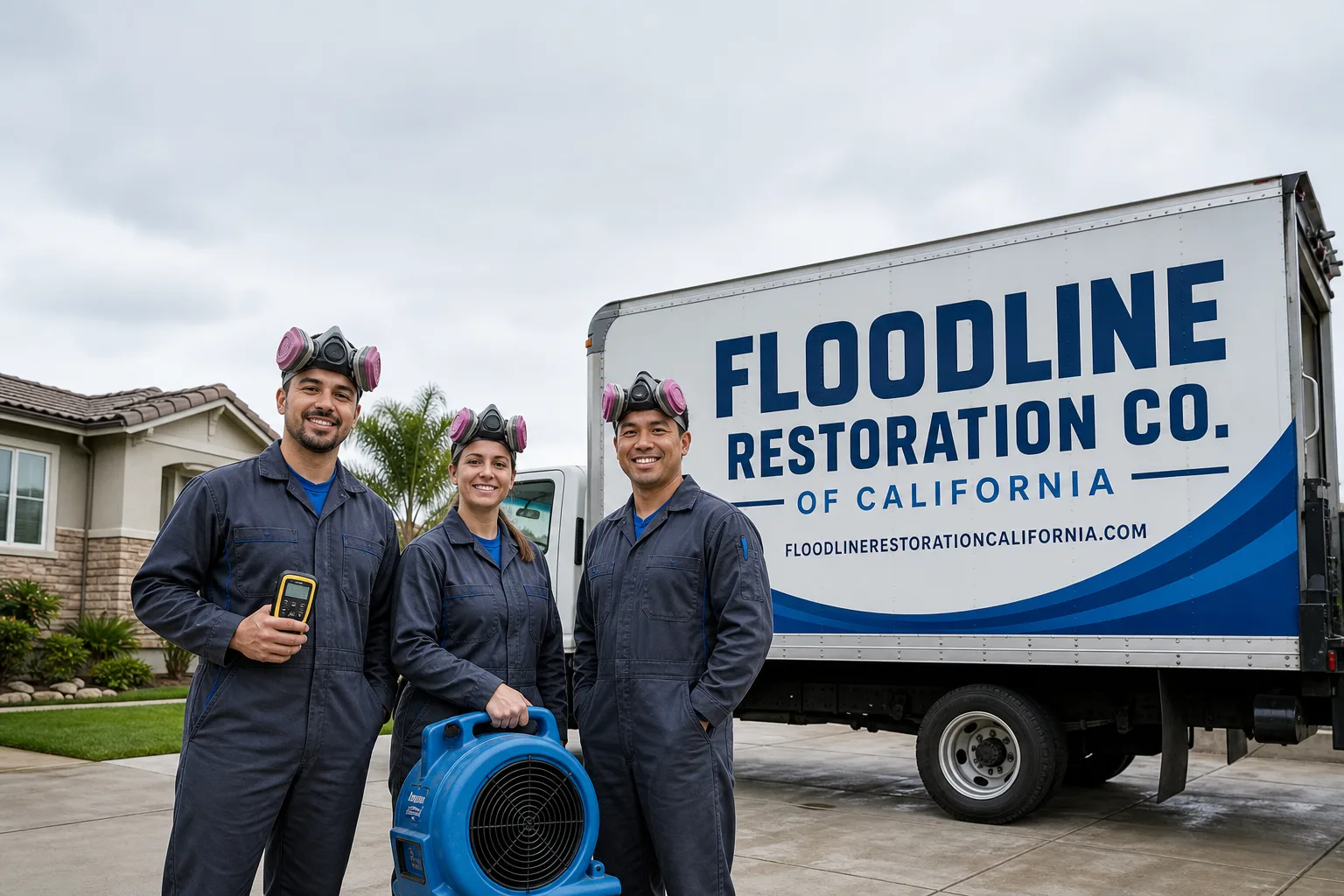
Fast, Reliable Storm & Disaster Restoration Across Stanford
Storm damage in Stanford does not wait for university paperwork, and neither do we. When a eucalyptus comes through a faculty roof near Campus Drive or a Diablo wind event sends debris through a window on the west side of campus, our crews are on the road within the hour because a live dispatcher answers the phone at 2 a.m., not a recording. Floodline Restoration Co. has worked storm damage across the 94305 ZIP long enough to know the ground rules here are different: county permits, university approvals, historic materials. We handle all of it. Call (888) 737-2439 and you will speak to a person who can send a certified crew to Stanford today.
The line the storm leaves is where we start. Not where a call center starts.
Why Floodline Restoration Co. of California Is Stanford’s Preferred Storm & Disaster Restoration Company
Stanford homeowners answer to two authorities when a storm hits: Santa Clara County and Stanford University. Most restoration contractors have no experience with either. We have navigated both for years, and that institutional knowledge saves Stanford residents weeks of delay and thousands in re-do work. Our Storm & Disaster Restoration crews know that a faculty home on a ground lease requires Stanford Real Estate & Facilities Management pre-approval before Board-Up goes up, and that a sandstone building on the main quad cannot be dried with standard residential equipment. We bring that specific, hard-won knowledge to every job.
Founded in 2010 by Curt Bowman, Floodline Restoration Co. has built its reputation in the Bay Area on a simple promise: the same background-checked, uniformed technician who reads the moisture map on day one is the person who handles daily readings, hands the log to the homeowner and the carrier, and rebuilds what needs rebuilding. Curt built the company around a dispatch board, not a sales desk. That is why a live person answers at every hour and why our 90-Day Done Right Promise, the Keystone Standard, is in writing on every job. No arguing. No paperwork battles. If it is not done right, we make it right.
Stanford customers have told us the same thing for years: they want a square deal and a name they can hold accountable. That is what we are.
Our Storm & Disaster Restoration Services in Stanford
Storm Damage Cleanup
After a high-wind event on the Stanford campus, the first hazard is rarely the one you see. Broken glass, downed limbs, and wind-driven debris hide structural damage, and water follows every opening within hours. Our Storm Damage Cleanup crews clear debris from entryways, inspect roof and siding for breaches, and document everything with photographs for the insurance file. On Stanford’s west side near Jasper Ridge, we also flag ember-carrying debris left against structures, because the next Diablo wind event turns that debris into a fire vector. A typical storm damage cleanup in Stanford runs $400 to $1,800 depending on scope, and we are typically on site within 60 to 90 minutes of your call.
Flood Damage Restoration
Stanford’s storm water does not drain like Palo Alto’s. The campus sits at the base of the Santa Cruz Mountain foothills, and runoff from the hills and from the creek corridors along the county’s unincorporated edges moves fast after a heavy rain. When that water enters a 1960s faculty home or a mid-century staff duplex, extraction needs to start the same visit. We use professional-grade Dri-Eaz dehumidifiers and Phoenix air movers, moisture-map every affected surface, and keep daily readings logged until the dry standard is met. Flood damage restoration in Stanford typically falls between $2,500 and $12,000 depending on square footage and how long water sat before we arrived. The faster you call, the smaller that number stays.
Emergency Board-Up
A smashed window on a Stanford faculty home cannot wait for a Monday approval cycle. We board up immediately to stop further rain entry, then work with Stanford Real Estate & Facilities Management after the fact if the structure is on university ground-lease property. Emergency board-up in Stanford runs $150 to $600 per opening, and we carry the plywood, fasteners, and fast-set hardware to handle multiple openings in one visit. No waiting on a supply run while rain keeps coming in.
Roof Tarping
Wind damage to a mid-century roof near Stanford’s campus core can expose hundreds of square feet in minutes. We tarp the breach with heavy-duty reinforced material, secure it against the next wind event, and document the condition for the insurance carrier. Roof tarping in Stanford typically costs $400 to $1,200 depending on access and roof pitch. The county and Stanford Capital Planning both want to see that tarp up fast, and so do we.
What happens when you call
- 1
A real person answersNo phone trees - you reach a local pro.
- 2
You get an upfront price rangeHonest numbers before anyone is dispatched.
- 3
A background-checked tech heads outLicensed & insured, dispatched right away.
- 4
You approve before work beginsNothing starts until you say go.
Trusted Brands We Service in Stanford
Stanford’s storm damage jobs often involve equipment that needs to work the first time, in wet conditions, with no second chances. We run Dri-Eaz and Phoenix drying equipment on Stanford jobs because those brands hold up to the continuous runtime a campus job demands, and our technicians are trained to IICRC, RIA, and IFA standards on that equipment. When a faculty home off Sand Hill Road needs a dehumidifier evaluated or a pump replaced mid-job, we do not hand the homeowner a parts list and wish them luck. We handle it. Same crew, same visit, done right and backed in writing.
Common Storm & Disaster Restoration Problems We See in Stanford Homes
Stanford’s storm damage patterns are not the patterns we see in Palo Alto or Mountain View. The housing stock, the terrain, and the ownership structure all change what goes wrong and how it must be fixed.
- University ground-lease approval delays. Faculty and staff homes on Stanford ground leases cannot have structural restoration work begin without Stanford Real Estate & Facilities Management sign-off. Contractors who skip this step get the job halted, and the homeowner eats the delay while water keeps moving through the structure. We start that approval conversation at the same time we start emergency mitigation.
- Historic sandstone and red-tile water damage. The core campus buildings from the late 19th and early 20th centuries are Richardsonian Romanesque sandstone, and they absorb water differently than modern stucco or wood siding. Standard drying protocols fail on those materials, and the damage compounds before anyone notices. We run drying plans specific to historic masonry, not a cookie-cutter residential rpm setting.
- Wildland-urban interface debris accumulation. The wooded western periphery near Jasper Ridge collects wind-thrown limbs and leaf litter against structures during every storm. Once dry season hits and the Diablo winds return, that accumulated debris becomes ember fuel. Clearing it after every storm is part of our cleanup protocol on Stanford’s west side, not an add-on.
- Dual-track permit confusion. Stanford is unincorporated Santa Clara County, so restoration permits run through the county, but structures on the core campus also trigger a parallel review by Stanford’s own Capital Planning office. Out-of-town contractors assume Palo Alto rules apply, file the wrong paperwork, and lose days while rain enters through an untarped roof. We file both tracks the first time.
Pricing for Storm & Disaster Restoration in Stanford, CA
We Also Serve Cities Near Stanford
If you are in Stanford proper or just across the line, our crews run the same routes every week. We serve storm damage calls in Palo Alto, Atherton, East Palo Alto, and Los Altos Hills with the same live dispatch, same certified technicians, and same 90-Day Done Right Promise. The county line changes the paperwork. It does not change how fast we get there.
Serving Stanford, CA - Our Local Coverage Area
We’re based in the Stanford area and know this community well. Use the map below to see our service coverage - if you’re nearby, we can almost certainly help.
FAQs - Storm & Disaster Restoration in Stanford
How does Stanford’s university ownership affect storm damage restoration on faculty housing?
Faculty and staff homes at Stanford sit on university-owned ground leases, so major restoration work requires pre-approval from Stanford Real Estate & Facilities Management before structural repairs begin. That approval runs parallel to Santa Clara County permits, and skipping it can halt a job mid-mitigation. We start the Stanford approval conversation while emergency board-up and water extraction are already underway so the job does not stall. Call (888) 737-2439 and we will walk you through exactly what your specific home needs from the university.
Do we need a separate permit from the City of Stanford for roof tarping after a storm?
Emergency roof tarping to stop active water entry does not require a permit, and we get it done the same day a storm opens your roof. The permit requirement kicks in during the permanent roof repair phase, and because Stanford is unincorporated, that goes through Santa Clara County, not a city building department. If your structure is on the core campus, Stanford Capital Planning will also review it. We handle both tracks. Call (888) 737-2439 and we will start the tarp and the paperwork on the same visit.
Why do Diablo wind events make storm damage worse on the Stanford campus?
Diablo winds come down the Santa Cruz Mountain foothills hot, dry, and fast, and they hit Stanford’s western edge near Jasper Ridge before anywhere else in the area. Those winds snap mature oaks and eucalyptus, drive debris into structures, and dry out vegetation until a single ember can ignite accumulated storm debris against a home. After any wind event, clearing that debris is our first priority on west-side Stanford properties. Call (888) 737-2439 and we will assess what the last Diablo event left against your structure.
Can you restore water damage to a historic sandstone building on Stanford’s main quad?
Yes. Restoration of Richardsonian Romanesque sandstone and red-tile structures on Stanford’s main quad requires drying protocols specific to historic masonry, which we run using professional-grade equipment and daily moisture logging. These are not standard residential programs, and we have worked with Stanford’s historic-material requirements before. The university’s Capital Planning office reviews the work, and we coordinate directly with them. Call (888) 737-2439 to discuss your specific building.
How fast can you board up a storm-damaged faculty home while university approval is pending?
Emergency board-up to stop active water entry and secure the structure does not wait for university approval, and we complete it the same day you call, often within the hour for Stanford addresses. Once the opening is secured and documented, we begin the Stanford Real Estate & Facilities Management approval process for the permanent repairs. The board-up itself runs $150 to $600 per opening. Call (888) 737-2439 and a live dispatcher will have a certified crew on the road to your Stanford home today.
Call Floodline Restoration Co. for Storm & Disaster Restoration in Stanford
Storm damage in Stanford is never a one-phone-call problem. It is a county problem, a university problem, and an insurance problem all at once, and you deserve a contractor who has worked all three before. Our crews are uniformed, background-checked, and certified, and our 90-Day Done Right Promise means the work is backed in writing. The same certified crew that extracts and dries is the crew that rebuilds. No handoffs. No inherited subcontractors. Just one company, one name, one phone number.
Call (888) 737-2439 for a free estimate. We answer live, 24 hours a day.
*Written by Curt Bowman, Owner at Floodline Restoration Co. of California.*