
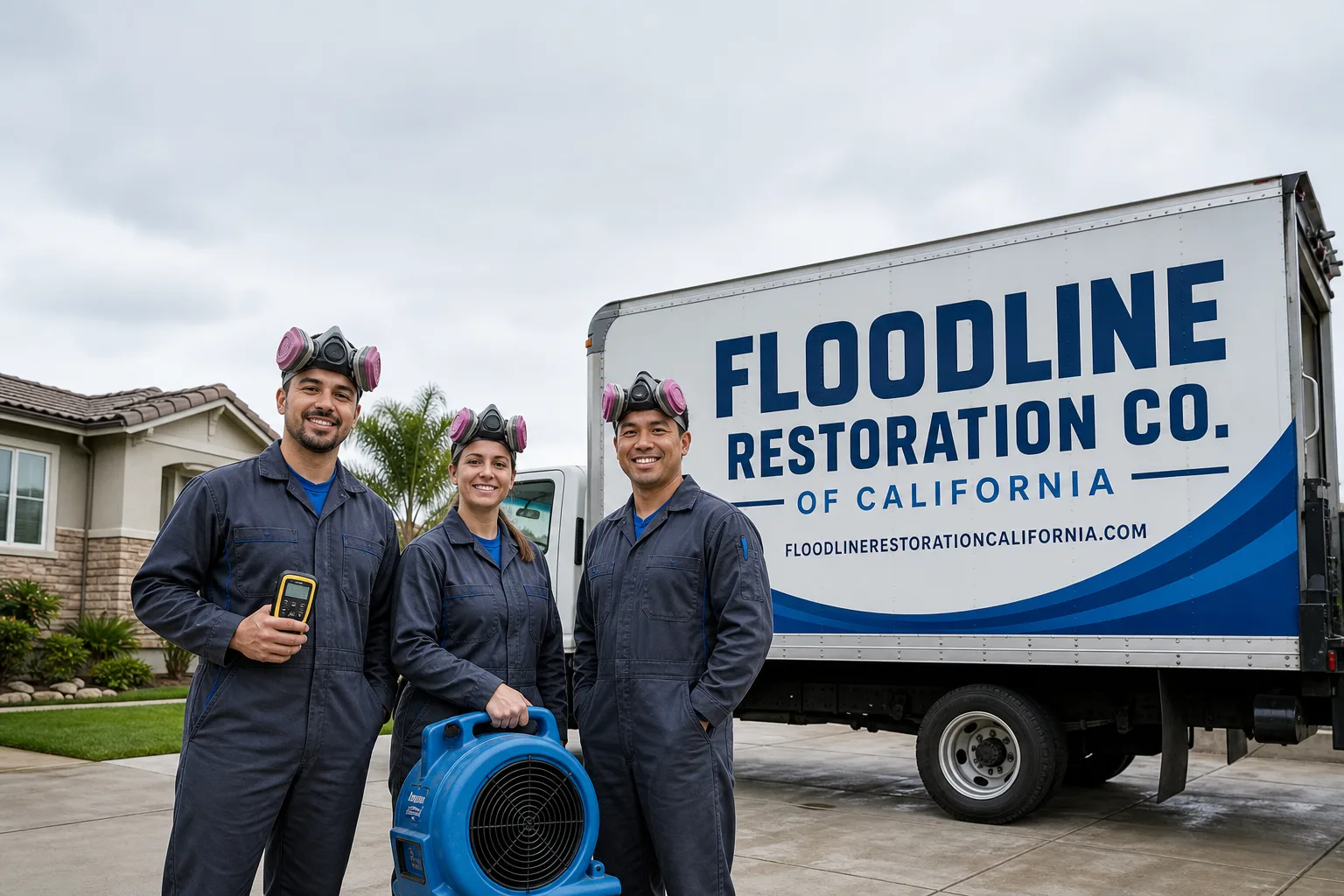
Fast, Reliable Sewage Cleanup Across Koreatown
Sewage cleanup in Koreatown typically costs between $1,850 and $6,400 depending on how far category 3 water has traveled, and our crews reach most addresses in the 90005 ZIP within 45 to 90 minutes. When a toilet overflows into a ground-floor unit off Wilshire or a waste line backs up in a pre-war courtyard on Serrano, speed matters more than anything else. The longer black water sits, the deeper it soaks into subfloor, shared wall cavities, and the crawl spaces under soft-story buildings. Call (888) 737-2439 and a live dispatcher answers, day or night, not a recording.
Our Sewage Cleanup team knows Koreatown’s buildings the way only years of local dispatch can teach. We know where the cleanouts hide behind locked alley gates, how water travels through stacked unit layouts, and why a third-floor backup is usually a ground-floor problem in disguise. For over 42 years, the name behind this work has answered the phone with a person and stood behind every job in writing.
Key Takeaways
- Koreatown sewage cleanup runs roughly $1,850-$6,400; a category 3 contamination is an emergency, not a wait-and-see.
- We’re at most Koreatown addresses in under 90 minutes, with a written scope before work starts.
- Our crews carry XPOWER and Dri-Eaz equipment sized for tight courtyard access and shared-wall containment.
- Every job is backed by the 90-Day Done Right Promise in writing. No arguing, no paperwork battles.
Why Floodline Restoration Co. of California Is Koreatown’s Preferred Sewage Cleanup Company
Koreatown’s housing stock doesn’t tolerate generic cleanup protocols. The 1920s-1940s courtyard apartments and 1960s-1980s stucco blocks that dominate the neighborhood share plumbing risers, wall cavities, and floor assemblies in ways a single-family home never will. When a cast-iron waste line separates at a lead joint on Kenmore Avenue, the sewage rarely stays in one unit. Our technicians have worked enough buildings between Western and Normandie to trace the path before the mop comes out.
We’re a company built around a dispatch board, not a sales desk. That means the person who answers your call at 2 a.m. can actually route a certified crew to your building, not schedule a callback for Tuesday. Our background-checked, uniformed technicians train to IICRC, RIA, and IFA standards, and they arrive with the right containment gear for dense multi-unit work: negative pressure setups, HEPA air scrubbers, and moisture-mapping equipment from Dri-Eaz.
The response time to Koreatown is real because our Los Angeles office coordinates local dispatch. We don’t waste time explaining the neighborhood to a crew seeing it for the first time. They already know that parking on 6th Street means blocking the driveway briefly, that the alley behind a 1920s courtyard is often gated, and that the building manager may be off-site and communicating in Korean. That’s local knowledge you can’t fake.
Our Sewage Cleanup Services in Koreatown
Sewage Backup Cleanup
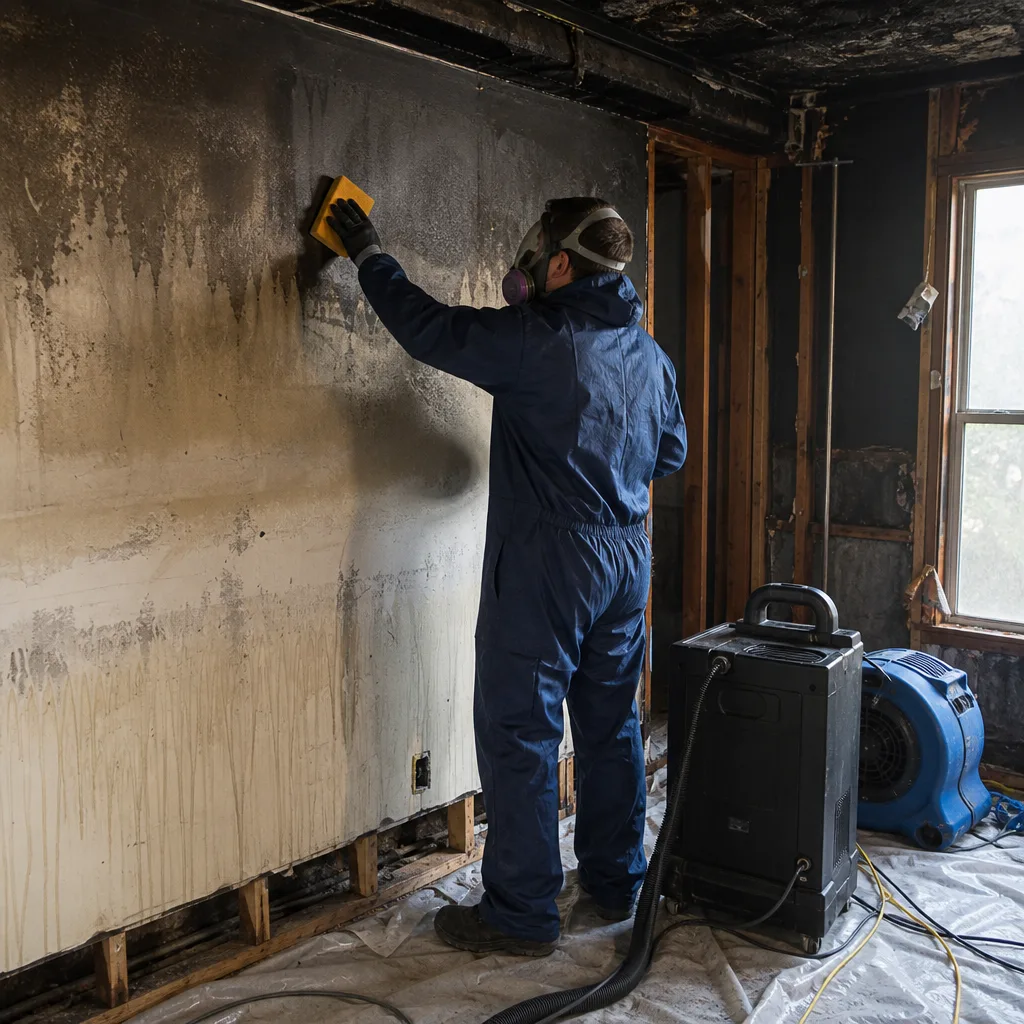
A sewage backup in a Koreatown apartment building is rarely a one-unit problem. Shared laterals and stacked wet walls mean that when the main line backs up behind a building on Harvard Boulevard, category 3 water can saturate drywall in three units and a utility closet before anyone notices. Our crew starts with a floor-by-floor walkthrough to map the actual migration path, not just the visible spill. We extract, contain, and sanitize every affected cavity using an EPA-registered disinfectant, then log daily moisture readings until the dry standard is met. A written scope is agreed before any work begins, so you know exactly what we’re doing and why.
Toilet Overflow Cleanup
In Koreatown’s pre-war courtyards, toilet overflows often trace back to a rusted cast-iron closet bend or a wax ring that failed after decades of micro-movement. An overtorqued flange bolt snapping on a corroded bend near a unit on Kingsley Drive can leave an uncapped waste opening, which is worse than the original spill. We handle the full scope: black water extraction, disposal of contaminated porous materials, structural drying of the subfloor, and flange repair if we’re already into the floor. The 90-Day Done Right Promise applies to the whole job, including any work behind the toilet.
Septic Failure Cleanup
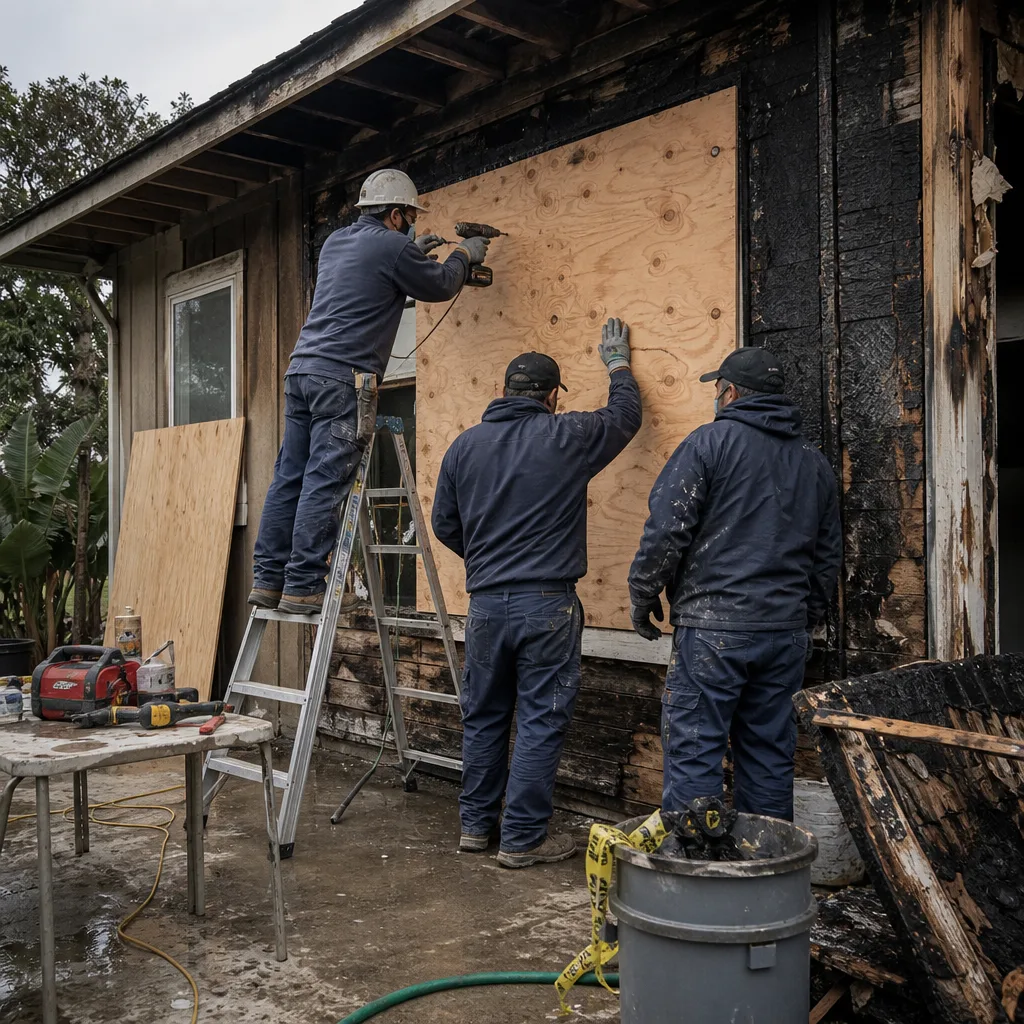
While most of Koreatown is on municipal sewer, older courtyard buildings and a handful of remaining private systems still fail in predictable ways. A saturated leach field or a collapsed septic line near a 1930s building can push black water up through floor drains and into units that were dry an hour ago. We bring the same professional-grade extraction and sanitization protocol to septic failures that we bring to municipal backups, with category 3 containment from the first visit. Because septic failures often involve hidden line breaks, we work with your plumber or bring in the right tester to locate the failure point before we finalize the drying plan.
Black Water Extraction
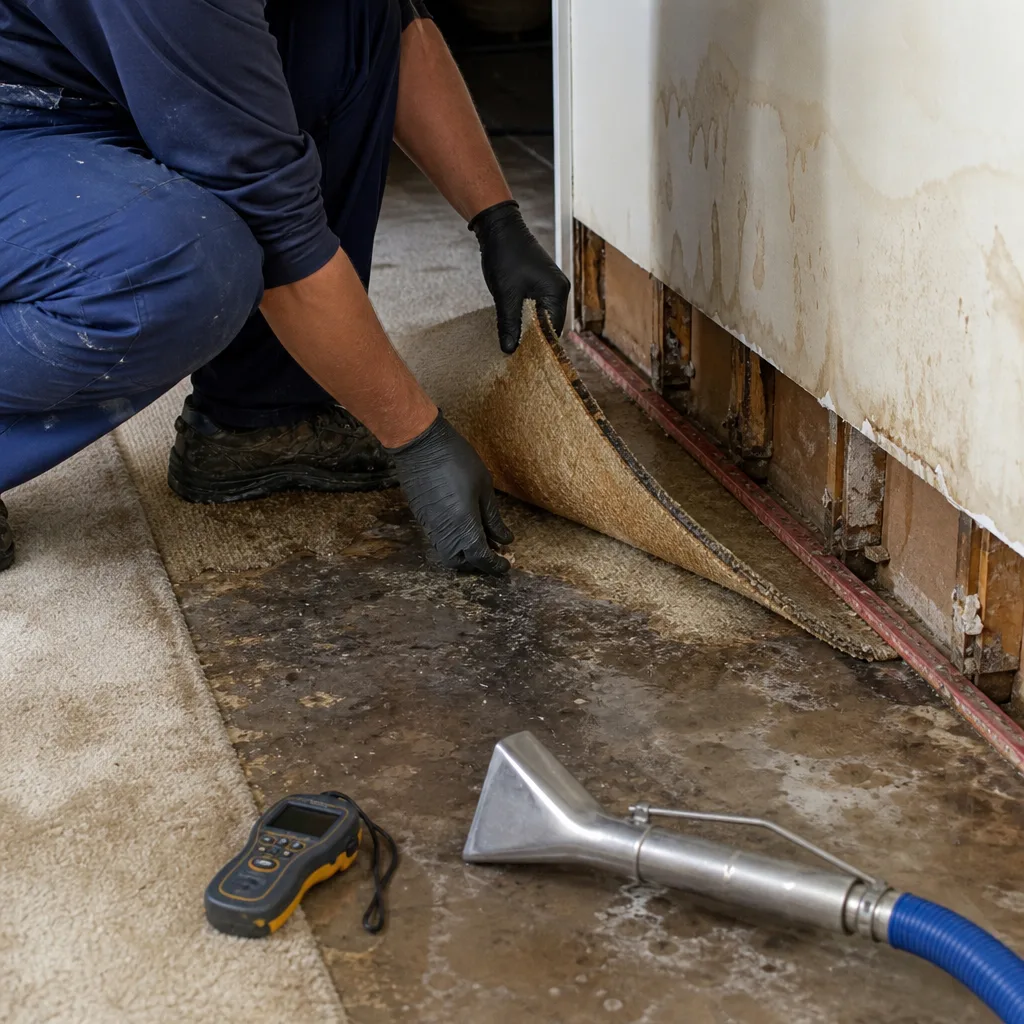
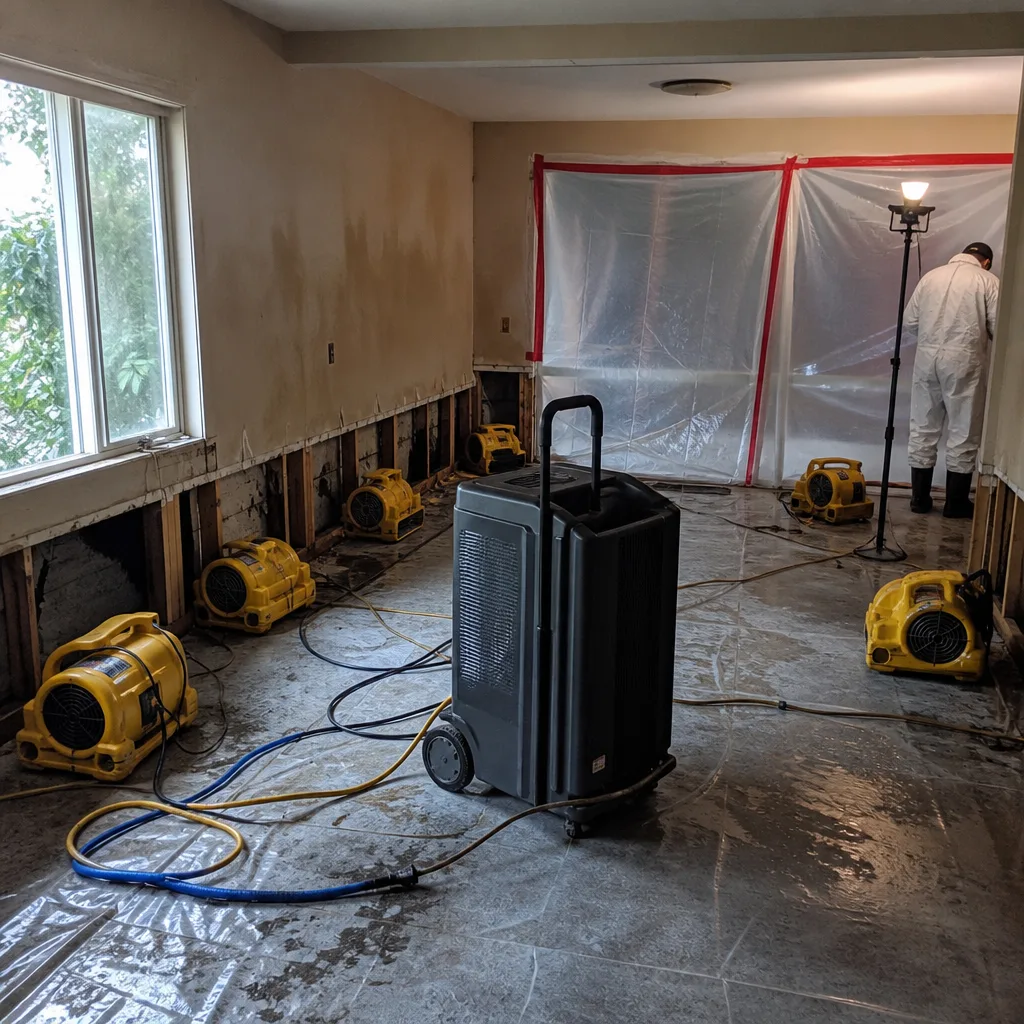
Black water is sewage, plain and simple, and it carries pathogens that require full PPE, containment barriers, and professional extraction equipment. In Koreatown’s dense buildings, that means sealing off the affected unit before we move air around, not after. We use XPOWER axial air movers for negative pressure containment and HEPA filtration from Dri-Eaz to control aerosolized droplets while we extract. The goal is simple: remove the sewage, dry the building, and leave the air safe to breathe. If the black water reached a crawl space under a soft-story building, we treat that as a separate containment zone, not an afterthought.
Crawl Space Sewage Removal
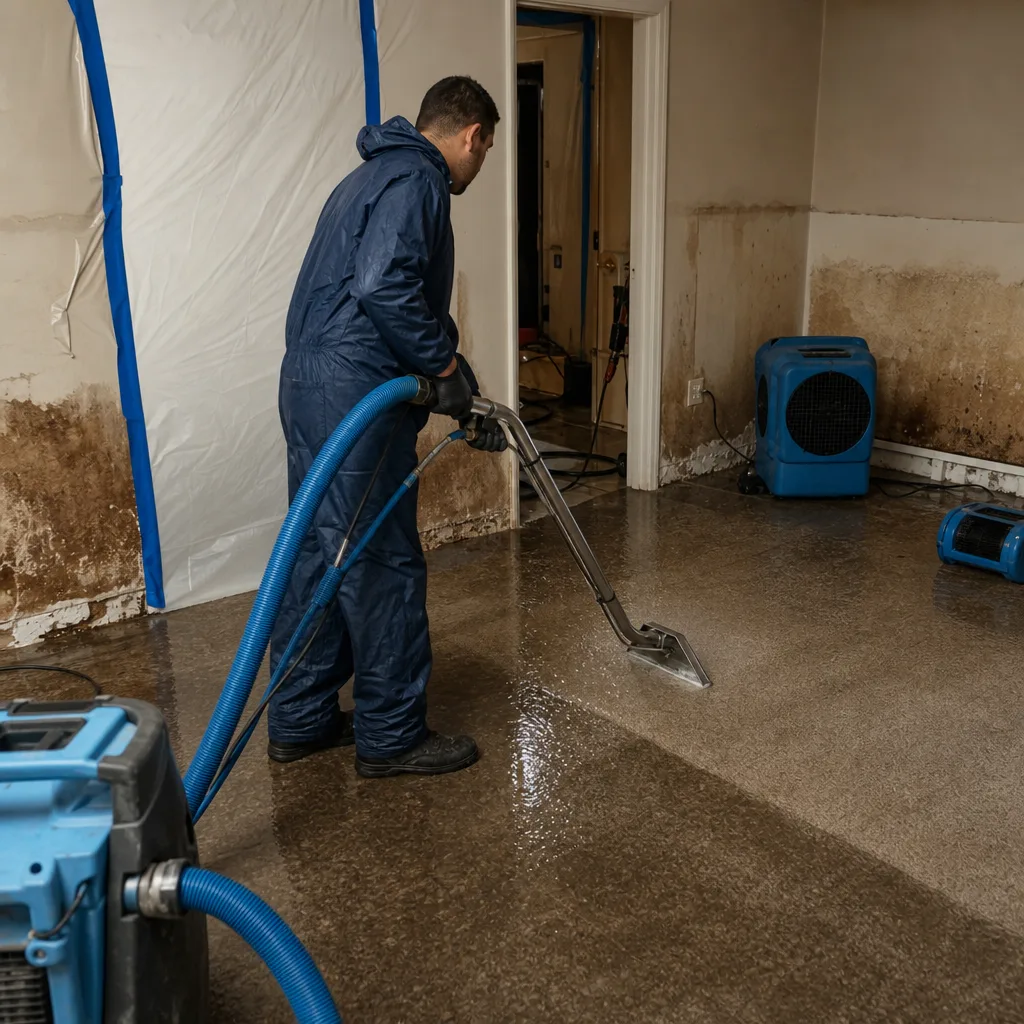
The crawl spaces under Koreatown’s soft-story ground floors are notoriously tight, often no more than 24 to 30 inches of clearance. That’s exactly where sewage pools when a lateral line sags or a waste line cracks after seismic movement. Improper extraction from these spaces leaves muck trapped between floor joists, which forces a re-tear-out months later when the smell returns. We send crews in with proper confined-space protocols, extract every bit of contaminated material, and run drying equipment until the joists hit the dry standard. A HEPA air scrubber runs during the whole process, so you’re not blowing sewage particles into the unit above.
What happens when you call
- 1
A real person answersNo phone trees - you reach a local pro.
- 2
You get an upfront price rangeHonest numbers before anyone is dispatched.
- 3
A background-checked tech heads outLicensed & insured, dispatched right away.
- 4
You approve before work beginsNothing starts until you say go.
Trusted Brands We Service in Koreatown
We work on every type of building Koreatown throws at us, from 1920s Spanish Colonial Revival courtyards to 1960s stucco apartment blocks, and we carry the right equipment for each. Our trucks stock XPOWER air movers, Dri-Eaz dehumidifiers and HEPA scrubbers, and the fittings and repair parts common to Koreatown’s aging cast-iron and galvanized waste systems. When a building on Oxford Avenue needs a same-visit extraction and the manager needs documentation for an insurance carrier, we’re already set up for both. We don’t make you wait for a parts run from across the county or reschedule because the crew didn’t have the right containment gear on board.
Common Sewage Cleanup Problems We See in Koreatown Homes
- Main drain cleanouts locked behind alley gates. Many Koreatown courtyards have their main cleanout in a rear alley that’s gated and locked, with the key held by an off-site owner or manager. By the time someone gets access, category 3 water has already saturated shared wall cavities. We carry tools for controlled gate access when authorized, and we start the interior containment while access is sorted out.
- Shared wall cavities spreading contamination. In pre-war courtyard buildings, sewage travels fast through shared wall cavities and under floor assemblies. A backup in a third-floor unit on Normandie Avenue can soak the ceiling cavity of the unit below before anyone sees a stain. Our moisture-mapping process traces those hidden paths before we write the scope.
- Crawl spaces under soft-story buildings trapping black water. Koreatown has one of LA’s highest concentrations of soft-story wood-frame apartments, and the crawl spaces under these buildings are where sewage hides. Low clearance and old framing make extraction slow work, but skipping it guarantees a repeat problem. We go in, extract everything, and dry the framing to the standard.
- Seismic movement cracking waste lines. The same soft-story vulnerability that makes these buildings a retrofit priority also means lateral waste lines shift with every tremor. Hairline cracks in cast-iron lines under buildings near Wilshire can seep for months before a backup surfaces. We check for the crack, not just the clog, when we’re tracing a Koreatown sewage problem.
Pricing for Sewage Cleanup in Koreatown, CA
Koreatown sewage cleanup runs a wide range because the scope depends on where the black water went. A contained toilet overflow in a single unit with a tile bathroom floor might run $1,850 to $3,200. A full backup saturating shared wall cavities, a crawl space, and three units of a courtyard building can reach $4,000 to $6,400. What you’re paying for, mostly, is the direction the water traveled and what it touched. Porous materials like drywall, insulation, and carpet pad have to be removed and replaced; tile and concrete can often be sanitized and dried. We give you a written scope before any work starts, with line items you can read. Direct insurance billing means we deal with the carrier, not you playing messenger. Call (888) 737-2439 for a free estimate on your specific situation.
We Also Serve Cities Near Koreatown
Beyond Koreatown, our crews cover the surrounding neighborhoods that share the same building stock and access challenges. We handle Sewage Cleanup in Koreatown and the immediate area, plus Los Angeles, Echo Park, Silver Lake, and Hollywood. The same certified crews, the same equipment, and the same written guarantee apply wherever we work.
Serving Koreatown, CA - Our Local Coverage Area
We’re based in the Koreatown area and know this community well. Use the map below to see our service coverage - if you’re nearby, we can almost certainly help.
FAQs - Sewage Cleanup in Koreatown
We start interior containment and extraction while a building manager or owner arranges gate access, and we carry the tools needed for controlled access when the owner authorizes it. The interior work doesn’t wait on the alley. We set up negative pressure and begin removing standing sewage from the affected unit immediately, then coordinate with whoever holds the key to get the cleanout opened for the line work. If the owner is off-site, we work through the property manager or the contact who called us. Call (888) 737-2439 and we’ll walk you through the access options for your building.
Yes, and that’s the core of how we work in Koreatown’s older buildings. We moisture-map the affected unit and any adjacent units above, below, and beside it before we finalize a drying plan, because sewage travels through shared cavities faster than people expect. If a wall cavity reads wet, we open it, extract, sanitize, and dry it properly. The written scope you approve includes every cavity we identify, so there’s no surprise tear-out later.
Every category 3 job gets full PPE, containment barriers, EPA-registered disinfectant application, and HEPA air scrubbing during the work. Our technicians train to IICRC, RIA, and IFA standards, and we treat sewage cleanup as a health hazard containment job, not just water removal. In dense buildings, that means sealing the affected unit before we move any air, so we’re not pushing aerosolized sewage into neighboring units or common hallways.
Often yes, if we get there before the contamination spreads through porous materials. A toilet overflow contained to a tile bathroom floor with a tile baseboard can usually be extracted, sanitized, and dried without tearing out the whole room. The variables are how long the water sat, what the subfloor is made of, and whether the walls wicked moisture behind the tile. We’ll tell you frankly what needs to come out and what can stay before we start cutting. The written scope gives you the answer in plain English.
Because the crawl space is a confined area, often with 24 to 30 inches of clearance, and sewage pools there against old wood framing that’s already under structural stress from the soft-story condition. We treat it as a separate containment zone with its own negative pressure setup and HEPA filtration. Every bit of contaminated material comes out, the joists get dried to the standard, and we don’t call the job done until the moisture log says it’s done. Skipping this step is exactly how Koreatown buildings end up with a sewage smell three months later and a full re-tear-out.
When sewage backs up in your Koreatown unit or building, call (888) 737-2439. A live person answers, a certified crew gets dispatched, and you get a written scope before any work starts. That’s the square deal, and we stand behind it.
Written by Curt Bowman, Owner at Floodline Restoration Co. of California, serving Koreatown and surrounding LA neighborhoods.