
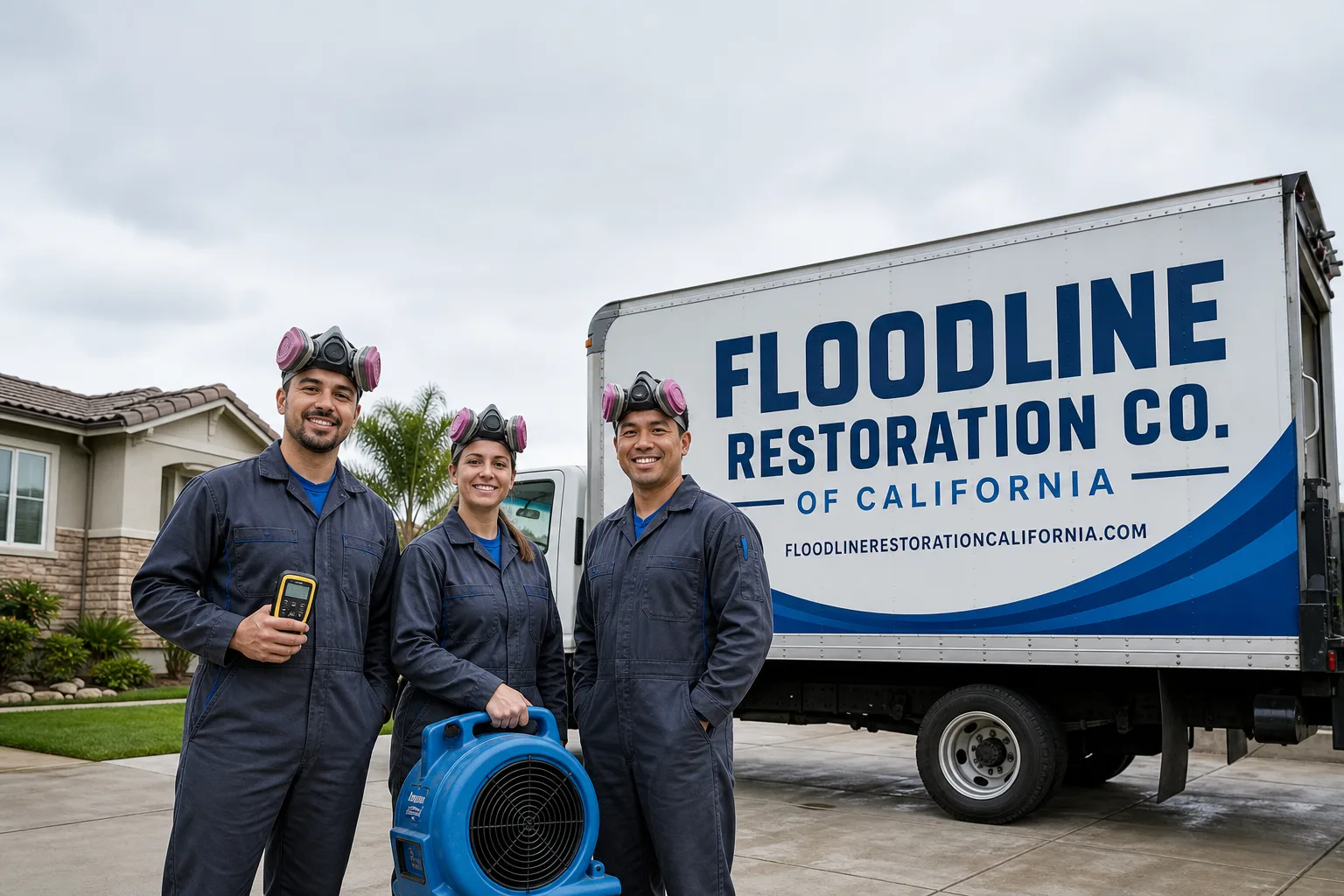
Fast, Reliable Mold Remediation Across Lakewood
Mold remediation in Lakewood typically costs $1,800-$6,500 depending on how far the colony has spread, and most jobs in this city take two to five days once containment is set. Lakewood’s slab-on-grade ranch homes hide moisture differently than houses with crawl spaces, which is why you need a crew that knows these 1950s foundations inside and out. We answer the phone at (888) 737-2439 with a live dispatcher any hour, any day, and we’ll have a certified technician walking your Lakewood property within hours, not days.
Floodline Restoration Co. has worked here long enough to know that a small dark patch on a Lakewood baseboard is rarely a small problem. The slab below it has been wicking water for weeks. We start there.
Why Floodline Restoration Co. of California Is Lakewood’s Preferred Mold Remediation Company
Lakewood homeowners call us because we understand what these houses are. Nearly every home in the 90712, 90713, 90714, and 90715 ZIP codes went up between 1950 and 1953, built on concrete slabs with original galvanized plumbing and asbestos-containing vinyl tile. That is not a footnote. It changes how mold behaves, how it spreads, and what has to happen before anyone pulls up a floor tile.
Our crews come background-checked and uniformed, trained to IICRC, RIA, and IFA standards. Curt Bowman founded this company around a dispatch board and a simple rule: a live person answers the phone at two in the morning. Homeowners near Mayfair Park and along Candlewood Street have called us at odd hours with water where there should not be water, and we have been there the same visit with moisture meters and a plan.
We do not hand the job off to a different crew after the initial assessment. The same team that maps the moisture on day one handles daily readings, documents everything for your insurance carrier, and stands behind the remediation in writing with our 90-Day Done Right Promise. If it is not done right, we make it right. No arguing, no paperwork battles. That is the Keystone Standard.
Our Mold Remediation Services in Lakewood
Mold Inspection & Testing
Every mold job in Lakewood should begin with a real inspection, not a visual guess. We use moisture meters and thermal imaging to find where water is entering, then collect air and surface samples if a lab confirmation is needed. Because Lakewood homes sit on slabs, we pay special attention to baseboards, bottom drywall courses, and the perimeter of rooms adjacent to bathrooms and kitchens, where in-slab supply lines have been failing for the last decade. Expect a written scope and a clear price before any work begins. No surprises on the bill.
Mold Removal
Removing mold from a Lakewood home means more than scrubbing visible growth. We set up containment with negative air pressure to keep spores from migrating through the same shared wall cavities that connect these compact ranch layouts. Affected drywall comes out in clean sections. We treat framing with antimicrobial agents, then dry everything to the standard before anything gets rebuilt. Most single-room removals in Lakewood are completed in two to three days once equipment is running.
Black Mold Remediation
Black mold, usually Stachybotrys, thrives in the slow, hidden leaks these slab homes produce. The long dry spells Lakewood gets mean a failing pipe behind a wall can go unnoticed for weeks, feeding the colony until it shows itself as staining or a persistent musty odor. We treat every black mold job as a containment project from the first cut, using HEPA-filtered air scrubbers and proper PPE. You will get a clearance test at the end, not just a promise that we cleaned it.
Air Quality Restoration
Once mold is removed, the air in the home has to be brought back to a healthy condition. We run HEPA air scrubbers during and after remediation, and we test indoor air before calling the job done. For Lakewood residents with respiratory concerns, allergies, or immune sensitivities, this final step matters as much as the removal itself. South of Del Amo and east toward the San Gabriel River corridor, the humidity that follows atmospheric river events makes air quality restoration a necessary close-out, not an add-on.
Common Mold Remediation Problems We See in Lakewood Homes
- Asbestos-containing vinyl tile discovered mid-job. Nearly all original 1950s floor tile in Lakewood has asbestos in the adhesive. Skipping testing before pulling tile spreads contamination and creates a regulatory problem. We test first, every time.
- Slab moisture migration nobody addressed. A small pipe leak under a slab can saturate concrete for weeks before you see anything. Surface cleaning alone lets mold regrow behind baseboards within months. The slab has to be dried.
- Atmospheric river humidity slowing the dry-out. When a storm system parks over the LA basin, outdoor humidity spikes and slows evaporation. Standard drying equipment struggles in those conditions. We use Dri-Eaz dehumidifiers sized for the challenge, not the brochure.
- Mold spreading through shared wall cavities in ranch layouts. Lakewood’s 1,000-1,400 square foot ranches have simple, interconnected framing. A colony that starts in one wall cavity can travel. Containment has to be set before demolition starts, or you have just moved the problem around the house.
Pricing for Mold Remediation in Lakewood, CA
A small, contained mold removal in a single Lakewood bathroom or closet typically runs $1,200-$2,500. A room-scale remediation with containment, drywall removal, slab drying, and air scrubbing usually lands between $2,800 and $6,500. Full-home remediation involving multiple rooms and asbestos floor tile abatement can exceed $10,000.
What moves the number: how much drywall has to come out, whether lab testing is required, how long the slab needs to dry, and whether original tile adhesive tests positive for asbestos. We give you a written scope with a fixed price before work starts. No hourly billing games. Direct insurance billing is available, and we work with your adjuster so you do not have to play messenger. Call (888) 737-2439 for a free estimate.
We Also Serve Cities Near Lakewood
Our crews handle mold remediation throughout the broader area. We regularly work in Signal Hill, Bellflower, Long Beach, and Paramount, and we bring the same slab-foundation expertise to every job. If you are outside Lakewood proper, check our Mold Remediation in Lakewood coverage page for dispatch details. We are one call away.
Serving Lakewood, CA - Our Local Coverage Area
We’re based in the Lakewood area and know this community well. Use the map below to see our service coverage - if you’re nearby, we can almost certainly help.
FAQs - Mold Remediation in Lakewood
Because virtually all 17,000 Lakewood homes built between 1950 and 1953 used the same 9×9 vinyl floor tile, and the adhesive commonly contains asbestos. Disturbing that tile during mold removal without testing can release fibers and create a regulatory violation. We test the adhesive before any flooring is pulled. If it is positive, we bring in licensed abatement procedures and built that cost into the written scope up front.
A slab-on-grade foundation means there is no crawl space buffer between the ground and your living space. When a galvanized supply line under the slab fails, water saturates the concrete and wicks upward through the flooring and into the bottom courses of drywall. Mold grows at the baseboard line and spreads outward. By the time you see it, the slab has usually been wet for weeks. Drying the slab is a mandatory part of any real remediation here.
Yes, and it often does. Lakewood’s ranch layouts are compact and share wall cavities between adjacent rooms. A leak under one bathroom can feed moisture into the hallway, the bedroom behind it, and the living room on the other side. That is why we moisture-map the entire home on day one, not just the room where you first noticed staining. You cannot fix what you have not measured.
When an atmospheric river stalls over the LA basin, Lakewood’s flat terrain and dense impervious surfaces cause water to pool quickly. The eastern edge of the city near the 90715 ZIP sits close to the San Gabriel River corridor, which adds localized flood risk. That water finds its way into slab homes with no subfloor to slow it down. After the visible water is gone, humidity lingers inside wall cavities for weeks, and that is when mold colonies expand. Post-storm inspections are worth scheduling.
We dry from the interior. Containment goes up first, affected drywall comes out, and then we target the slab itself with Dri-Eaz dehumidifiers and air movement. Daily moisture readings tell us when the concrete has reached the dry standard, not when it looks dry. That is the difference between remediation that lasts and a job that regrows mold within a year. You will get the moisture log in writing, and we stand behind it with the 90-Day Done Right Promise.
Why Lakewood’s Housing Stock Makes Mold Remediation Different Here
This is the part a generic mold page will never tell you. Lakewood is one of America’s first large-scale planned tract communities, with roughly 17,000 homes built between 1950 and 1953 using identical mass-production methods. That means the whole city shares the same original construction: galvanized steel supply lines, asbestos-containing 9×9 vinyl floor tile, and slab-on-grade foundations with in-slab plumbing. Every single mold job here is a hazmat consideration before it is a cleaning job.
On a 1952 ranch near Del Amo Boulevard, our tech traced persistent mustiness to a corroded galvanized supply line under the slab that had been wicking moisture into the concrete for weeks. Since the original vinyl tile tested positive for asbestos in the adhesive, we set up containment and removed only the affected drywall before deploying Dri-Eaz dehumidifiers to dry the slab. After three days, we replaced the damaged drywall and confirmed clearance with an air quality test, leaving the family with mold-free air and a documented remediation.
Neighboring cities like Long Beach and Cerritos have more varied housing stock. Some homes there have raised foundations. Some were built in the 1960s or later. Lakewood is different: nearly every house is the same age, the same style, and the same set of hidden risks. That uniformity is why we do not treat a Lakewood mold job like a job anywhere else. We treat it like a Lakewood job.
Trusted Equipment and Standards We Use in Lakewood
We run professional-grade equipment on every Lakewood job: Dri-Eaz dehumidifiers for slab drying, Phoenix air movers for cavity airflow, and HEPA-filtered scrubbers for airborne spore control. Our technicians train to IICRC, RIA, and IFA standards, which means the moisture reading you see on day one is taken the same way as the reading on the final day. Consistency matters when you are proving to an insurance adjuster that the home is dry.
We also carry the right containment materials for these smaller ranch homes. Setting containment in a 1,100 square foot Lakewood house is different from doing it in a sprawling two-story. It has to be tight, and it has to leave the family enough of a living space to get through the week.
Call Floodline Restoration Co. for Mold Remediation in Lakewood
If you have seen staining, smelled something musty, or just bought a 1950s Lakewood home and want to know what you are dealing with, call (888) 737-2439. A live person answers. We will schedule an inspection, give you a written scope with a fixed price, and explain exactly what needs to happen. Mold does not get better on its own, and in a slab home it usually gets worse where you cannot see it.
All our Lakewood work is backed by the 90-Day Done Right Promise. If it is not done right, we make it right. In writing. No arguing. That is how we have done it since day one, and that is how we will do it on your street.
Ask about our current offers: $50 off any repair over $250, the $89 seasonal tune-up, and a 5% senior and veteran discount, always. Done right, and backed in writing.
Written by Curt Bowman, Owner at Floodline Restoration Co., serving Lakewood and the surrounding communities for over 42 years.