
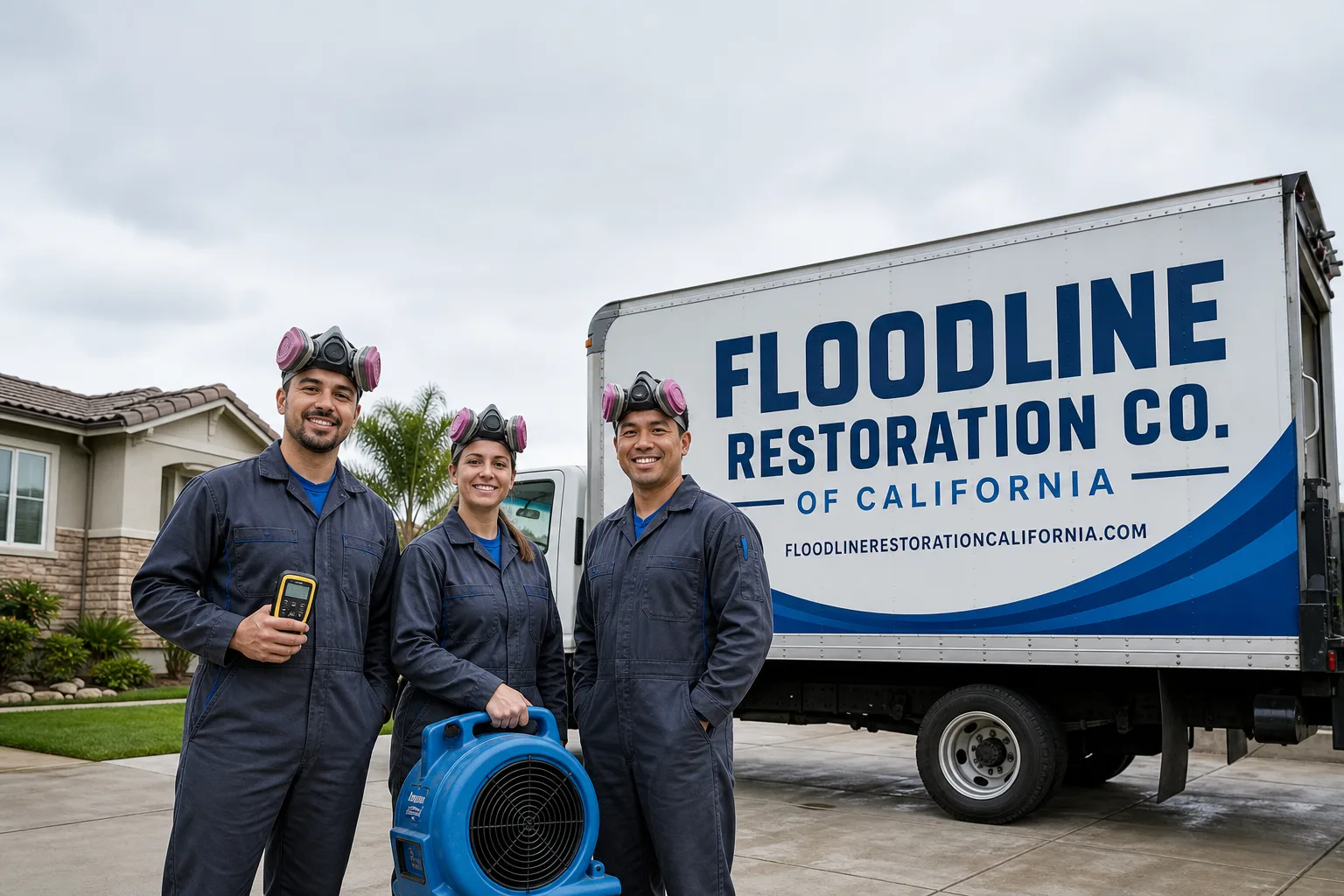
Fast, Reliable Fire & Smoke Damage Restoration Across Big Bear City
A kitchen fire, an electrical short in a wall heater, a chimney flare-up, a lightning strike on a dry ridge: when fire touches a Big Bear City home, the damage is rarely just the burn. Smoke drives into cedar planks, soot bonds to drywall and fabric, suppression water saturates insulation and subfloor, and in this climate, the clock starts running differently than it does down the hill. We handle the whole sequence with one crew: board-up and tarping, water mitigation, smoke and soot removal, odor elimination, contents pack-out, structural repair, and rebuild. Big Bear City homeowners call Floodline Restoration Co. of California at (888) 737-2439 any hour of the night, and a live person answers. Recovery starts then, not the next morning.
We work in Big Bear City year-round, which means our techs know what mountain fire damage actually does to a 1960s A-frame on a steep lot off Baldwin Lake Road. We budget for freeze cycles, icy driveways, and cabins that sat empty when the first flame started. That local knowledge changes how we scope a job, how we dry a structure, and how long the whole restoration realistically takes.
Why Floodline Restoration Co. of California Is Big Bear City’s Fire & Smoke Damage Restoration Company
We’ve been responding to Big Bear City fire damage long enough to know the rhythm of this town: heavy weekend traffic up Highway 38, part-time owners who live in Redlands or Fontana, and winter storms that turn a two-hour drive into four. Our crews are trained to IICRC, RIA, and IFA standards, background-checked, and uniformed. When they arrive at a cabin off North Shore Drive, they know to check the crawlspace before the living room, because in Big Bear City the crawlspace is where smoke odor hides and where freeze-thaw damage repeats.
Curt Bowman founded this company in 2010 around a dispatch board, not a sales desk. Every Big Bear City job gets a live coordinator, a written scope, photo documentation for the insurance carrier, and daily moisture readings until the dry standard is met. We don’t hand off a fire job between mitigation and rebuild. The same crew that tears out charred drywall is the crew that frames, insulates, and finishes the wall. One name on the whole job. That matters in a small mountain community where word travels fast and a contractor’s reputation lasts decades.
Our Fire & Smoke Damage Restoration team has seen every failure mode a Big Bear City cabin can produce, from ice-dam water feeding a smoldering roof fire to baseboard heater failures in original 1950s construction. We know this housing stock.
Our Fire & Smoke Damage Restoration Services in Big Bear City
Smoke & Soot Removal
Smoke in a Big Bear City cabin behaves differently than smoke in a stucco tract home in the Inland Empire. The housing stock here is dominated by mid-century wood-frame cabins, A-frames, and modest seasonal homes with porous cedar or pine interior surfaces. Soot bonds permanently to those surfaces within days, especially when a cabin sits unheated and closed up after a fire while the owner is still 90 miles down the hill. We remove soot with dry sponge methods and HEPA vacuuming before any wet cleaning touches the surface. In Big Bear City, typical smoke and soot removal runs $900 to $3,800 depending on square footage and surface type. On cedar plank walls, we test pH before selecting a cleaner, because aggressive alkaline degreasers can etch old-growth wood and leave ghost stains.
Odor Removal & Deodorization
Big Bear City’s altitude changes how odor behaves. At roughly 6,750 feet, air is thinner and cooler, which means smoke particles linger longer and settle deeper into unheated cavities. A cabin that smells acceptable in January can start off-gassing again in July when summer heat warms the framing. We use thermal fogging, ozone, and hydroxyl generation in sequence, and we seal the crawlspace before fogging the interior. If you fog without sealing the crawlspace in a Big Bear City cabin, the odor travels into the unheated subfloor and returns every time the structure warms. Odor removal in Big Bear City typically runs $800 to $4,500. We log every treatment so the carrier can see the process.
Structural Fire Repair
Structural repair on a Big Bear City cabin means working with what’s already there: original 2×4 framing, low-pitched or flat rooflines, and sheathing that has cycled through forty winters of freeze and thaw. Soda blasting char off a beam is often safer than cutting it out, especially when the beam is load-bearing and the cabin’s foundation has shifted over decades. We rebuild to current San Bernardino County code while matching the original profile. Structural fire repair in Big Bear City typically runs $5,000 to $50,000+. It is scoped, documented, and priced in writing before a saw is lifted.
Contents Cleaning & Pack-Out
Cabin contents are unusual: wool blankets, old skis, family photo albums, fishing gear, and kitchen cabinets stocked with decades of cookware. We inventory, pack out, and clean everything off-site in our Esporta wash system, or treat items in place when the damage is light. Big Bear City contents cleaning and pack-out typically runs $1,500 to $9,000 depending on volume. We photograph every item twice: once as we find it, once after cleaning. Those photos go to your adjuster.
What happens when you call
- 1
A real person answersNo phone trees - you reach a local pro.
- 2
You get an upfront price rangeHonest numbers before anyone is dispatched.
- 3
A background-checked tech heads outLicensed & insured, dispatched right away.
- 4
You approve before work beginsNothing starts until you say go.
Common Fire & Smoke Damage Restoration Problems We See in Big Bear City Homes
- The discovery lag. A fire starts from an electrical short in a part-time cabin on Fox Farm Road on a Tuesday. The owner lives in Redlands and doesn’t come up until Saturday. Five days of acidic soot bonding to cedar siding, drywall, and fabric. What a valley tech treats as a standard fire job is, here, a deep contamination job requiring soda blasting and cavity sealing.
- Ice-dam interplay after a winter fire. A chimney fire weakens sheathing near the roofline. The next hard freeze forms an ice dam along that same low-pitched eave. Meltwater saturates the charred insulation and rotted decking. You now have a fire damage job that is also a freeze-thaw water damage job, and both need to be addressed together or the smell returns.
- Smoke odor pushed into the crawlspace. Unsealed crawlspaces under Big Bear City cabins are cold, dark, and full of fiberglass insulation that absorbs smoke like a sponge. A well-intentioned fogging without crawlspace sealing drives odor deeper. Every warm day after that, the smell rises through the floorboards.
- Aggressive demolition on old-growth timber. Original cedar and pine framing in Big Bear City cabins is often tighter-grained and denser than modern lumber. Cutting it out for cosmetic char can compromise the structure. Soda blasting and surface char removal preserves the framing while eliminating the smell.
The Big Bear City Discovery Lag: Why Fire Damage Here Is Different
Big Bear City sits at roughly 6,750 feet in the San Bernardino Mountains, surrounded by thousands of part-time-occupied vacation cabins. That combination, high-altitude hard freezes plus absentee ownership, creates a damage pattern that simply does not exist in neighboring low-desert communities like Yucca Valley or Lucerne Valley. A cabin owner living 90 miles away in Redlands or Fontana often doesn’t learn their wall heater shorted until they arrive the following weekend. What a valley tech would treat as a fresh fire loss has, by then, become a deeper problem: soot bonded to porous cedar, suppression water saturated into subfloor, and the first signs of smoke odor migrating into joist bays.
Last winter, our crew responded to a fire in a 1960s A-frame on Aspen Drive after an unattended cabin’s aging baseboard heater shorted and ignited a nearby curtain. The fire itself was contained to the living room, but the real challenge was the water and soot that had permeated the original cedar plank walls and the crawlspace, where decades-old fiberglass insulation had wicked smoke odor into every joist bay. Our techs used Dri-Eaz dehumidifiers and a HEPA air scrubber to pull the smoke-laden moisture from the low-pitched roof assembly, then performed targeted soda blasting on the charred beams, a technique we’ve refined for Big Bear City’s tight, wood-frame cabins where aggressive demolition would compromise the remaining structure.
That is what we mean when we say this page gives Big Bear City cabin owners something a generic fire restoration page cannot: a winter-ready plan that accounts for the discovery lag, high-altitude drying physics, and legacy wood construction.
Pricing for Fire & Smoke Damage Restoration in Big Bear City, CA
We Also Serve Cities Near Big Bear City
When a Big Bear City fire job involves a family member’s cabin across the ridge, we respond there too. Our crews work throughout Big Bear Lake, down through Lucerne Valley, and across Yucaipa and Mentone. If you own a place in any of these communities, the same crew that handles your Big Bear City fire damage can handle it.
Serving Big Bear City, CA - Our Local Coverage Area
We’re based in the Big Bear City area and know this community well. Use the map below to see our service coverage - if you’re nearby, we can almost certainly help.
FAQs - Fire & Smoke Damage Restoration in Big Bear City
How does Big Bear City’s altitude affect how long it takes to dry out a cabin after fire suppression water damage?
At 6,750 feet, cooler air holds less moisture and dry time extends by 20 to 40 percent compared to jobs in the valleys below. A Big Bear City cabin fire with suppression water typically needs 5 to 9 days of active drying with Dri-Eaz dehumidifiers and air movers, versus 3 to 5 days down the hill. Call (888) 737-2439 if you’re dealing with wet framing right now.
Why is smoke odor harder to remove from a Big Bear City cabin than from a modern home in the Inland Empire?
Smoke odor is harder to remove in Big Bear City because the housing stock is primarily wood-frame cabins with unheated crawlspaces, porous cedar and pine interiors, and older insulation that absorbs smoke deeply. Modern homes with drywall and sealed attics don’t hold smoke the same way. We seal crawlspaces before fogging in Big Bear City specifically because of this. Call (888) 737-2439 and we’ll explain the process for your cabin.
Does a fire in a part-time Big Bear City vacation cabin require a different initial response than a primary residence fire?
Yes. A part-time cabin fire in Big Bear City often goes undiscovered for days, so our first step is a full contamination assessment across every porous surface, not just the visible damage. We also check the crawlspace and attic before any cleaning begins. The discovery lag changes how we treat soot and odor. Call (888) 737-2439 for a walkthrough.
What are the signs that fire damage in a Big Bear City cabin has affected the roof structure in a way that requires more than surface repair?
Signs include charred or cracked sheathing near the roofline, a low-pitched eave with visible ice-dam staining, soft spots when walking the roof, or a smoke smell that returns whenever the cabin warms. Big Bear City’s ice-dam cycle after fire weakens sheathing makes structural roof repair more common here than in warmer foothill areas. Call (888) 737-2439 for a structural assessment.
Can you perform fire damage restoration in Big Bear City during winter when driveways are snowed in and temperatures drop below freezing?
Yes. We respond to Big Bear City fire damage in winter with four-wheel-drive vehicles, snow-capable equipment, and drying plans adjusted for freezing temperatures. Our techs are trained for cold-weather restoration, and we schedule work around the mountain’s weather windows. Call (888) 737-2439 any time, day or night.
Call Floodline Restoration Co. of California in Big Bear City
If you’re reading this after a fire in Big Bear City, call us now at (888) 737-2439. A live person answers. We’ll dispatch a crew to your cabin or home, document the damage for your adjuster, and walk you through the entire restoration process, from first board-up to finished rebuild. Every job is backed by our 90-Day Done Right Promise, in writing. The Keystone Standard. Done right, every time, your home first, standing behind it. That’s how we work in Big Bear City.
Written by Curt Bowman, Owner at Floodline Restoration Co. of California, serving Big Bear City and the surrounding mountain communities.